

Your pipeline is 25.9h behind, and it's time to catch up. We've just spotted a compelling anomaly: a sentiment score of +0.810 with momentum holding steady at +0.000. This spike isn't just a number; it reflects a growing narrative around innovation, particularly in the context of educational advancements for Native American communities, as highlighted in recent articles. If you’re not tuning into these nuances, your sentiment analysis could be lagging significantly behind the curve.
What does this mean for you? If your pipeline isn't designed to handle multilingual origins or recognize dominant entities, you might be missing out on critical insights. Your model missed this by 25.9 hours, and it’s crucial to understand the implications. The leading language in this sentiment surge is English, but the themes are global. A dominant entity like "innovation" is driving the conversation forward while you're stuck in yesterday's news cycle.

English coverage led by 25.9 hours. Nl at T+25.9h. Confidence scores: English 0.92, Spanish 0.92, Sv 0.92 Source: Pulsebit /sentiment_by_lang.
Here’s how we can catch this anomaly using our API. First, we want to filter our queries by geographic origin to ensure we’re capturing the right audience. Here's the Python code to do just that:
import requests
# Set the parameters for the query
params = {
"topic": "innovation",
"lang": "en"
}
# Make the API call
response = requests.get("https://api.pulsebit.lojenterprise.com/sentiment", params=params)
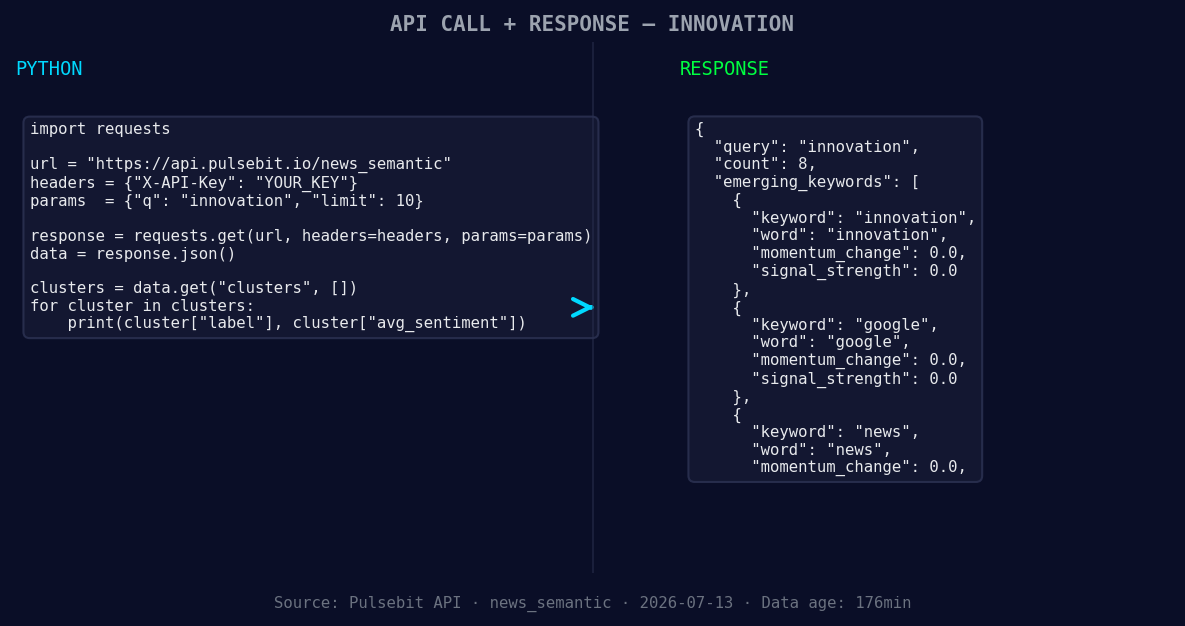
*Left: Python GET /news_semantic call for 'innovation'. Right: returned JSON response structure (clusters: 3). Source: Pulsebit /news_semantic.*
# Check the response
if response.status_code == 200:
data = response.json()
print(data)
Now that we’ve filtered the data, we need to analyze the narrative framing around this spike. Let’s run the cluster reason string back through our sentiment scoring to see how it's framing the conversation. Here’s the code for that:
# Define the cluster reason string
cluster_reason = "Clustered by shared themes: shambhunath, group, empowering, future, careers."

# Make the POST request
post_response = requests.post("https://api.pulsebit.lojenterprise.com/sentiment", json={"text": cluster_reason})

# Output the sentiment score
if post_response.status_code == 200:
    sentiment_data = post_response.json()
    print(sentiment_data)
Now, let’s build on this insight. Here are three specific things we can construct using this pattern:
- Geographic Filter for Innovation: Use the geo filter to capture innovation sentiment specifically from regions that are known for tech advancements. Set your signal threshold to +0.81 to ensure you're catching only the most relevant insights.

Geographic detection output for innovation. India leads with 6 articles and sentiment +0.82. Source: Pulsebit /news_recent geographic fields.
Meta-Sentiment Analysis on Google Trends: Run a similar sentiment analysis using the meta-sentiment loop for themes related to Google. Analyze how innovation and news sentiment are shaping perceptions about Google with a threshold of +0.00.
Empowerment Signals in Education: Focus on the forming themes around empowerment. Use our API to analyze articles with a sentiment score of +0.81 or higher that discuss educational gains for Native Americans. This could reveal deeper insights into community sentiment.
If you’re eager to dive deeper, head over to our documentation: pulsebit.lojenterprise.com/docs. The great part? You can copy-paste the above code and get this running in under 10 minutes. Don't let your pipeline lag behind—catch the wave of innovation sentiment today.


Top comments (0)