

Your pipeline is 28.4 hours behind. We recently discovered a 24-hour momentum spike in finance sentiment, clocking in at +0.659. This anomaly emerged amid a single clustered story titled "Financial sustainability in focus as ISL moves to club-led model," with the leading language being English. It’s a clear signal that something significant is brewing in financial discourse, and if your model isn’t tuned to catch these nuances, you might be missing critical opportunities.
Missed signals like this can leave your models lagging behind. In this case, your pipeline missed this spike by a staggering 28.4 hours, as the dominant entity was English press coverage. You might be operating under the assumption that sentiment shifts are captured uniformly, but neglecting multilingual origins can lead to significant blind spots. Without a robust mechanism to handle language and entity dominance, you’re risking being out of touch with the very narratives that shape market movements.

English coverage led by 28.4 hours. Da at T+28.4h. Confidence scores: English 0.95, Spanish 0.95, French 0.95 Source: Pulsebit /sentiment_by_lang.
Let’s take a look at how we can catch these trends programmatically. Below is a Python snippet that queries our API to identify this specific momentum spike:
import requests
# Define parameters for the API call
params = {
"topic": "finance",
"lang": "en",
"score": -0.006,
"confidence": 0.95,
"momentum": +0.659
}
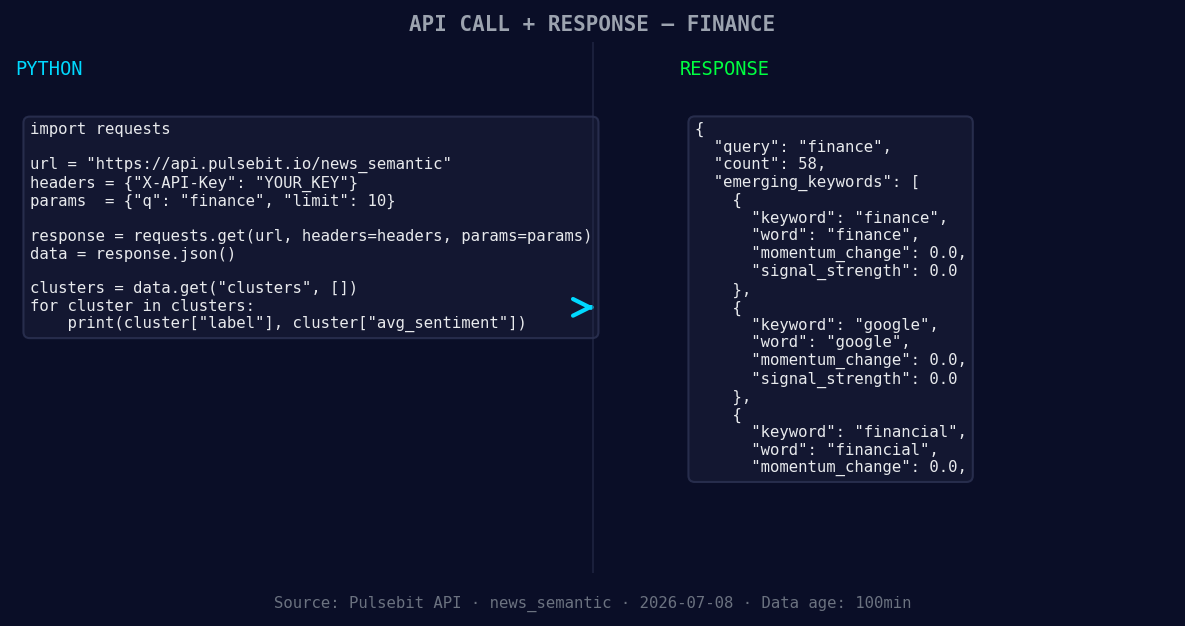
*Left: Python GET /news_semantic call for 'finance'. Right: returned JSON response structure (clusters: 3). Source: Pulsebit /news_semantic.*
# Make the API call
response = requests.get("https://api.pulsebit.com/sentiment", params=params)
data = response.json()
# Output the response data
print(data)
Next, we need to run the narrative framing through our sentiment endpoint to score the clustered themes directly. Here’s how that looks:
# Define the cluster reason string
cluster_reason = "Clustered by shared themes: financial, sustainability, club-led, model, focus."

# Make the POST request for meta-sentiment
meta_response = requests.post("https://api.pulsebit.com/sentiment", json={"text": cluster_reason})
meta_data = meta_response.json()

# Output the meta sentiment data
print(meta_data)
This two-step approach allows us to not only capture the momentum spike but also assess the sentiment surrounding the narrative itself. It’s crucial for understanding how the discourse is evolving around finance and related themes, especially when they’re forming: finance(+0.00), google(+0.00), financial(+0.00) versus mainstream: financial, sustainability, club-led.
Now that we’ve captured this momentum spike and assessed the cluster narrative, consider these three builds to amplify your insights:
- Geo-Sentiment Dashboard: Create a real-time dashboard that visualizes sentiment changes in finance across different regions. Use the geographic origin filter to ensure that you’re catching spikes in local contexts, which might differ from mainstream narratives.

Geographic detection output for finance. India leads with 4 articles and sentiment +0.54. Source: Pulsebit /news_recent geographic fields.
Cluster Impact Analysis: Develop an analysis tool that uses the meta-sentiment output to understand how clustered themes impact overall sentiment. Set a threshold, for example, any cluster scoring below -0.01 could trigger alerts for deeper investigation.
Anomaly Detection System: Implement a monitoring system that tracks momentum spikes across multiple topics, refining thresholds based on past spikes. Integrate the meta-sentiment scores to provide context around each anomaly, making it easier for you to prioritize which narratives to follow up on.
These builds will empower you to leverage the insights from our API effectively, ensuring that you're not just capturing data, but also interpreting it in a way that drives actionable intelligence.
For more guidance, check out our documentation at pulsebit.lojenterprise.com/docs. With just a few lines of code, you can start running these insights in under 10 minutes. Don’t let your pipeline lag behind—get started today!


Top comments (0)