

Your Pipeline Is 26.0h Behind: Catching Culture Sentiment Leads with Pulsebit
We recently uncovered a striking anomaly: a 24h momentum spike of +0.248 in the cultural sentiment surrounding the Tyndis Biennale, with the leading language being English. This spike signals a notable shift in sentiment tied to maritime and cultural themes, clustered under the title "Tyndis Biennale to celebrate Malabar’s maritime, cultural legacy." The data shows a clear opportunity for those of us capturing cultural narratives—an opportunity that many pipelines might miss if they don't account for multilingual origin or entity dominance.

English coverage led by 26.0 hours. Sw at T+26.0h. Confidence scores: English 0.90, Spanish 0.90, French 0.90 Source: Pulsebit /sentiment_by_lang.
The Problem
If your pipeline doesn't handle multilingual origin or dominant entities effectively, you might have missed this cultural momentum by a staggering 26 hours. This delay is critical, especially when the leading language is English, and sentiment around themes like "maritime," "tyndis," and "biennale" is rapidly evolving. Your model might still be processing older data, leaving you out of sync with emerging narratives that can significantly impact your decision-making.
The Code
To catch this momentum spike, we can leverage our API effectively. Here’s how you can do it in Python.
First, we need to filter by language and country, focusing on English content:

Geographic detection output for culture. India leads with 6 articles and sentiment +0.31. Source: Pulsebit /news_recent geographic fields.
import requests
# Set the parameters for the API call
params = {
"topic": "culture",
"score": +0.388,
"confidence": 0.90,
"momentum": +0.248,
"lang": "en"
}
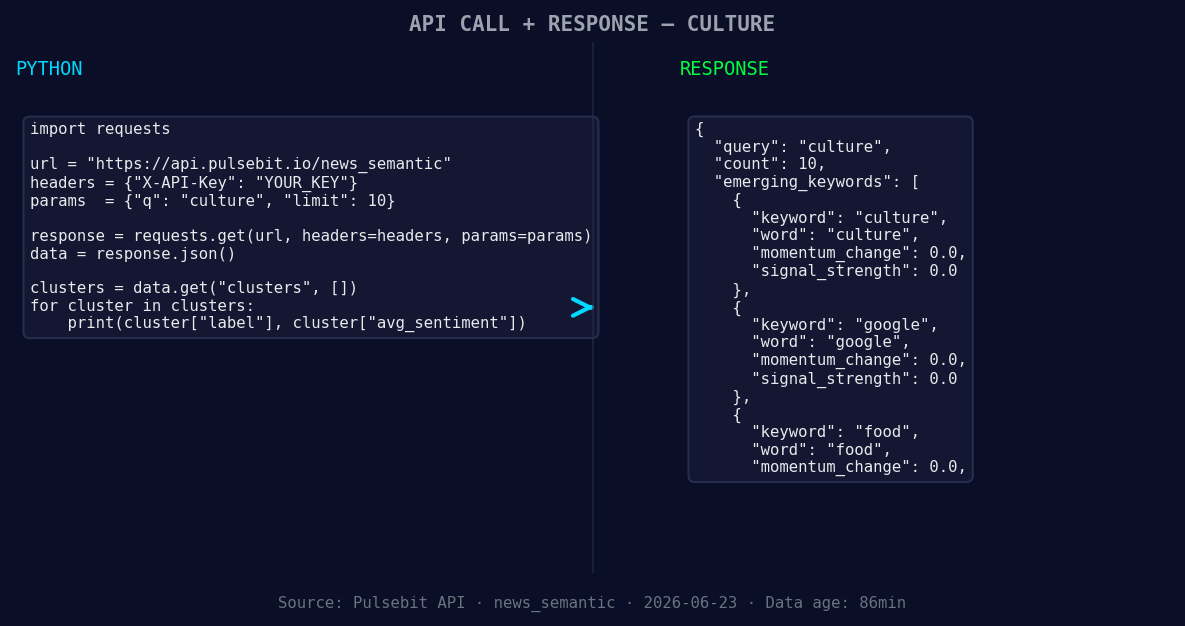
*Left: Python GET /news_semantic call for 'culture'. Right: returned JSON response structure (clusters: 3). Source: Pulsebit /news_semantic.*
# Make the API call to filter by language
response = requests.get('https://api.pulsebit.com/your-endpoint', params=params)
data = response.json()
Next, we’ll run the cluster reason string back through the sentiment analysis endpoint to score the narrative framing itself. Here’s how we can do that:
# The cluster reason string we want to analyze
cluster_reason = "Clustered by shared themes: maritime, tyndis, biennale, cultural, celebrate."

# Make the API call to score the narrative
sentiment_response = requests.post('https://api.pulsebit.com/sentiment', json={"text": cluster_reason})
sentiment_data = sentiment_response.json()

print(sentiment_data)
This code will give us insights into the framing of the narrative surrounding the Tyndis Biennale, allowing us to understand the sentiment behind the cultural themes in play.
Three Builds Tonight
With this newfound insight, here are three specific builds you can implement:
Cultural Momentum Tracker: Set up a threshold alert for any topics with a momentum spike of +0.2 or higher, filtered by English language content. Use the geo filter to catch anomalies in sentiment surrounding local events.
Meta-Sentiment Dashboard: Create a dashboard that visualizes the meta-sentiment scores from cluster narratives. For example, analyze the sentiment around "maritime," "tyndis," and "biennale." Utilize the meta-sentiment loop to enrich your storytelling datasets.
Trending Topics Analysis: Monitor topics that are forming but not yet mainstream—like "culture," "google," and "food." Set a signal threshold of +0.1 for emerging sentiments and connect this to your data pipeline to gain early insights on trends before they hit the mainstream radar.
Get Started
Ready to dive in? Check out our documentation and start implementing these insights today. You can copy-paste and run this code in under 10 minutes, and who knows what cultural narratives you might catch!


Top comments (0)