

Your Pipeline Is 27.3h Behind: Catching Tech Sentiment Leads with Pulsebit
We just spotted an intriguing anomaly: a 24h momentum spike of +0.243 in the tech sector. This uptick is led by an English press narrative centered around an MoU between Odisha and HCLTech for an AI Data Centre, with a leading language lagging at 27.3 hours. If you’re not factoring in multilingual contexts and entity dominance, you could easily miss crucial shifts like this one.

English coverage led by 27.3 hours. Id at T+27.3h. Confidence scores: English 0.75, Spanish 0.75, Da 0.75 Source: Pulsebit /sentiment_by_lang.
What does this mean for your pipeline? If your model isn't equipped to handle multiple languages or the nuances of entity significance, you could be trailing behind by over a day. In this case, the leading language is English, but the dominant sentiment is pulling from a cluster of themes that span across various entities and narratives. For instance, the articles are revolving around specific themes like ‘mou’, ‘Odisha’, ‘signs’, and ‘HCLTech’, which could indicate shifting priorities in tech investments. Your model missed this by 27.3 hours, and that’s significant.
Here’s how we can catch this momentum spike in our data pipeline using our API. First, let’s filter the sentiment based on geographic origin and language. Below is the Python code that accomplishes this:
import requests
# Define the parameters for the API call
params = {
"topic": "tech",
"score": +0.017,
"confidence": 0.75,
"momentum": +0.243,
"lang": "en" # Geographic origin filter
}
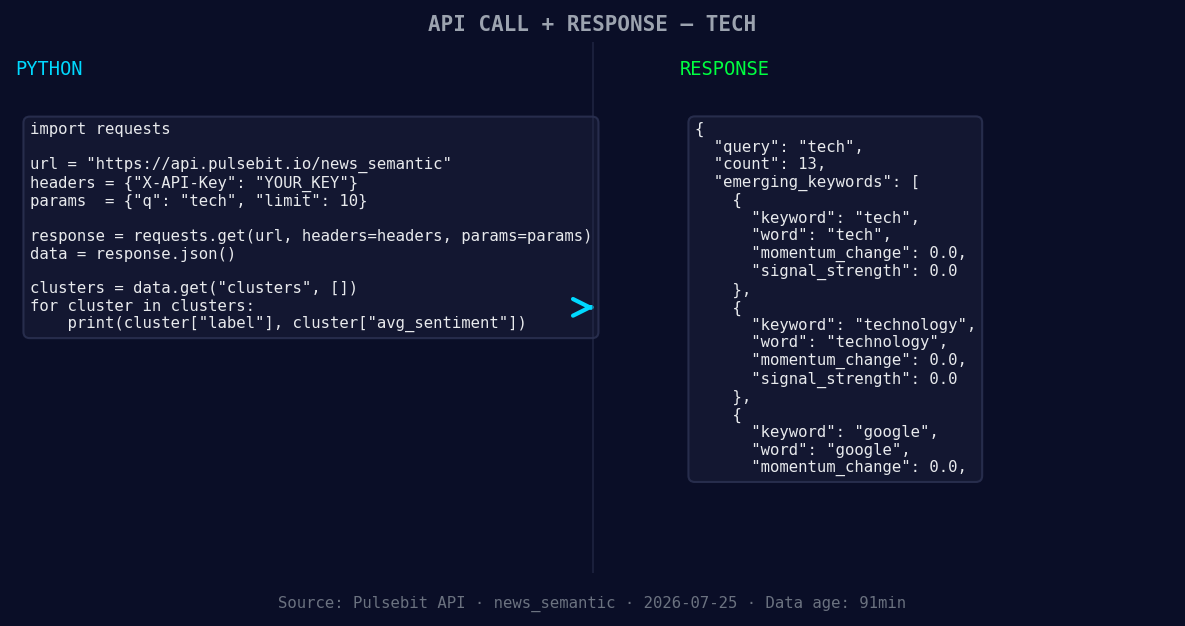
*Left: Python GET /news_semantic call for 'tech'. Right: returned JSON response structure (clusters: 3). Source: Pulsebit /news_semantic.*
# API endpoint to get sentiment data
url = "https://api.pulsebit.com/v1/sentiment"
# Make the API call
response = requests.get(url, params=params)
# Check if the request was successful
if response.status_code == 200:
sentiment_data = response.json()
print(sentiment_data)
else:
print(f"Error: {response.status_code}")
Next, let’s run the cluster reason string through our sentiment API to score the narrative framing itself. This is essential for understanding how the sentiment around the themes is being perceived. Here’s how we do it:
# Input example for meta-sentiment moment
meta_input = "Clustered by shared themes: mou, odisha, signs, hcltech, data."

# API endpoint to score the narrative
meta_url = "https://api.pulsebit.com/v1/sentiment"

# Make the API call for meta-sentiment
meta_response = requests.post(meta_url, json={"text": meta_input})

# Check if the request was successful
if meta_response.status_code == 200:
    meta_sentiment = meta_response.json()
    print(meta_sentiment)
else:
    print(f"Error: {meta_response.status_code}")
Now that you have the tools to catch this anomaly, let’s discuss three specific builds that can help you leverage this data:
- Geo-filtered Sentiment Dashboard: Build a real-time sentiment dashboard that leverages the geographic filter. Use a threshold of confidence above 0.75 to only display high-reliability sentiment scores related to emerging tech narratives in English-speaking regions.

Geographic detection output for tech. India leads with 11 articles and sentiment +0.55. Source: Pulsebit /news_recent geographic fields.
Meta-Sentiment Analyzer: Create a service that analyzes the narrative framing around emerging tech topics. Use the meta-sentiment loop to score narratives above a certain threshold (e.g., +0.02) to highlight which themes are gaining traction and which are not.
Alert System for Forming Themes: Implement an alert system that notifies you when sentiment scores for forming themes like ‘tech’, ‘technology’, and ‘Google’ start trending positively against the mainstream themes like ‘mou’, ‘Odisha’, and ‘signs’. Set a signal strength threshold of 0.5 as a baseline for alerts.
With these builds, you can ensure that you're not just catching up but staying ahead in the fast-paced world of tech sentiment.
For more details on how to implement these, check out our documentation at pulsebit.lojenterprise.com/docs. You can copy-paste and run this code in under 10 minutes.


Top comments (0)