

Your 24-hour momentum spike of +0.162 is not just a number; it’s a signal. This spike in stock market sentiment is revealing a significant trend that you may have missed. In particular, the leading language is English press, which indicates that sentiment from this demographic has surged ahead by 12.8 hours. This is crucial, as it highlights how quickly sentiment can shift within specific communities, and if you’re not tuned into these nuances, your model may be lagging in its response time.
The underlying problem here is clear: your model missed this spike by over half a day. If you’re not accounting for multilingual origins or the dominance of certain entities, you risk falling behind. For instance, while your system may be processing data from a variety of sources, it’s the English-language articles driving this momentum that are leading the charge. By not integrating these factors, you’re leaving yourself vulnerable to missing key signals in the data, ultimately impacting your decision-making.

English coverage led by 12.8 hours. Id at T+12.8h. Confidence scores: English 0.95, Spanish 0.95, French 0.95 Source: Pulsebit /sentiment_by_lang.
Here’s how you can catch these emerging sentiment shifts in real-time:
import requests
# Define the parameters for the API call
topic = 'stock market'
score = -0.175
confidence = 0.95
momentum = +0.162
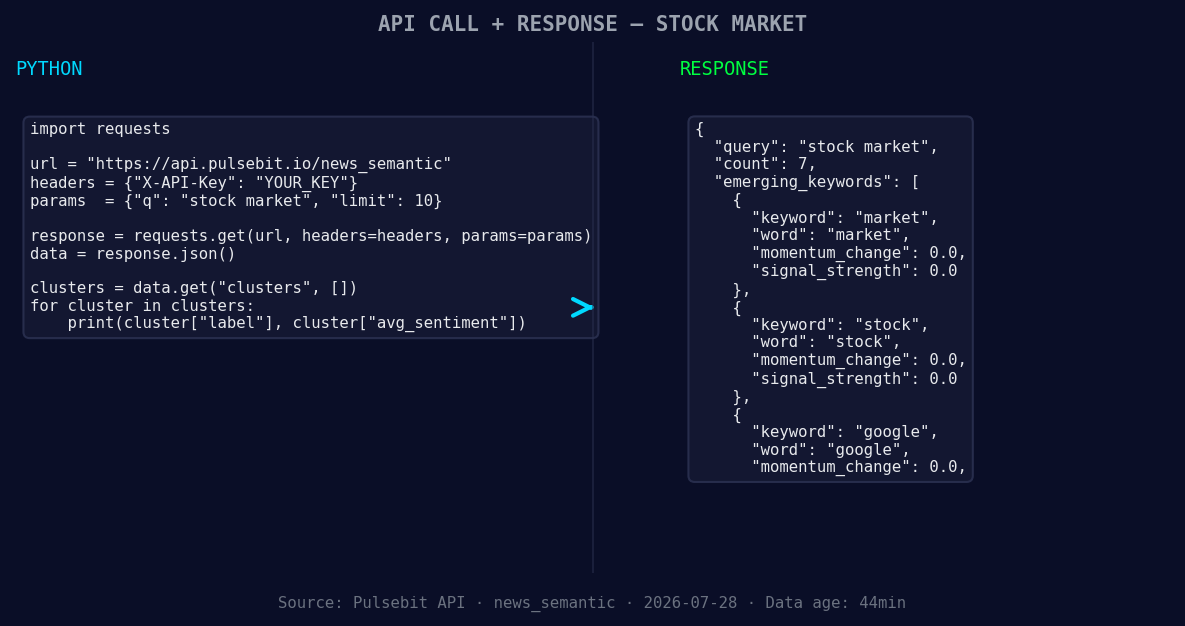
*Left: Python GET /news_semantic call for 'stock market'. Right: returned JSON response structure (clusters: 3). Source: Pulsebit /news_semantic.*
# Geographic origin filter: query by language
response = requests.get('https://api.pulsebit.com/sentiment',
params={'topic': topic, 'lang': 'en'})
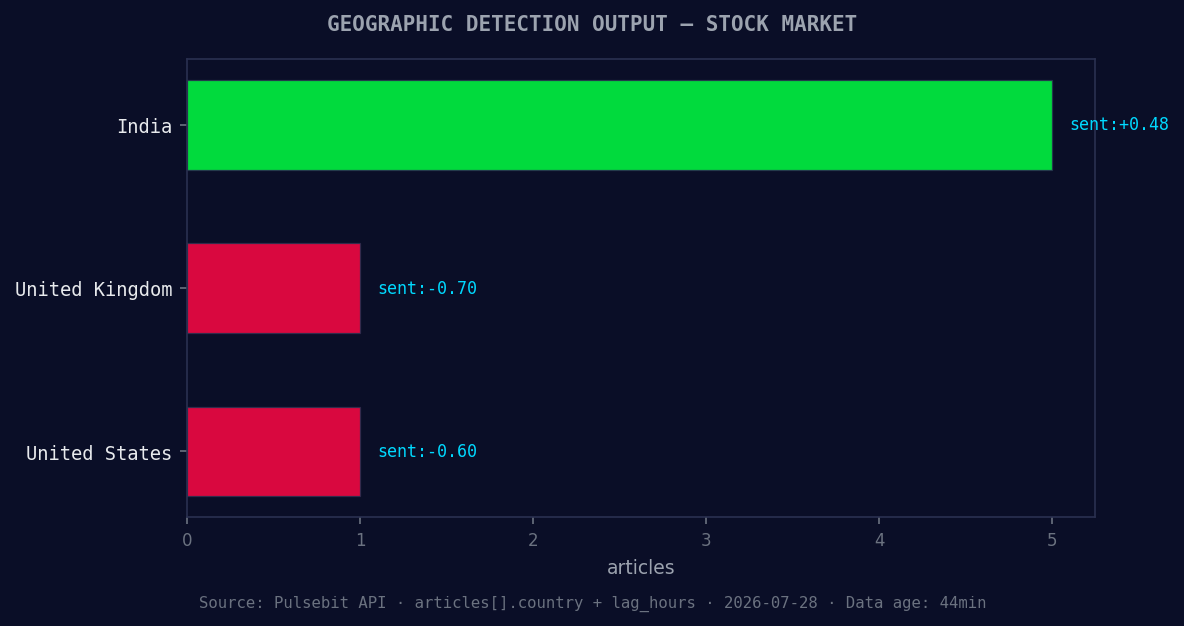
*Geographic detection output for stock market. India leads with 5 articles and sentiment +0.48. Source: Pulsebit /news_recent geographic fields.*
data = response.json()
# Check the response
print(data)
# Meta-sentiment moment: run the cluster reason string back through POST /sentiment
cluster_reason = "Clustered by shared themes: sensex, points, stock, markets, drop."
meta_response = requests.post('https://api.pulsebit.com/sentiment',
json={'text': cluster_reason})
meta_data = meta_response.json()
# Output the meta sentiment data
print(meta_data)
Here, we first filter our query to focus on English-language data, which is crucial for catching that 12.8-hour lead. Then, we analyze the cluster story to see how the narrative framing influences sentiment. This two-step approach is essential for understanding the context behind the numbers, helping us develop a more nuanced view of market dynamics.
To build on this pattern, consider the following three strategies:
Real-time Alert System: Implement a webhook that triggers when momentum exceeds a threshold of +0.150, specifically for the English sentiment data. This prompts immediate attention to potential trading opportunities.
Sentiment Framing Analysis: Use the meta-sentiment loop to score narratives around forming themes such as market and stock. If the sentiment score dips below -0.200 while the momentum is rising, it could indicate a potential reversal point.
Geographic Segmentation: Establish a filter to focus on regions where sentiment is most active, such as the US or UK, using the geo filter. This allows you to track specific developments that may not be captured in broader analyses.
If you’re looking to enhance your sentiment analysis pipeline and catch these valuable insights, get started with our documentation at pulsebit.lojenterprise.com/docs. You should be able to copy, paste, and run the code in under 10 minutes. Don't let your system lag behind—stay ahead of the curve with real-time sentiment tracking.


Top comments (0)