

Your Pipeline Is 8.2h Behind: Catching Digital Transformation Sentiment Leads with Pulsebit
We just stumbled upon an interesting anomaly: a 24-hour momentum spike of +0.723 in sentiment around "digital transformation." This is noteworthy, especially as it highlights not just a sudden interest, but an evolving narrative in our global discourse. The leading language for this spike is English, with a significant cluster story centering on "AI powered data centres fuel Southeast Asia’s digital transformation amid energy." This insight could have serious implications for how we respond to emerging trends.
But here's the catch: If your pipeline isn't designed to handle multilingual origins or the dominance of specific entities, your model missed this by a staggering 8.2 hours. This delay could cost you vital insights, especially when the leading language is English and the sentiment is rising. By the time you react, you're already trailing behind the conversation.

English coverage led by 8.2 hours. Sl at T+8.2h. Confidence scores: English 0.75, Spanish 0.75, Sv 0.75 Source: Pulsebit /sentiment_by_lang.
Let’s get into the code so you can catch this momentum before it’s old news. First, we’ll filter the data for the relevant geographic origin using our API to focus on English content. Here’s how you can do that using Python:

Geographic detection output for digital transformation. India leads with 2 articles and sentiment +0.85. Source: Pulsebit /news_recent geographic fields.
import requests
# Define parameters
topic = 'digital transformation'
momentum = +0.723
score = +0.723
confidence = 0.75
params = {
"topic": topic,
"lang": "en", # Filter by English language
}
# Make the API call
response = requests.get('https://api.pulsebit.com/v1/sentiment', params=params)
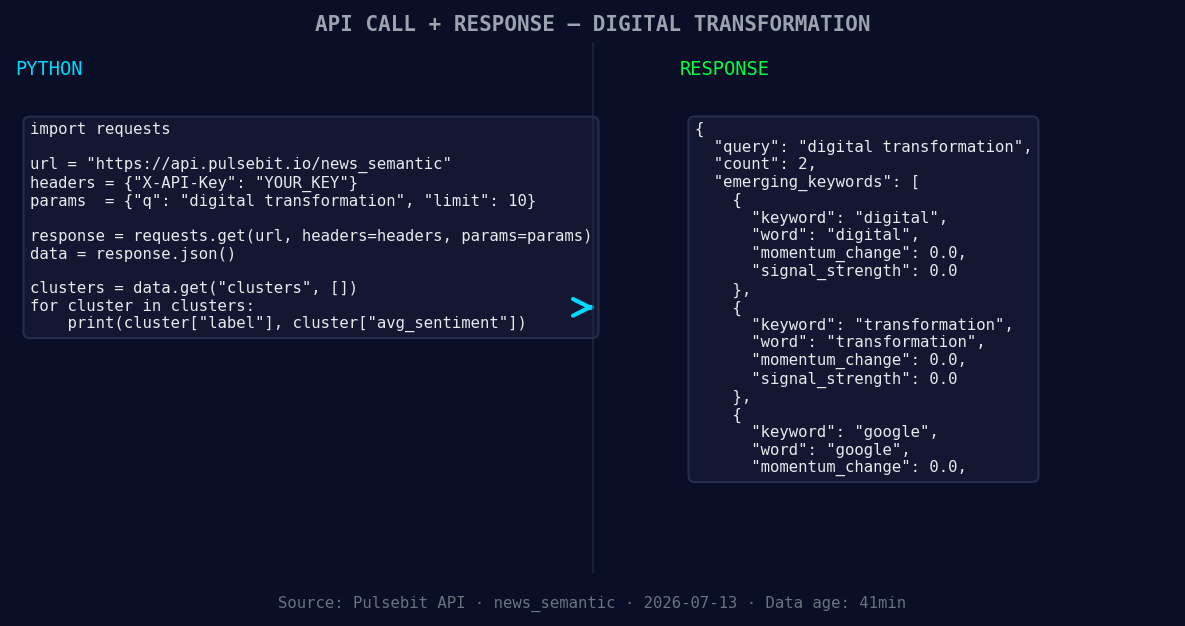
*Left: Python GET /news_semantic call for 'digital transformation'. Right: returned JSON response structure (clusters: 3). Source: Pulsebit /news_semantic.*
# Check the response
if response.status_code == 200:
data = response.json()
print(data)
else:
print("Error:", response.status_code)
Next, we'll run the cluster reason string through our sentiment analysis endpoint. This will help us understand how the narrative is framed within the context of the spike:
# Define the cluster reason string
cluster_reason = "Clustered by shared themes: powered, data, centres, fuel, southeast."

# Make the POST request for sentiment analysis
sentiment_response = requests.post('https://api.pulsebit.com/v1/sentiment', json={"text": cluster_reason})

# Check the response
if sentiment_response.status_code == 200:
    sentiment_data = sentiment_response.json()
    print(sentiment_data)
else:
    print("Sentiment Analysis Error:", sentiment_response.status_code)
Now that we've captured the spike and analyzed the narrative, let’s explore three specific builds we can implement based on this data.
Geo-Filtered Alert System: Set up a webhook that triggers when the sentiment score exceeds a threshold (e.g., +0.5) for topics related to "digital transformation" in English. This allows you to react swiftly when sentiment spikes, ensuring your team is always in the loop.
Meta-Sentiment Dashboard: Create a dashboard that visualizes the sentiment around clustered themes like "powered," "data," and "centres." Use the results from the meta-sentiment loop to not only score the narratives but also to track how these themes evolve over time.
Content Strategy Alignment: Use the insights from the forming themes—digital, transformation, and Google—to fine-tune your content strategy. By focusing on these emerging keywords, you can create timely and relevant content that aligns with the current sentiment and drives engagement.
You can get started with our API at pulsebit.lojenterprise.com/docs. The example code above can be copy-pasted and run in under 10 minutes, allowing you to catch the next wave of digital transformation sentiment before it passes you by.


Top comments (0)