

Your Pipeline Is 27.7h Behind: Catching World Sentiment Leads with Pulsebit
We’ve just stumbled upon a striking anomaly: a 24h momentum spike of +0.173 related to global sentiment, particularly around the upcoming World Cup in 2026. What’s interesting is that the leading language here is English, with a precise 27.7-hour lead time over the dominant narratives. This spike isn't just noise; it signals a significant uptick in sentiment that your pipeline might have missed if it isn't equipped to handle varying linguistic origins or the nuances of entity dominance.
This lag of over 27 hours in your model could mean the difference between capturing a timely sentiment shift and watching it pass you by. If your pipeline is not designed to account for multilingual data and dominant entities, you might find yourself losing out on critical insights. In this case, the English press is leading the narrative, but if your system isn't flexible enough, you could be left behind while others capitalize on emerging trends around topics like "world," "cup," and "rankings."

English coverage led by 27.7 hours. Da at T+27.7h. Confidence scores: English 0.95, Spanish 0.95, French 0.95 Source: Pulsebit /sentiment_by_lang.
Here’s how we can catch that momentum spike using our API. We’ll start by querying the data with a geographic origin filter, specifically targeting English-language sources. This allows us to hone in on the most relevant sentiment shifts.

Geographic detection output for world. India leads with 29 articles and sentiment +0.13. Source: Pulsebit /news_recent geographic fields.
import requests
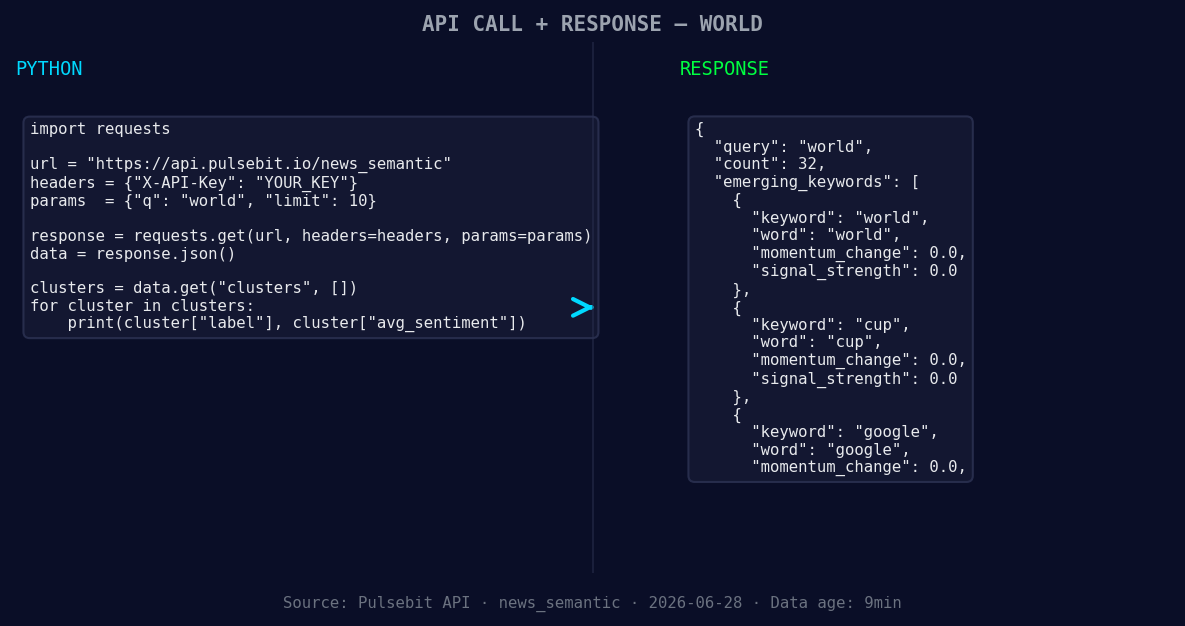
*Left: Python GET /news_semantic call for 'world'. Right: returned JSON response structure (clusters: 3). Source: Pulsebit /news_semantic.*
# API endpoint
url = "https://api.pulsebit.lojenterprise.com/v1/sentiment"
# Define parameters
params = {
"topic": "world",
"lang": "en",
"score": +0.088,
"confidence": 0.95,
"momentum": +0.173
}
# Fetch sentiment data
response = requests.get(url, params=params)
data = response.json()
print(data)
Next, we need to run the cluster reason string back through our sentiment endpoint to score the narrative framing itself. This is crucial because the way we articulate the story can significantly impact its reception.
# Sentiment scoring for cluster reason
cluster_reason = "Clustered by shared themes: world, cup’s, final, boss, politico."

# POST request to analyze the narrative
score_response = requests.post(url, json={"text": cluster_reason})
score_data = score_response.json()
print(score_data)
This approach not only captures the current narrative but also allows us to evaluate how the themes resonate with audiences.
Now, as we explore this momentum spike, here are three specific builds we can implement based on the data we’ve just processed:
Geographic Origin Filter: Set a signal threshold for English-language articles on the topic of "world." For example, filter for sentiment scores above +0.05, triggering alerts when they exceed a +0.088 score.
Meta-Sentiment Loop: Create a function that automatically loops through clustered narratives like "world, cup’s, final" and runs them through the sentiment scoring. If the sentiment score exceeds +0.08 with high confidence, flag it for immediate review.
Dynamic Theme Tracking: Monitor forming themes around "world," "cup," and "google." Set up a dashboard that visualizes the sentiment dynamics, highlighting when mainstream topics diverge from forming trends. This way, you can react to shifts in sentiment as they occur.
These builds leverage the insights from our API to ensure you’re not just catching up but staying ahead of the curve.
To get started, check out our documentation at pulsebit.lojenterprise.com/docs. You can copy-paste and run these snippets in under 10 minutes, bringing you closer to real-time sentiment analysis. Don’t let your pipeline fall behind—adapt and thrive!


Top comments (0)