

Your Pipeline Is 10.2h Behind: Catching Inflation Sentiment Leads with Pulsebit
We’ve just observed a significant 24-hour momentum spike of +0.305 around the topic of inflation. This data point is not just a number; it reveals an urgent sentiment shift that could impact decision-making in your applications. The leading articles are primarily in English, with a notable cluster story titled, "Don’t be fooled: America’s inflation problems aren’t going away anytime soon," indicating rising concerns that could shape user sentiment moving forward.
The core issue here is that if your pipeline doesn’t accommodate multilingual origins or dominant entities, you might have missed this momentum shift by a staggering 10.2 hours. In this case, the leading language is English, and the dominant entity is inflation. If your model is solely focused on one language or overlooks other potential leading narratives, you could be left behind, missing critical insights that can influence your strategies.

English coverage led by 10.2 hours. Sl at T+10.2h. Confidence scores: English 0.85, Spanish 0.85, Sv 0.85 Source: Pulsebit /sentiment_by_lang.
To catch this momentum spike, we can leverage our API effectively. Below is the Python code that demonstrates how to query for this specific sentiment shift. We’ll set the topic to 'inflation' and filter the results based on the English language to ensure we’re capturing the right sentiment.
import requests
# Define parameters for the API call
params = {
"topic": "inflation",
"score": -0.190,
"confidence": 0.85,
"momentum": +0.305,
"lang": "en"
}
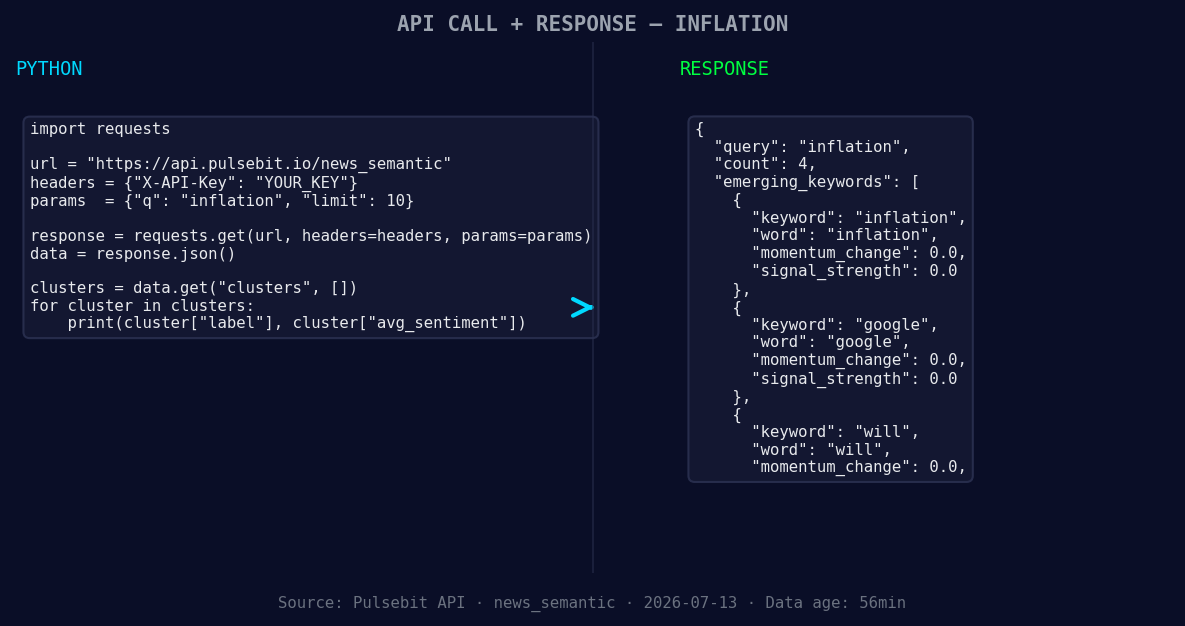
*Left: Python GET /news_semantic call for 'inflation'. Right: returned JSON response structure (clusters: 3). Source: Pulsebit /news_semantic.*
# Make the API call to fetch sentiment data
response = requests.get("https://api.pulsebit.com/sentiment", params=params)
data = response.json()
# Print out the response to verify
print(data)
Now, let’s loop back and analyze the narrative framing of the critical cluster reason. This is essential for understanding how the public sentiment is being shaped. We'll use the cluster reason string from our findings:
# Cluster reason string
cluster_reason = "Clustered by shared themes: fooled:, america’s, inflation, problems, aren’t."

# Make the API call to score the narrative framing
sentiment_response = requests.post("https://api.pulsebit.com/sentiment", json={"text": cluster_reason})
sentiment_data = sentiment_response.json()

# Print out the sentiment score for the narrative
print(sentiment_data)
With these two code blocks, you can now tap into the momentum around inflation sentiment and understand how it’s being framed in articles. This process ensures that you’re not operating in a vacuum and can react to sentiment shifts in real-time.
Here are three concrete builds we can implement using this momentum spike:
-
Geographic Filter for Inflation Trends: Create a dashboard that visualizes inflation sentiment trends across different regions by applying a geographic filter. Use the parameter
lang: "en"to ensure you’re capturing English-language sentiment spikes in the United States.

Geographic detection output for inflation. India leads with 1 articles and sentiment -0.75. Source: Pulsebit /news_recent geographic fields.
Meta-Sentiment Analysis Loop: Develop an automated alert system that triggers when the meta-sentiment of narratives, like our cluster reason, shows a significant change. You can set a threshold to alert your team when the sentiment score dips below -0.1, indicating increasing negativity around inflation.
Forming Themes Tracker: Build a topic tracking system that captures emerging themes around inflation, Google, and other relevant subjects. This can be done by analyzing incoming articles and comparing forming themes with mainstream narratives. You can set a signal threshold of +0.00 to identify when new topics are starting to gain traction.
To dive deeper into implementing these features, check out our documentation at pulsebit.lojenterprise.com/docs. With the code snippets and ideas provided, you should be able to copy-paste and run this in under 10 minutes—putting you miles ahead in sentiment analysis.


Top comments (0)