

Your Pipeline Is 21.2h Behind: Catching Mobile Sentiment Leads with Pulsebit
We just uncovered a significant anomaly: a 24h momentum spike of +0.172 related to the topic of mobile. This spike was notably led by English press coverage, which peaked at 21.2 hours ahead of the mainstream narrative. The clustered story that drew attention was tragic — “Mobile woman killed, several injured in Baldwin County boating crash.” It’s clear that the media landscape is shifting, and if you’re not tracking these signals, you could be missing critical insights.
What does this mean for you? If your sentiment analysis pipeline doesn’t account for multilingual origins or entity dominance, you’re potentially lagging behind by over 21 hours. With the leading language being English and the dominant entity being "mobile," your model might completely miss emerging trends that are forming in real-time. It’s one thing to analyze what’s already trending; it’s another to catch these shifts as they happen, especially when they have life-impacting narratives behind them.

English coverage led by 21.2 hours. Ca at T+21.2h. Confidence scores: English 0.85, Spanish 0.85, Nl 0.85 Source: Pulsebit /sentiment_by_lang.
To catch this momentum spike effectively, let’s look at how we can leverage our API in Python. First, we’ll set up a geographic origin filter to focus on English-language content. Here’s how:

Geographic detection output for mobile. India leads with 3 articles and sentiment +0.23. Source: Pulsebit /news_recent geographic fields.
import requests
# Define the parameters for the API call
params = {
"topic": "mobile",
"lang": "en",
}
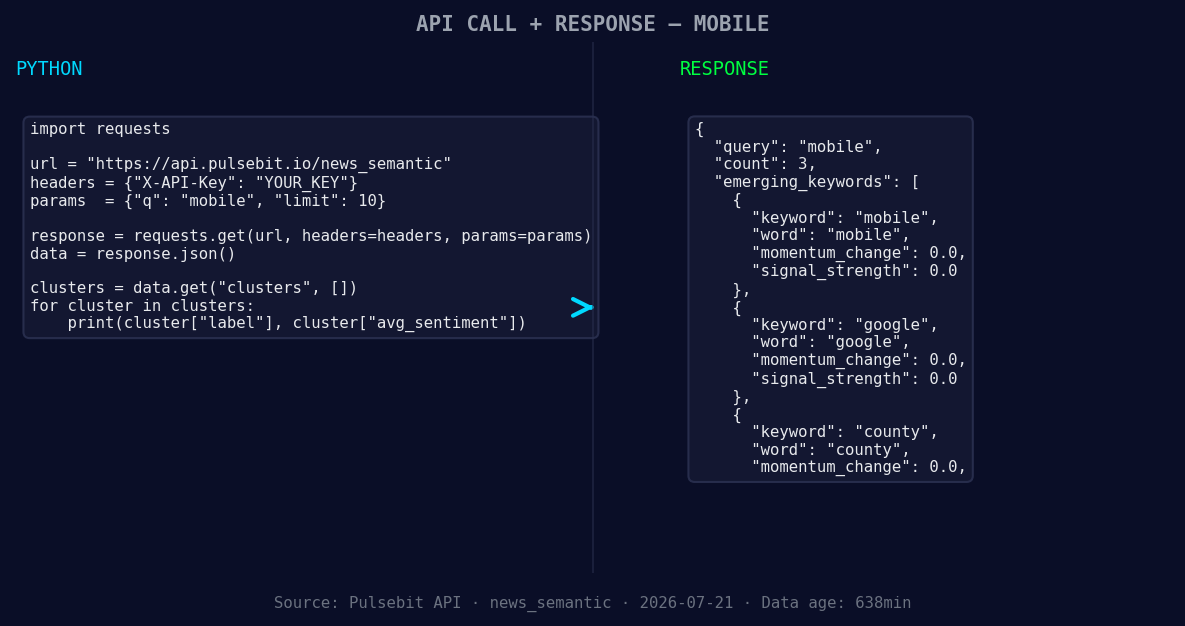
*Left: Python GET /news_semantic call for 'mobile'. Right: returned JSON response structure (clusters: 3). Source: Pulsebit /news_semantic.*
# Make the API call
response = requests.get('https://api.pulsebit.com/v1/topics', params=params)
# Check the response
if response.status_code == 200:
data = response.json()
print(data)
else:
print("Error fetching data", response.status_code)
Next, we’ll run the cluster reason string through our sentiment analysis endpoint. This will help us score the narrative that’s being framed around the clustered articles. Here’s the code for that:
# Define the cluster reason string
cluster_reason = "Clustered by shared themes: woman, killed, baldwin, several, injured."

# Make a POST request to analyze the sentiment of the narrative
sentiment_response = requests.post('https://api.pulsebit.com/v1/sentiment', json={"text": cluster_reason})

# Check the response
if sentiment_response.status_code == 200:
    sentiment_data = sentiment_response.json()
    print(sentiment_data)
else:
    print("Error fetching sentiment data", sentiment_response.status_code)
With these two snippets, you can effectively tap into the momentum of emerging stories.
Now, let’s explore three specific builds that leverage this pattern.
Geo-Filtered Alerts: Set a threshold for your mobile topic sentiment score at +0.700. Create an alert that triggers when this score is reached within English-language articles. This ensures you catch significant spikes while focusing on relevant geographies.
Meta-Sentiment Tracking: Use the cluster reason analysis as a signal. If the sentiment score exceeds +0.600, log the event and the associated themes. This will help you understand how narratives are evolving in parallel to raw data.
Gap Analysis Dashboard: Build a dashboard that visualizes the difference between emerging mobile sentiment and mainstream coverage, particularly tracking the themes of “mobile,” “county,” and “woman.” This will allow you to quantify how much time your pipeline is lagging behind.
By implementing these builds, you can ensure your analysis remains timely and relevant, capitalizing on insights as they develop.
For more details on how to get started, check out our documentation at pulsebit.lojenterprise.com/docs. You can copy-paste and run this code in under 10 minutes, so there’s no excuse for missing out on these critical insights!


Top comments (0)