

Your Pipeline Is 20.3h Behind: Catching Banking Sentiment Leads with Pulsebit
We just uncovered a notable anomaly: a 24-hour momentum spike of +0.256 in banking sentiment. This spike is not just a number; it's a call to action for us developers who rely on timely and accurate data. The most significant insight here is that the leading language driving this momentum is French, with a 20.3-hour lead time. If your pipeline isn’t equipped to handle multilingual data or account for this dominance, you might be missing critical signals that can shape your decision-making.

French coverage led by 20.3 hours. Et at T+20.3h. Confidence scores: French 0.90, English 0.90, Spanish 0.90 Source: Pulsebit /sentiment_by_lang.
Without the ability to process multilingual origins effectively, your model likely missed this spike by over 20 hours. When the leading language is French and the sentiment around banking is rising, this is a significant gap in your pipeline. You need to act fast to ensure you're not left behind, especially when the dominant entity is Deutsche Bank, which is making waves by exiting the Indian retail business. Missing this kind of information can lead to missed opportunities or, worse, incorrect assumptions about market sentiment.
Here’s how we can catch this momentum spike using Python and our API. First, we’ll filter the data by geographic origin, focusing on French language content related to banking.

Geographic detection output for banking. India leads with 7 articles and sentiment +0.21. Source: Pulsebit /news_recent geographic fields.
import requests
# Define the parameters for the API call
params = {
"topic": "banking",
"lang": "fr"
}
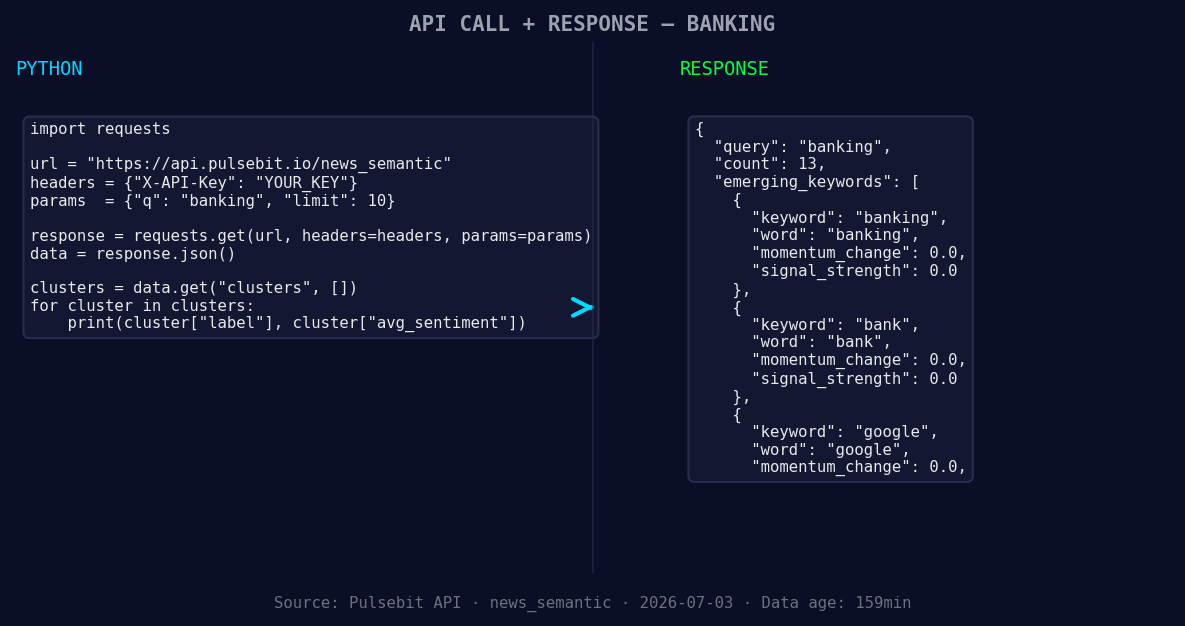
*Left: Python GET /news_semantic call for 'banking'. Right: returned JSON response structure (clusters: 3). Source: Pulsebit /news_semantic.*
# Make the API call to get sentiment data
response = requests.get("https://api.pulsebit.com/v1/sentiment", params=params)
data = response.json()
# Display the relevant results
print(data)
Next, we’ll leverage the cluster reason string to score the narrative framing around this spike. This will allow us to understand the context better and potentially uncover why this spike is occurring.
# Now we run the cluster reason string through the sentiment endpoint
cluster_reason = "Clustered by shared themes: why, deutsche, bank, what, exiting."
sentiment_response = requests.post("https://api.pulsebit.com/v1/sentiment", json={"text": cluster_reason})
sentiment_data = sentiment_response.json()

# Display the sentiment score for the narrative
print(sentiment_data)
With these two API calls, we can catch significant sentiment spikes and also analyze the framing of the narratives that drive them.
So, what are some specific builds we can create with this pattern? Here are three actionable ideas:
Real-Time Alert System: Set a threshold for momentum spikes over +0.25 in the French language. Use the geo filter to only trigger alerts when sentiment shifts in banking are detected. This ensures you’re immediately notified when significant activity occurs.
Meta-Sentiment Dashboard: Build a dashboard that visualizes sentiment scores derived from the cluster reason strings. Set a threshold where sentiment scores above +0.5 generate a notification. This can help you track how narratives around key entities evolve over time.
Cross-Topic Correlation: Create an endpoint that monitors correlations between banking sentiment and other forming themes such as technology or government regulation. For example, if banking sentiment is rising alongside discussions about Google, you might want to investigate potential implications for fintech collaborations or disruptions.
Getting started with this is straightforward. Visit pulsebit.lojenterprise.com/docs to find all the details on how to implement these features. You can copy, paste, and run the code in under 10 minutes. With these capabilities in place, you won’t just catch up to the conversation; you’ll lead it.


Top comments (0)