

Your Pipeline Is 20.1h Behind: Catching Software Sentiment Leads with Pulsebit
We recently stumbled upon a fascinating data point: a 24h momentum spike of -0.237 for the topic "software." This anomaly isn't just a number; it reflects a critical shift in sentiment that we can't afford to ignore. The leading language driving this spike? Spanish press, with a 20.1-hour lead time, indicating that our systems might be lagging in multilingual sentiment analysis. The cluster story, “Atlassian Faces Legal Setback Over Worker Dismissal,” has emerged with three articles, signaling a potential shift in perceptions around Atlassian and its practices.

Spanish coverage led by 20.1 hours. Ca at T+20.1h. Confidence scores: Spanish 0.90, English 0.90, French 0.90 Source: Pulsebit /sentiment_by_lang.
But what does this mean for you as a developer?
If your pipeline isn't set up to handle multilingual origins or entity dominance, you might miss crucial insights like this by over 20 hours. The Spanish press is already discussing the implications of Atlassian's legal troubles, while your model might still be catching up on the latest English-language coverage. This is a wake-up call to ensure that your sentiment analysis pipeline can swiftly adapt to shifts in language and topic relevance.
Let’s dive into the code that catches this critical sentiment shift.
import requests
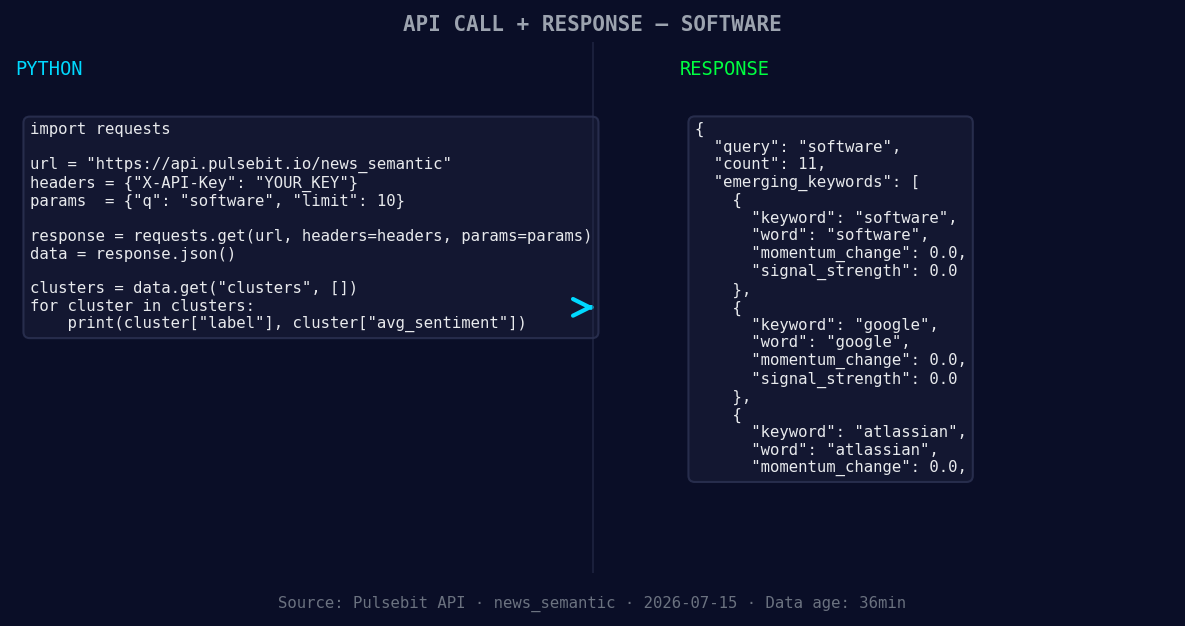
*Left: Python GET /news_semantic call for 'software'. Right: returned JSON response structure (clusters: 3). Source: Pulsebit /news_semantic.*
# Define parameters
topic = 'software'
score = +0.256
confidence = 0.90
momentum = -0.237
lang_filter = 'sp' # Spanish language filter
# Step 1: Geographic origin filter
response = requests.get(
"https://api.pulsebit.com/sentiment",
params={
"topic": topic,
"score": score,
"confidence": confidence,
"momentum": momentum,
"lang": lang_filter
}
)
# Check the response
if response.status_code == 200:
sentiment_data = response.json()
print("Filtered Sentiment Data:", sentiment_data)
else:
print("Error fetching data:", response.status_code)
# Step 2: Meta-sentiment moment
cluster_reason = "Clustered by shared themes: testingxperts, hyderabad, software, testing, firm."
meta_sentiment_response = requests.post(
"https://api.pulsebit.com/sentiment",
json={"text": cluster_reason}
)
# Check the response for meta sentiment
if meta_sentiment_response.status_code == 200:
meta_sentiment_data = meta_sentiment_response.json()
print("Meta Sentiment Data:", meta_sentiment_data)
else:
print("Error fetching meta sentiment:", meta_sentiment_response.status_code)
In this code, we first filter for sentiment data by language, ensuring we capture relevant spikes from the Spanish press. Next, we run a meta-sentiment analysis on the narrative framing itself, extracting deeper insights from the underlying themes of the articles. This two-step approach allows us to adapt our responses based on emerging trends, particularly around software-related discussions.
Now, let's consider three specific builds we can implement with this newfound insight.
Spanish Language Filtered Alert System: Set up a real-time alert system that triggers when sentiment momentum for software in Spanish dips below a threshold of -0.2. Use the geographic origin filter to ensure you're capturing relevant discussions from Spanish-speaking regions.
Meta-Sentiment Analysis Dashboard: Create a dashboard that visualizes the meta-sentiment scores of clustered narratives. Focus on the themes forming around "Atlassian," "testingxperts," and "Hyderabad," and set alerts whenever the sentiment score drops below 0.1, indicating potential negative shifts.
Comparative Sentiment Analysis: Build an endpoint that continuously compares the sentiment around Atlassian with other emerging topics like "software" and "Google." Use the geographic filter to see how different regions perceive these topics, helping you to pivot strategies based on real-time sentiment shifts.

Geographic detection output for software. India leads with 5 articles and sentiment +0.54. Source: Pulsebit /news_recent geographic fields.
With these builds, you can ensure your sentiment analysis pipeline is agile, responsive, and truly insightful.
Ready to get started? Visit our docs and see how you can implement this in under 10 minutes. Your pipeline's responsiveness to sentiment changes might just depend on it.


Top comments (0)