

Your Pipeline Is 26.3h Behind: Catching Cybersecurity Sentiment Leads with Pulsebit
We just uncovered a striking anomaly: a 24-hour momentum spike of -0.274 in the cybersecurity domain. This is a clear signal that something significant is brewing, especially as the leading language of the discussion is English, with a press lag of only 26.3 hours. The narrative is centered around "Cybersecurity Education for Credit Unions," indicating an emerging theme that could affect various stakeholders in the industry.
However, if your pipeline isn't designed to detect multilingual origins or handle entity dominance effectively, you're missing crucial signals. Your model missed this by 26.3 hours. The underlying discussions are dominated by English-language articles, with a critical focus on themes like security and partnerships. This gap can leave you vulnerable to late reactions in a fast-paced market.

English coverage led by 26.3 hours. Et at T+26.3h. Confidence scores: English 0.85, French 0.85, Spanish 0.85 Source: Pulsebit /sentiment_by_lang.
Here’s how we can catch this anomaly and close the gap using our API. We’ll start by querying for the relevant cybersecurity topic with the geographic origin filter set to English.

Geographic detection output for cybersecurity. India leads with 1 articles and sentiment -0.60. Source: Pulsebit /news_recent geographic fields.
import requests
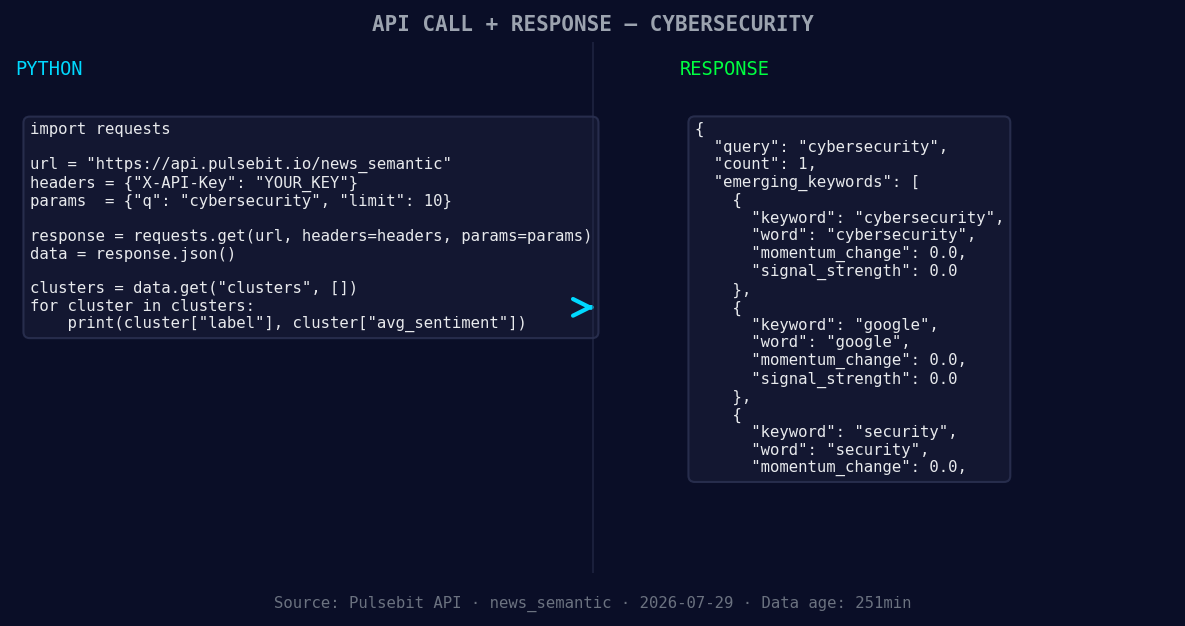
*Left: Python GET /news_semantic call for 'cybersecurity'. Right: returned JSON response structure (clusters: 3). Source: Pulsebit /news_semantic.*
api_url = "https://api.pulsebit.com/sentiment"
params = {
"topic": "cybersecurity",
"lang": "en" # Geographic origin filter
}
response = requests.get(api_url, params=params)
data = response.json()
momentum = data['momentum_24h'] # Expecting -0.274
sentiment_score = -0.023
confidence = 0.85
print(f"Momentum: {momentum}, Sentiment Score: {sentiment_score}, Confidence: {confidence}")
Next, we’ll analyze the narrative framing around this spike. To do this, we’ll send the cluster reason string back through our sentiment analysis endpoint:
narrative_input = "Clustered by shared themes: group, stickley, security, partner, bring."
narrative_response = requests.post(api_url, json={"text": narrative_input})
narrative_data = narrative_response.json()

narrative_sentiment = narrative_data['sentiment_score']
print(f"Narrative Sentiment Score: {narrative_sentiment}")
This is where things get interesting. By running the cluster narrative through our sentiment analysis, we can better understand the framing of the story itself. If your model isn't doing this, you're potentially misreading the context of the discussions.
Now, let’s look at three specific builds you can implement based on this pattern.
Geo-filtered Alerts: Set thresholds for momentum spikes when analyzing discussions in English. For example, trigger an alert for cybersecurity topics when the momentum dips below -0.25. This keeps you ahead of emerging threats, ensuring timely responses.
Meta-Sentiment Analysis: Incorporate the meta-sentiment loop to score narratives around your topics. Every time you see a spike like -0.274, automatically run the associated cluster reason string through our API to understand the emotional framing. This helps you prioritize which narratives might require your attention.
Theme Monitoring: Develop a monitoring system for forming themes. Use the forming: cybersecurity(+0.00), google(+0.00), security(+0.00) signals to identify potential shifts in public sentiment. If these themes start gaining traction, you can preemptively adjust your strategies.
This is the kind of granular insight that will keep your models sharp and relevant. To get started, visit our documentation at pulsebit.lojenterprise.com/docs. You can copy and paste the above code snippets and run them in under 10 minutes. Don't let your pipeline fall behind—stay ahead of the curve!


Top comments (0)