

Your Pipeline Is 23.3h Behind: Catching Finance Sentiment Leads with Pulsebit
We just observed a significant anomaly in our recent data: a 24h momentum spike of +0.531 in the finance sector. This spike is particularly noteworthy given that the leading articles are in English and are clustered around the theme of Wall Street futures rising amid market fluctuations. With this information, it’s clear that there’s a wave of sentiment building that requires our immediate attention.
But here's the kicker: your model missed this by a staggering 23.3 hours. If you’re relying solely on a pipeline that doesn’t account for multilingual sources or entity dominance, you’re losing out on critical insights. The dominant language of the articles is English, and this single-language focus can blind you to the nuances present in other languages, which may provide a richer sentiment landscape.

English coverage led by 23.3 hours. Ca at T+23.3h. Confidence scores: English 0.85, Spanish 0.85, French 0.85 Source: Pulsebit /sentiment_by_lang.
To help you catch these signals in real-time, here’s a quick Python snippet to extract this momentum data using our API.
import requests
# Define the parameters for fetching sentiment data
params = {
"topic": "finance",
"lang": "en",
"momentum": 0.531,
}
# API Call to fetch articles
response = requests.get("https://api.pulsebit.com/v1/articles", params=params)
data = response.json()
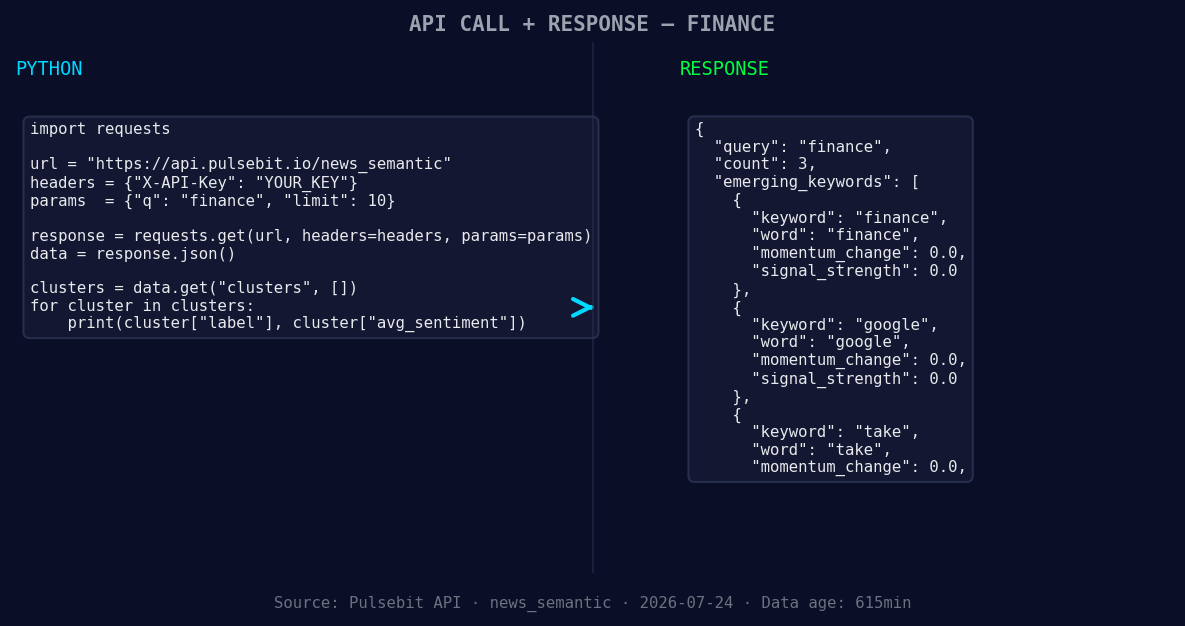
*Left: Python GET /news_semantic call for 'finance'. Right: returned JSON response structure (clusters: 3). Source: Pulsebit /news_semantic.*
# Print out the response
print(data)
Next, we need to run the cluster reason string through our sentiment scoring endpoint to assess the narrative framing itself.
# Define the narrative framing string
narrative = "Clustered by shared themes: finance, ‘strengthens, climate, resilience’, among."

# API Call to score the narrative
sentiment_response = requests.post("https://api.pulsebit.com/v1/sentiment", json={"text": narrative})
sentiment_data = sentiment_response.json()

# Print out the sentiment score for the narrative
print(sentiment_data)
With this setup, you can quickly identify emerging trends and sentiment shifts in the finance sector, allowing you to adapt your strategy accordingly.
Now, let’s explore three specific things you can build utilizing this rich data:
Geo-Filtered Alerts: Create a system that triggers alerts when sentiment in the finance sector crosses a certain threshold (e.g., score > +0.25) specifically for English-language articles. For instance, you could set up a cron job that runs the earlier Python code every hour to check for spikes.
Meta-Sentiment Dashboard: Build a dashboard that visualizes the meta-sentiment of clustered narratives. Utilize the cluster reason string to provide context to the data. When sentiment scores surpass a confidence level of 0.85, highlight these narratives prominently.
Integrate Forming Themes: Develop a module that integrates forming themes like finance, Google, and climate into your strategy. For instance, if the forming theme score for finance is +0.00, trigger an alert to review it against mainstream trends that include ‘strengthens’ and ‘climate’. This can provide a deeper understanding of how emerging narratives interact with mainstream sentiment.
By leveraging these insights, you can ensure your models are up-to-date and responsive to the rapid shifts in sentiment, especially in the finance sector where timing is everything.
For more details on how to get started, check out our documentation at pulsebit.lojenterprise.com/docs. You can copy-paste the code snippets provided here and run them in under 10 minutes. Happy coding!

Geographic detection output for finance. Hong Kong leads with 1 articles and sentiment +0.75. Source: Pulsebit /news_recent geographic fields.


Top comments (0)