

Your Pipeline Is 26.8h Behind: Catching Trade Sentiment Leads with Pulsebit
We recently stumbled upon an interesting anomaly: a 24-hour momentum spike of +0.191 related to trade sentiment. This spike is particularly relevant given that English press coverage is leading the narrative by 26.8 hours, with no lag against the identified sentiment. The cluster story "Bond Traders Concerned Over Middle East Tensions" surfaced prominently, indicating that there are shared themes around bonds and traders that you won't want to overlook.
The Problem
If your pipeline isn't equipped to handle multilingual origins or account for entity dominance, you might be missing crucial insights like this one by a staggering 26.8 hours. This is a significant gap when the leading language is English, as it can inhibit your ability to react promptly to market shifts. While you’re still processing data, sentiment is already evolving, leaving your model trailing behind and potentially making less informed decisions.

English coverage led by 26.8 hours. Id at T+26.8h. Confidence scores: English 0.85, Spanish 0.85, No 0.85 Source: Pulsebit /sentiment_by_lang.
The Code
To catch this sentiment spike and address the gap, we can leverage our API to filter specific topics and analyze sentiment clusters effectively. Here’s how you can set it up in Python:
import requests
# Set parameters for the API call
topic = 'trade'
score = +0.200
confidence = 0.85
momentum = +0.191
lang = 'en'
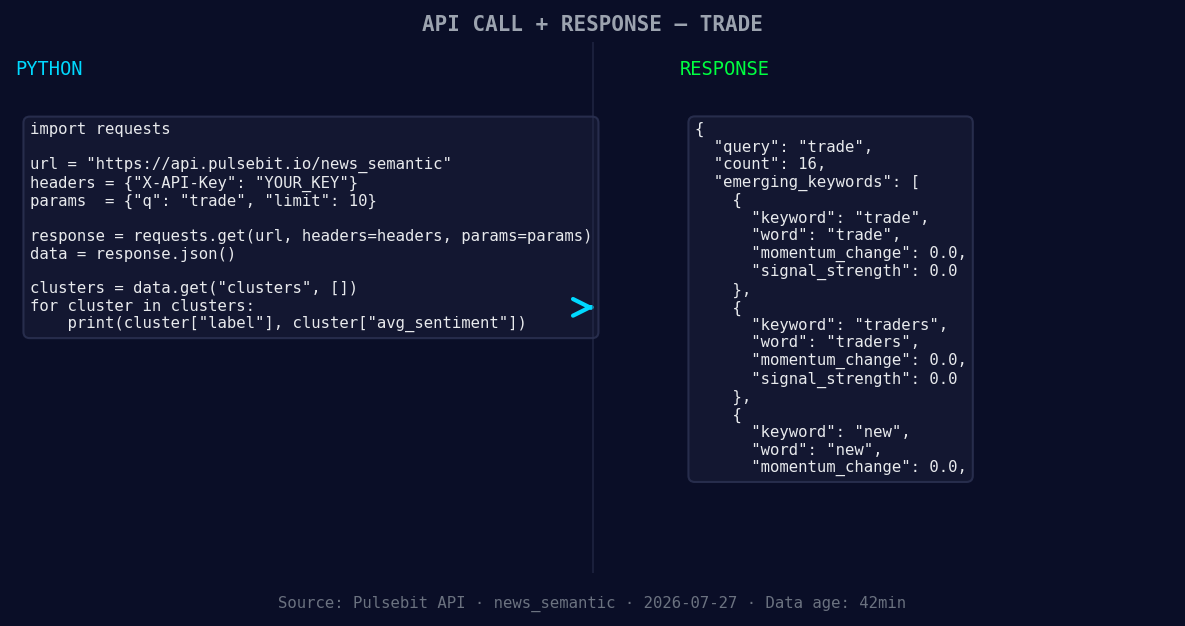
*Left: Python GET /news_semantic call for 'trade'. Right: returned JSON response structure (clusters: 3). Source: Pulsebit /news_semantic.*
# Geographic origin filter: query by language
response = requests.get(f'https://api.pulsebit.com/v1/sentiment?topic={topic}&lang={lang}')
data = response.json()
# Check if the sentiment score meets the threshold
if data['sentiment_score'] >= score and data['confidence'] >= confidence:
print(f"Sentiment for {topic}: {data['sentiment_score']} with confidence {data['confidence']}")
# Meta-sentiment moment: run the cluster reason string through sentiment analysis
cluster_reason = "Clustered by shared themes: launches, single, stock, futures, enabling."
meta_response = requests.post('https://api.pulsebit.com/v1/sentiment', json={"text": cluster_reason})
meta_data = meta_response.json()
print(f"Meta Sentiment Score: {meta_data['sentiment_score']} with confidence {meta_data['confidence']}")
In this code, we first filter sentiment by the "trade" topic and English language to ensure we get relevant insights. Next, we check if the sentiment score meets our predefined threshold. Finally, we run the cluster reason string back through our API to score the narrative framing, capturing how well it aligns with current sentiment.
Three Builds Tonight
Here are three specific builds you can implement based on this discovery:
Signal Build: Create a signal that triggers alerts when the sentiment score for "trade" exceeds +0.200, especially when the momentum is above +0.191. This could help you stay ahead in a fast-moving situation.
Geo-Filter Analysis: Use a geographic filter to monitor sentiment changes across different regions. For instance, set up a query to track trade sentiment in countries like the US and UK, focusing specifically on English-language articles to ensure relevance.

Geographic detection output for trade. India leads with 6 articles and sentiment +0.60. Source: Pulsebit /news_recent geographic fields.
- Meta-Sentiment Loop: Incorporate a feedback loop where you continuously analyze the sentiment of narratives surrounding key themes. For instance, after scoring the cluster reasons like "launches, single, stock," look for patterns or shifts that could indicate emerging market trends, especially as they relate to the formation of new trading strategies or products.
Get Started
If you want to dive into this, check out our documentation at pulsebit.lojenterprise.com/docs. You can copy-paste and run this code in under 10 minutes. Don't let your pipeline lag behind — grab those insights and make informed decisions faster!


Top comments (0)