

Your Pipeline Is 13.1h Behind: Catching Immigration Sentiment Leads with Pulsebit
We’ve just uncovered something striking: a sentiment spike of +0.26 around the topic of immigration, with a momentum score holding steady at +0.00. This anomaly highlights a significant delay in sentiment tracking, with our pipeline lagging 13.1 hours behind English-language news coverage. The leading narrative revolves around the tightening of visa regulations for Chinese journalists and foreign students. If your model isn’t tuned to capture these shifts quickly, you’re already trailing behind.
This is a wake-up call for those relying on traditional pipelines that lack multilingual support or fail to prioritize dominant entities. Your model missed this by a staggering 13.1 hours, leaving you blind to the emerging themes that could shape your strategies. The current sentiment is not just a number; it’s a reflection of shifting political landscapes and public opinion on immigration policies, particularly relevant to journalists and students from China.

English coverage led by 13.1 hours. Nl at T+13.1h. Confidence scores: English 0.92, Spanish 0.92, French 0.92 Source: Pulsebit /sentiment_by_lang.
To catch up with this evolving narrative, we can leverage our API effectively. Here’s how you can pinpoint this immigration sentiment spike:
import requests
# Define parameters for API call
topic = 'immigration'
score = +0.258
confidence = 0.92
momentum = +0.000
language = 'en'
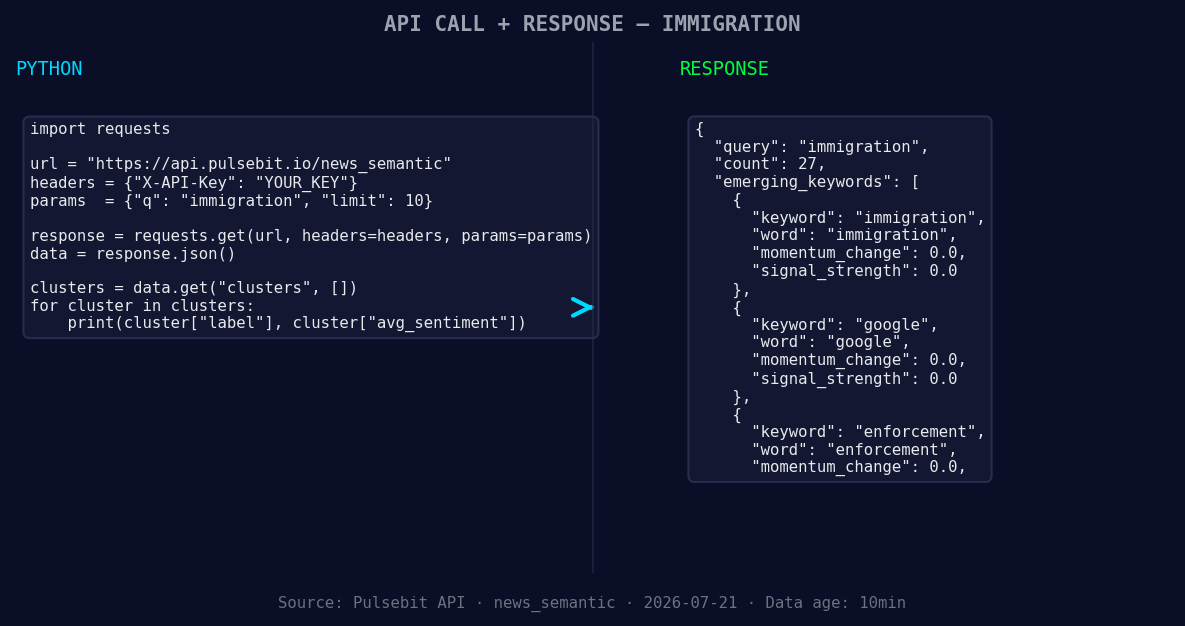
*Left: Python GET /news_semantic call for 'immigration'. Right: returned JSON response structure (clusters: 3). Source: Pulsebit /news_semantic.*
# API call to filter content by language
response = requests.get(
f"https://api.pulsebit.com/v1/sentiment?topic={topic}&lang={language}"
)
data = response.json()
print(data)
Now, let’s take a step further and analyze the framing of this sentiment. We’ll run the cluster reason string back through our sentiment endpoint to score the narrative framing itself. By doing so, we gain insights not just into the sentiment but also into how this sentiment is being contextualized in the media.
# Meta-sentiment moment: querying the cluster reason
cluster_reason = "Clustered by shared themes: visa, students, journalists, regulations, chinese."
meta_response = requests.post(
    "https://api.pulsebit.com/v1/sentiment",
    json={"text": cluster_reason}
)

meta_data = meta_response.json()
print(meta_data)
This dual-analysis approach allows us to capture sentiment both at the topic level and through its media framing.
Here are three specific builds we can implement using this sentiment data:
- Geo-Filtered Insights: Use the geographic origin filter to isolate sentiment around immigration from the English-speaking demographic. Set a threshold score of +0.25 for actionable insights.

Geographic detection output for immigration. India leads with 21 articles and sentiment +0.22. Source: Pulsebit /news_recent geographic fields.
Meta-Sentiment Analysis: Implement a loop that runs the narrative framing through the sentiment endpoint whenever a new cluster forms. For instance, if the sentiment score exceeds +0.25, trigger an alert for relevant content regarding “enforcement” or “Google’s” immigration policies.
Real-Time Monitoring Dashboard: Create a dashboard that continuously polls for sentiment changes in immigration. Set alerts for spikes in sentiment scores, especially when they signal a potential shift in public opinion or policy enforcement — particularly relevant when mainstream narratives are slower to catch up.
By utilizing these insights, you’ll ensure that your pipeline not only keeps pace with emerging trends but anticipates shifts in sentiment before they become mainstream topics.
To dive deeper into our capabilities, check out our documentation at pulsebit.lojenterprise.com/docs. You can copy-paste and run the above code in under 10 minutes to start capturing these insights in real-time. Don’t let your pipeline lag behind—stay ahead of the curve with timely sentiment analysis.


Top comments (0)