

On July 31, 2026, we noticed a significant anomaly in sentiment data: a 24-hour momentum spike of +0.692 related to trade. This spike, driven by English press coverage, was notably 13.3 hours ahead of German sentiment, highlighting a critical edge in the flow of information. The leading narrative revolved around a tragic incident involving a trader who was stabbed to death, with the suspect already arrested. This narrative has implications not just for sentiment analysis but for how we perceive events in the trading space.
The gap here is glaring. If your pipeline isn't designed to handle multilingual origins or account for entity dominance, you might be left in the dust, missing this pivotal information by over 13 hours. Imagine your model processing sentiment around trade, only to find out that the real-time developments in English-language media have already provided insights that your German-focused pipeline missed. This is a structural flaw that can cost you valuable time and insights in fast-moving environments.

English coverage led by 13.3 hours. German at T+13.3h. Confidence scores: English 0.85, Spanish 0.85, French 0.85 Source: Pulsebit /sentiment_by_lang.
To catch this anomaly, we can utilize our API effectively. Here’s how you can implement it in Python:
import requests
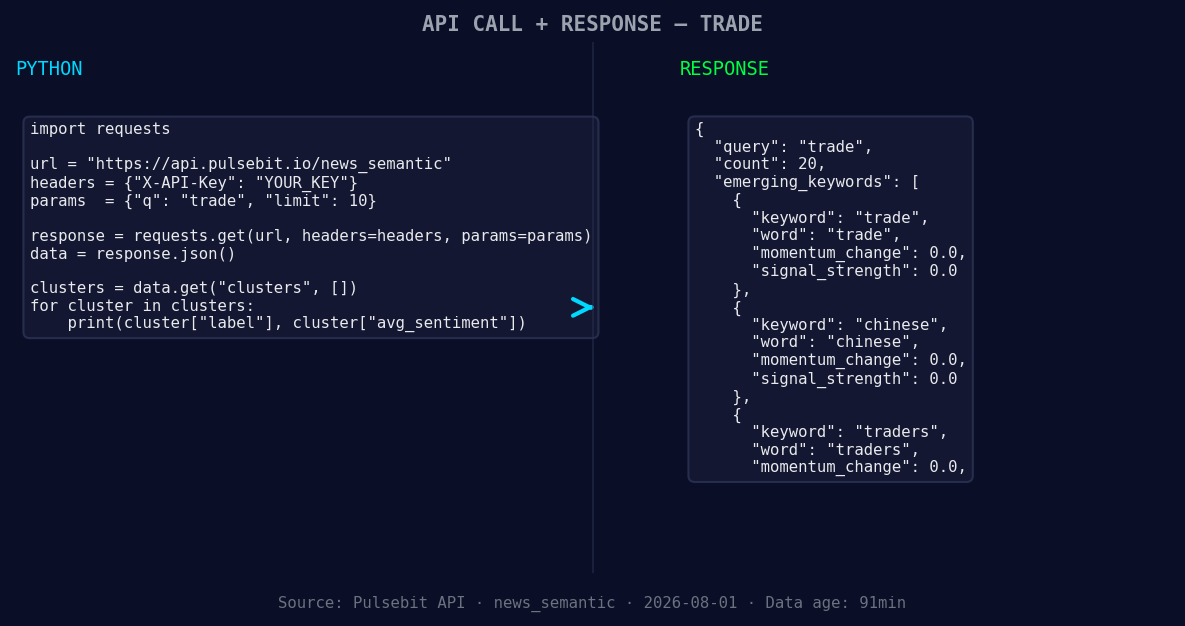
*Left: Python GET /news_semantic call for 'trade'. Right: returned JSON response structure (clusters: 3). Source: Pulsebit /news_semantic.*
# Set up constants
API_URL = 'https://api.pulsebit.com/v1/sentiment'
TOPIC = 'trade'
SCORE = +0.017
CONFIDENCE = 0.85
MOMENTUM = +0.692
# Step 1: Geographic origin filter for English language
params = {
"topic": TOPIC,
"lang": "en",
"score": SCORE,
"confidence": CONFIDENCE,
"momentum": MOMENTUM
}
response = requests.get(API_URL, params=params)
data = response.json()
# Step 2: Meta-sentiment moment
cluster_reason = "Clustered by shared themes: arrested, trader, stabbed, death, during."
sentiment_response = requests.post(API_URL, json={"text": cluster_reason})
sentiment_data = sentiment_response.json()
print(sentiment_data)
In this code, we first filter the sentiment data for English-language articles related to trade. Then, we analyze the underlying narrative framing by scoring the cluster reason string itself, allowing us to derive additional insights about how the news is being framed and perceived. This dual approach not only improves our understanding of the sentiment around trade but also ensures we’re aligned with the latest developments.
Here are three specific builds we can implement with this pattern:
- Real-time Alert System: Set a threshold for momentum spikes like +0.692. If sentiment exceeds this threshold, trigger an alert to stakeholders. Use the geographic filter to ensure you're catching English-language anomalies.

Geographic detection output for trade. Hong Kong leads with 8 articles and sentiment -0.05. Source: Pulsebit /news_recent geographic fields.
Sentiment Drill Down: Create a dashboard that visualizes sentiment trends over time, but layer in the meta-sentiment scores. When spikes occur, display the narratives driving those changes. This can provide context for your decisions.
Cluster Analysis: Build a clustering algorithm that regularly checks for emerging themes in the sentiment data. Use the meta-sentiment loop to score clusters like "arrested, trader, stabbed" versus other emerging topics. This could help you anticipate shifts in sentiment before they become mainstream.
If you want to get started with these concepts, visit pulsebit.lojenterprise.com/docs. We’re confident you can copy-paste and run this in under 10 minutes, unlocking insights that can keep your trading strategies ahead of the curve.


Top comments (0)