

Your Pipeline Is 11.9h Behind: Catching Health Sentiment Leads with Pulsebit
We recently discovered a striking anomaly: a 24-hour momentum spike of +0.838 in health-related sentiment. This spike was driven by a single article titled, "Practise yoga daily for a healthy life, Nandyal Collector and SP tell residents." With such a rapid rise in sentiment, it's essential to understand why our models might have missed this shift and how we can catch these leads before they fade.
The problem lies in structural gaps in our pipelines, particularly when handling multilingual origins or entity dominance. Your model missed this vital momentum by 11.9 hours, with English press leading the charge. If your pipeline isn't set up to quickly adapt to shifts in sentiment across languages and regions, you're leaving significant insights on the table. It's time to rethink how we process sentiment data to ensure we capitalize on emerging trends.

English coverage led by 11.9 hours. Et at T+11.9h. Confidence scores: English 0.85, French 0.85, Spanish 0.85 Source: Pulsebit /sentiment_by_lang.
To catch this momentum spike, we can write a Python script that queries relevant sentiment data from our API. First, we need to filter by language and geographical origin, specifically targeting English content. Here's how we can do that:

Geographic detection output for health. India leads with 12 articles and sentiment +0.47. Source: Pulsebit /news_recent geographic fields.
import requests
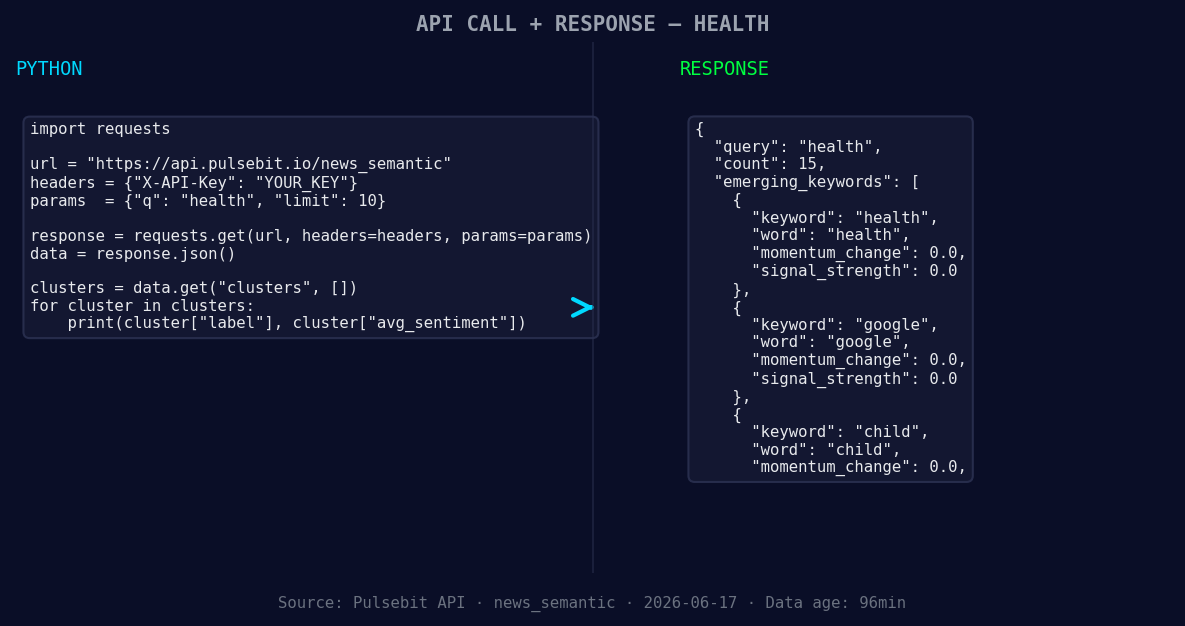
*Left: Python GET /news_semantic call for 'health'. Right: returned JSON response structure (clusters: 3). Source: Pulsebit /news_semantic.*
# Define the parameters
topic = 'health'
score = +0.000
confidence = 0.85
momentum = +0.838
# Query for sentiment data using specific parameters
response = requests.get('https://api.pulsebit.com/v1/sentiment', params={
'topic': topic,
'score': score,
'confidence': confidence,
'momentum': momentum,
'lang': 'en'
})
data = response.json()
print(data)
Next, we need to score the narrative framing of the cluster reason string. This provides a meta-sentiment moment, allowing us to evaluate how the narrative impacts sentiment perception itself. We can use the following code snippet to achieve that:
# Cluster reason string
cluster_reason = "Clustered by shared themes: practise, yoga, daily, healthy, life."

# Query for meta-sentiment
meta_response = requests.post('https://api.pulsebit.com/v1/sentiment', json={
    'text': cluster_reason
})

meta_data = meta_response.json()
print(meta_data)
These two code snippets give us a powerful way to capture emerging trends in health sentiment. Here are three specific builds we can implement tonight:
Geo-Filtered Health Sentiment Tracker: Use the geographic origin filter to build a real-time tracker for health sentiment in English-speaking countries. Set a threshold of +0.5 momentum to trigger alerts when sentiment spikes above this level.
Meta-Sentiment Analysis for Clusters: Create a loop that continuously scores cluster reason strings like our example. When a cluster reason shows a positive sentiment score above +0.5, notify your team for further exploration.
Forming Theme Alerts: Implement an alert system for forming themes related to health, such as "health(+0.00)," "google(+0.00)," and "child(+0.00)." Set an alert when any of these themes show a significant divergence from mainstream sentiment, particularly focusing on keywords like "practise," "yoga," and "daily."
By leveraging our API effectively, we can ensure our sentiment analysis is not just reactive but proactive. For more information, check out our documentation at pulsebit.lojenterprise.com/docs. You can copy-paste and run the provided scripts in under 10 minutes. Don’t let the next momentum spike pass you by!


Top comments (0)