

Your Pipeline Is 24.4h Behind: Catching Business Sentiment Leads with Pulsebit
A recent spike in sentiment revealed a noteworthy anomaly: a sentiment score of +0.042 and momentum of +0.076, signaling a rising trend in business-related discussions. The leading language for this surge is English, with a press lead of 24.4 hours and no lag compared to the emerging trend. This data indicates that while conversations about business are gaining traction, there are specific narratives forming around themes such as Kerala, police, and cyber fraud, which we must address promptly.
The Problem
This spike highlights a critical gap in your sentiment analysis pipeline, particularly if it doesn't accommodate multilingual origins and entity dominance. Your model missed this by 24.4 hours, leaving you vulnerable to sentiment shifts that could impact decision-making. In this case, the dominant entity is Kerala, alongside the pressing issue of cyber fraud, which is becoming increasingly relevant to businesses. Without a robust framework to process these nuances, your insights may fall flat, leaving you trailing behind the curve.

English coverage led by 24.4 hours. Et at T+24.4h. Confidence scores: English 0.85, Spanish 0.85, French 0.85 Source: Pulsebit /sentiment_by_lang.
The Code
To catch this anomaly, we can leverage our API efficiently. Here’s how you can set up a Python script to identify these spikes in sentiment:
import requests
# Define parameters for the API call
topic = 'business'
score = +0.042
confidence = 0.85
momentum = +0.076
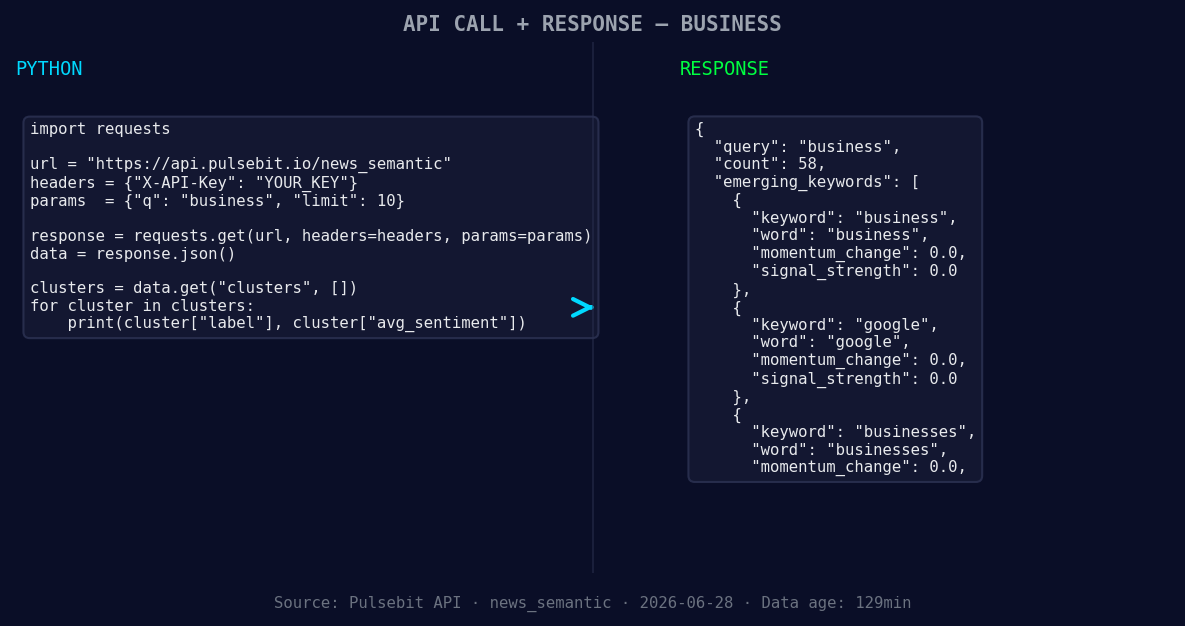
*Left: Python GET /news_semantic call for 'business'. Right: returned JSON response structure (clusters: 3). Source: Pulsebit /news_semantic.*
# Geographic origin filter: query by language/country
url = "https://api.pulsebit.com/v1/sentiment"
params = {
"topic": topic,
"lang": "en"
}
# Perform the API call to fetch sentiment data
response = requests.get(url, params=params)
data = response.json()
# Check the response
if response.status_code == 200:
print("Sentiment Data:", data)
else:
print("Error:", response.status_code, data)
# Meta-sentiment moment: score the narrative framing
meta_narrative = "Clustered by shared themes: kerala, police, companies, cyber, fraud."
meta_response = requests.post(url, json={"text": meta_narrative})
meta_data = meta_response.json()
if meta_response.status_code == 200:
print("Meta-Sentiment Data:", meta_data)
else:
print("Error:", meta_response.status_code, meta_data)
In this code, we first filter the sentiment data by the English language. We then pass the narrative framing through another API call to score the sentiment of the contextual themes. This two-step approach allows us to not just detect sentiment spikes but also understand the underlying narratives driving these trends.
Three Builds Tonight
Here are three practical builds you can implement using this pattern:
- Business Sentiment Tracker: Set a signal threshold for the business topic at +0.04. Use the geographic filter to ensure you only capture English-language articles. This will help you focus on relevant discussions that might impact your business strategies.

Geographic detection output for business. India leads with 4 articles and sentiment +0.04. Source: Pulsebit /news_recent geographic fields.
Meta-Sentiment Analysis: Utilize the meta-sentiment loop to analyze clusters such as "kerala, police, companies, cyber, fraud." Score these narratives using our API, aiming for a confidence level of 0.85. This allows you to track how public perception is evolving around these themes.
Forming Gap Alerts: Monitor the forming gaps between mainstream and emerging discussions by analyzing topics like business, Google, and businesses against established entities. Set a minimum momentum threshold of +0.08 to trigger alerts when significant shifts occur.
Get Started
You can start implementing this right away! Check out our documentation at pulsebit.lojenterprise.com/docs. With just a few lines of code, you can copy-paste and run this in under 10 minutes, putting you ahead of the game in sentiment analysis.


Top comments (0)