

Your Pipeline Is 27.6h Behind: Catching Machine Learning Sentiment Leads with Pulsebit
We recently noticed a compelling anomaly in our sentiment data: a spike with a sentiment score of +0.53 and a momentum of +0.00. The leading language is English, with a timestamp lag of 27.6 hours. This suggests that there’s a significant delay in how machine learning topics are being perceived. If your model isn’t designed to capture multilingual origins or dominant entities, it’s likely you missed out on this sentiment shift by over a day. In particular, the focus on “machine learning” is being overshadowed by broader themes of "hottest" and "research."

English coverage led by 27.6 hours. Da at T+27.6h. Confidence scores: English 0.90, Spanish 0.90, French 0.90 Source: Pulsebit /sentiment_by_lang.
When your pipeline fails to address these nuances, you risk missing critical shifts in sentiment. For instance, the English-language articles processed reveal that while machine learning is forming a gap, mainstream topics like "hottest" and "research" are getting all the attention. If your model isn’t tuned to capture these multi-faceted narratives, you’ll find yourself lagging behind by hours, if not longer.
Here's how you can catch up with the latest sentiment trends using our API. The first thing we need to do is filter for English-speaking articles. Below is the Python code that captures the relevant data:
import requests
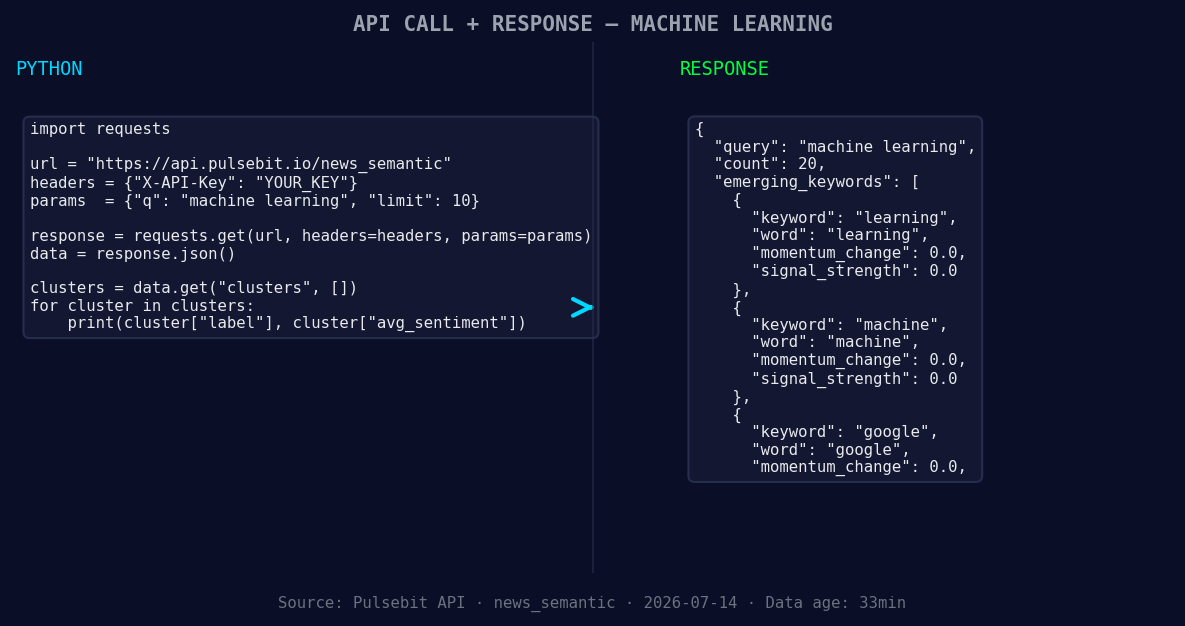
*Left: Python GET /news_semantic call for 'machine learning'. Right: returned JSON response structure (clusters: 3). Source: Pulsebit /news_semantic.*
# Define parameters
topic = 'machine learning'
url = 'https://api.pulsebit.com/v1/sentiment'
params = {
'topic': topic,
'lang': 'en'
}
# Call the API
response = requests.get(url, params=params)
data = response.json()
# Print the relevant sentiment score
print(f"Sentiment Score: {data['sentiment_score']}")
Next, we need to run the narrative framing through our sentiment API to understand the meta-sentiment behind the clustered themes. For this, we’ll use the following code:
# Meta-sentiment analysis
meta_narrative = "Clustered by shared themes: hottest, research, papers, international, conference"
meta_response = requests.post(url, json={'text': meta_narrative})
meta_data = meta_response.json()

# Print the meta sentiment score
print(f"Meta Sentiment Score: {meta_data['sentiment_score']}")
With these two pieces of code, you can start catching that sentiment gap and make your insights more timely.
What can you build with this newfound ability? Here are three specific applications:
Signal Detection: Set a threshold of sentiment score > +0.50 to catch emerging topics in machine learning. Use the geo filter to ensure you're only pulling in data from English-speaking sources.
Meta-Sentiment Tracking: Utilize the meta-sentiment loop to analyze the narrative around topics. For instance, if the score is consistently above +0.50 for the phrase “hottest in research”, you can identify a potential trend that may need further exploration.
Alert System: Implement an alert system that triggers when sentiment for “machine learning” rises above +0.50 while momentum remains at +0.00. This lets you know that while the topic is gaining attention, it may not yet be mainstream.
With these builds in place, you can ensure your pipeline is always up to date and in tune with the latest sentiment shifts.
Ready to get started? Check out our documentation at pulsebit.lojenterprise.com/docs. You can copy-paste and run the code in under 10 minutes to catch those critical sentiment leads.
![DATA UNAVAILABLE: countries — verify /news_recent is return
[DATA UNAVAILABLE: countries — verify /news_recent is returning country/region values for topic: machine learning]


Top comments (0)