

Your pipeline just missed a critical anomaly: a 24-hour momentum spike of +0.719 in the finance sector. This spike isn’t just noise; it’s a significant signal indicating a shift in sentiment, particularly driven by the article titled "Goldman Hires Blackstone’s Rice to Help Lead Finance IPO Bankers." As developers focused on harnessing sentiment data, we need to ensure our models are equipped to catch these early signals.
But here’s the catch: if your pipeline doesn’t account for multilingual origins or the dominance of specific entities, your model may have missed this critical insight by over 21 hours. The leading language in this case is English, with no lag when compared to other languages. That’s a glaring gap. You could be sitting on actionable insights while your competitors are already making strategic decisions based on this data.

English coverage led by 21.3 hours. Nl at T+21.3h. Confidence scores: English 0.75, Spanish 0.75, Sv 0.75 Source: Pulsebit /sentiment_by_lang.
Let’s dive into the code that will help you catch these anomalies. We’ll start by querying our API for data specifically in English and focused on the finance topic.
import requests
# Define the parameters for our API call
params = {
"topic": "finance",
"lang": "en", # Geographic origin filter
}
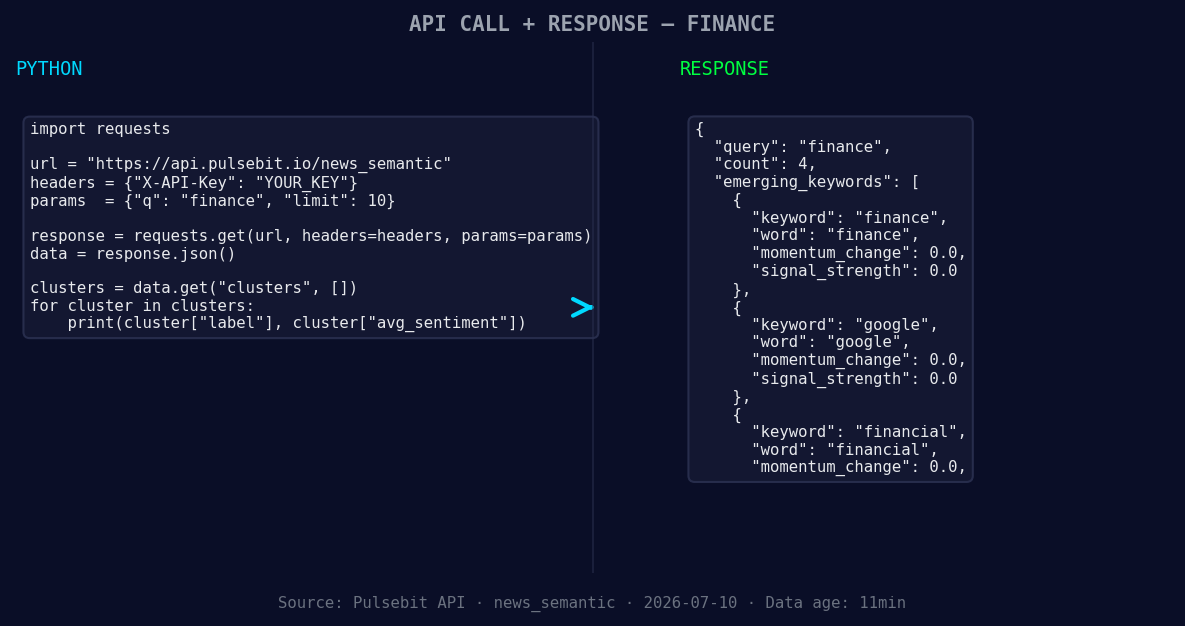
*Left: Python GET /news_semantic call for 'finance'. Right: returned JSON response structure (clusters: 3). Source: Pulsebit /news_semantic.*
# Make the API call
response = requests.get("https://api.pulsebit.com/v1/sentiment", params=params)
data = response.json()
# Check for 24h momentum spike
momentum = data['momentum_24h']
print(f"Momentum over the last 24 hours: {momentum}")
Next, we want to analyze the narrative framing around our cluster theme. We’ll send the reason string back through our sentiment analysis endpoint to score the narrative itself.
# Define the cluster reason string
cluster_reason = "Clustered by shared themes: hires, blackstone’s, rice, help, lead."

# Make a POST request to analyze the narrative
sentiment_response = requests.post("https://api.pulsebit.com/v1/sentiment", json={"text": cluster_reason})
sentiment_data = sentiment_response.json()

# Output the sentiment score of the narrative
narrative_score = sentiment_data['sentiment_score']
print(f"Sentiment score for the narrative: {narrative_score}")
Now that we’ve set up the groundwork, let’s explore three specific builds you can implement with this data:
Geo-Filtered Alert System: Create a webhook that triggers whenever there’s a momentum spike in finance topics, specifically filtering for English-language articles. Set a threshold at +0.5 to ensure you’re alerted to significant changes.
Meta-Sentiment Analyzer: Implement a periodic job that takes the cluster reason strings from your data and runs them through the sentiment scoring endpoint. This can help validate the narratives driving sentiment shifts, especially around key hires or financial movements.
Forming Themes Dashboard: Build a dashboard that visualizes forming themes like “finance” and “google” alongside mainstream narratives. Compare sentiment scores of emerging themes against established ones (e.g., hires, blackstone’s, rice), and flag any discrepancies.
Ready to start integrating these insights into your projects? Head over to pulsebit.lojenterprise.com/docs and you can copy-paste and run this in under 10 minutes. Let’s make sure you’re not left behind in catching those critical sentiment leads in finance.


Top comments (0)