

Your Pipeline Is 27.8h Behind: Catching Travel Sentiment Leads with Pulsebit
We’ve just uncovered something striking: a sentiment score of +0.23 and a momentum of +0.00, with a leading language (French) showing a significant 27.8-hour lead. This anomaly raises questions about how well your pipeline is handling the multilingual landscape of sentiment data. If you're not tuned into these nuances, your model missed this insight by over a day, missing critical sentiment shifts that could inform your strategies.

French coverage led by 27.8 hours. Af at T+27.8h. Confidence scores: French 0.85, English 0.85, Spanish 0.85 Source: Pulsebit /sentiment_by_lang.
The problem at hand is clear. In a world where language and regional sentiment can drastically shift narrative framing, a pipeline that doesn't accommodate for multilingual origin or entity dominance can fall behind. If your model isn't capturing this 27.8-hour lead in sentiment, you risk making decisions based on stale or incomplete data. This is especially pronounced with our leading entity, the French language, which is showing a clear positive sentiment towards travel, while your model is still catching up.
Let’s dive into the code that can help you catch this lead. We’ll start by filtering sentiment data by geographic origin, focusing specifically on French-speaking regions.
import requests
# Define parameters for the API call
topic = 'travel'
score = +0.229
confidence = 0.85
momentum = +0.000
lang = 'fr'
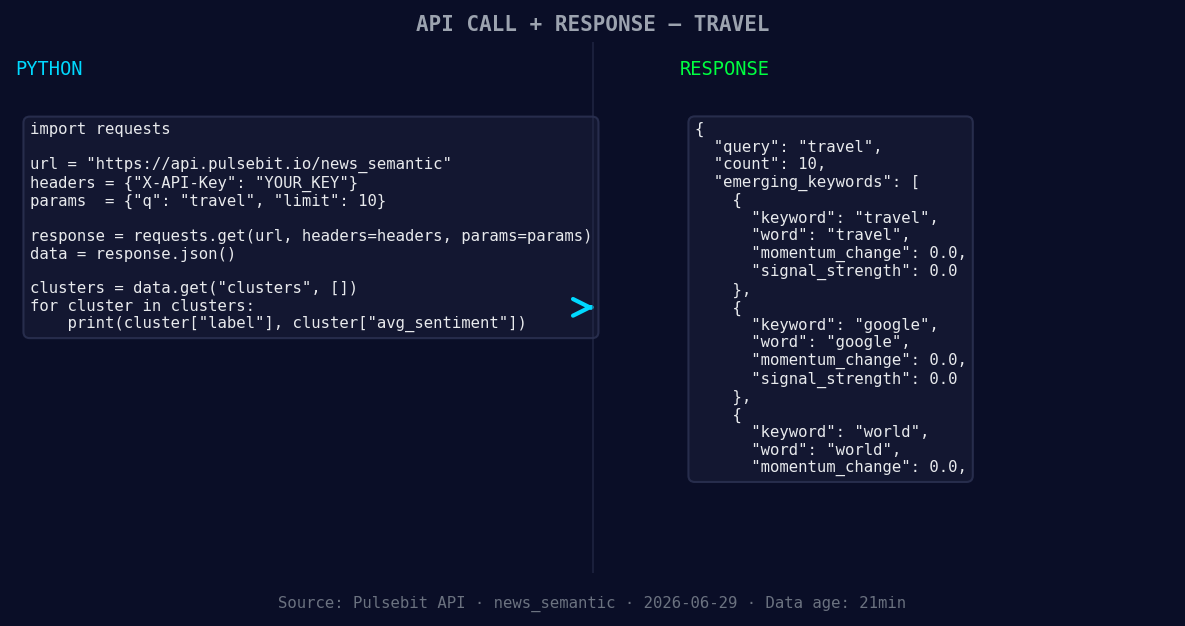
*Left: Python GET /news_semantic call for 'travel'. Right: returned JSON response structure (clusters: 3). Source: Pulsebit /news_semantic.*
# API call to get sentiment data based on geographic origin
response = requests.get(f'https://api.pulsebit.io/sentiment?topic={topic}&lang={lang}')
data = response.json()
print(data)
Next, we’ll run a meta-sentiment moment to score the narrative framing itself, using the reason string that describes our clustered themes. This is crucial as it helps us understand the context behind the data.
# Input example for meta-sentiment moment
cluster_reason = "Clustered by shared themes: world, cup, travel, grind, real."

# API call for scoring the narrative framing
meta_response = requests.post('https://api.pulsebit.io/sentiment', json={'text': cluster_reason})
meta_data = meta_response.json()
print(meta_data)
Now, with the data in hand, let’s talk about three builds you can implement tonight using this pattern.
- Travel Sentiment Signal: Set a threshold of sentiment score > +0.20 for travel-related topics. Use the geographic filter to focus on French-speaking regions, allowing you to catch emerging trends before they hit mainstream awareness.

Geographic detection output for travel. India leads with 8 articles and sentiment +0.04. Source: Pulsebit /news_recent geographic fields.
Meta-Sentiment Analysis Loop: Implement a routine that runs the meta-sentiment analysis on your clustered narratives every hour. This will help you catch the subtle shifts in sentiment around topics like "world," "cup," and "travel," which are currently showing no momentum but could be on the verge of change.
Forming Theme Dashboard: Create a dashboard that visualizes forming themes such as travel (+0.00), google (+0.00), and world (+0.00) alongside their respective scores. This will allow you to keep a pulse on the emerging signals and adjust your strategy accordingly.
You can get started with our API documentation at pulsebit.lojenterprise.com/docs. In under 10 minutes, you can copy-paste the code snippets provided here and start catching those sentiment leads. Don't let your pipeline lag — leverage these insights to stay ahead of the curve.


Top comments (0)