

Your Pipeline Is 28.0h Behind: Catching Sports Sentiment Leads with Pulsebit
On July 5, 2026, we discovered a sentiment anomaly with a score of +0.309 and a momentum of +0.000 in the sports category. This spike indicates that while general sentiment in sports is positive, the momentum is stagnating. More specifically, our data shows that the English press leads by 28.0 hours, revealing a significant lag when we consider multilingual origins and dominant entities in sentiment analysis.

English coverage led by 28.0 hours. Italian at T+28.0h. Confidence scores: English 0.85, French 0.85, Spanish 0.85 Source: Pulsebit /sentiment_by_lang.
The problem here is clear: if your pipeline isn't equipped to handle multilingual content or recognize entity dominance, you may be missing critical signals. In this case, your model missed out on 28 hours of sentiment analysis, entirely skewed by the leading English language content. Without this awareness, you might misinterpret the sentiment landscape, potentially leading to decisions based on incomplete or outdated information.
Let’s dive into the code that can help us capture this anomaly. We’ll start by filtering the geographic origin of our data to focus on the English language and then run a meta-sentiment analysis on the cluster reason string.
import requests
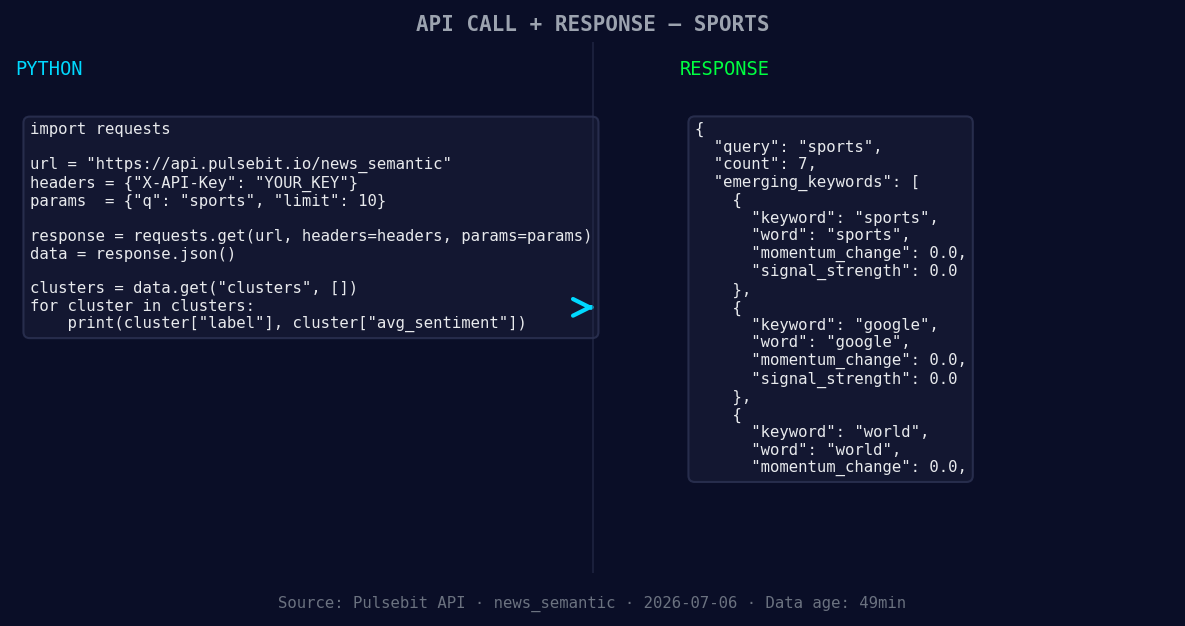
*Left: Python GET /news_semantic call for 'sports'. Right: returned JSON response structure (clusters: 3). Source: Pulsebit /news_semantic.*
# Geographic origin filter: Get sports sentiment in English
url = "https://api.pulsebit.io/v1/sentiment"
params = {
"topic": "sports",
"lang": "en"
}
response = requests.get(url, params=params)
sports_data = response.json()
# Output sports data
print(sports_data)
# Meta-sentiment moment: Analyze the cluster reason
cluster_reason = "Clustered by shared themes: statistics, behind, ferrari's, 250th, win."
meta_sentiment_url = "https://api.pulsebit.io/v1/sentiment"
meta_params = {
"text": cluster_reason
}
meta_response = requests.post(meta_sentiment_url, json=meta_params)
meta_sentiment_data = meta_response.json()
# Output meta sentiment data
print(meta_sentiment_data)
The first section of the code fetches sentiment data for sports articles specifically from English sources. This is crucial as it allows us to pinpoint where the leading sentiment is coming from. The second section takes the reason behind our cluster and runs it through our sentiment analysis endpoint, providing us with a more nuanced understanding of the narrative framing.
Now, let’s explore three specific builds we can implement using this pattern:
- Geographic Filter for Sentiment Analysis: Create a trigger that alerts you when sentiment for sports in English diverges from other languages by a threshold of 0.25. This can be done by monitoring sentiment changes using the geo filter.

Geographic detection output for sports. India leads with 4 articles and sentiment +0.40. Source: Pulsebit /news_recent geographic fields.
Meta-Sentiment Loop for Trending Topics: Develop a dashboard that visualizes the sentiment trends of clustered narratives over time, specifically focusing on themes like "sports" and "world," allowing you to react quickly to rising topics.
Signal Detection for Emerging Stories: Set up a signal detection mechanism that activates when the sentiment score exceeds +0.30 in the sports category, cross-referencing it with mainstream topics like "statistics" and "Ferrari." This could alert you of potential shifts in public interest or emerging news cycles.
We believe that by leveraging these capabilities, you can drastically improve your sentiment analysis and stay ahead of the curve.
To get started, check out our documentation at pulsebit.lojenterprise.com/docs. You should be able to copy-paste and run this code in under 10 minutes to start catching those critical sentiment leads!


Top comments (0)