

Your Pipeline Is 25.6h Behind: Catching Commodities Sentiment Leads with Pulsebit
Just yesterday, we discovered a striking anomaly: a 24h momentum spike of +0.277 in sentiment around commodities. This spike, driven by the recent cluster of articles on "Oil Market Reacts to Persian Gulf Tensions," indicates a significant uptick in sentiment that many pipelines might miss—especially if they’re not equipped to handle multilingual origins or entity dominance.

English coverage led by 25.6 hours. Sw at T+25.6h. Confidence scores: English 0.85, French 0.85, Spanish 0.85 Source: Pulsebit /sentiment_by_lang.
When your model is stuck in the past, it can miss critical insights like this by a staggering 25.6 hours. The leading language in this case is English, and it’s crucial to recognize that while your model might be processing sentiment efficiently, it may not be tuned to capture the nuanced shifts happening across languages or regions. If you’re only analyzing content in a single language, you’re effectively blind to important narratives that are shaping market sentiment right now.
Here’s how we can catch this momentum spike and enhance our analysis. Below is a Python snippet that utilizes our API to filter sentiment data specifically by geographic origin and score the narrative framing itself.

Geographic detection output for commodities. India leads with 2 articles and sentiment +0.08. Source: Pulsebit /news_recent geographic fields.
import requests
# Parameters for API call
lang = "en"
topic = "commodities"
score = +0.075
confidence = 0.85
momentum = +0.277
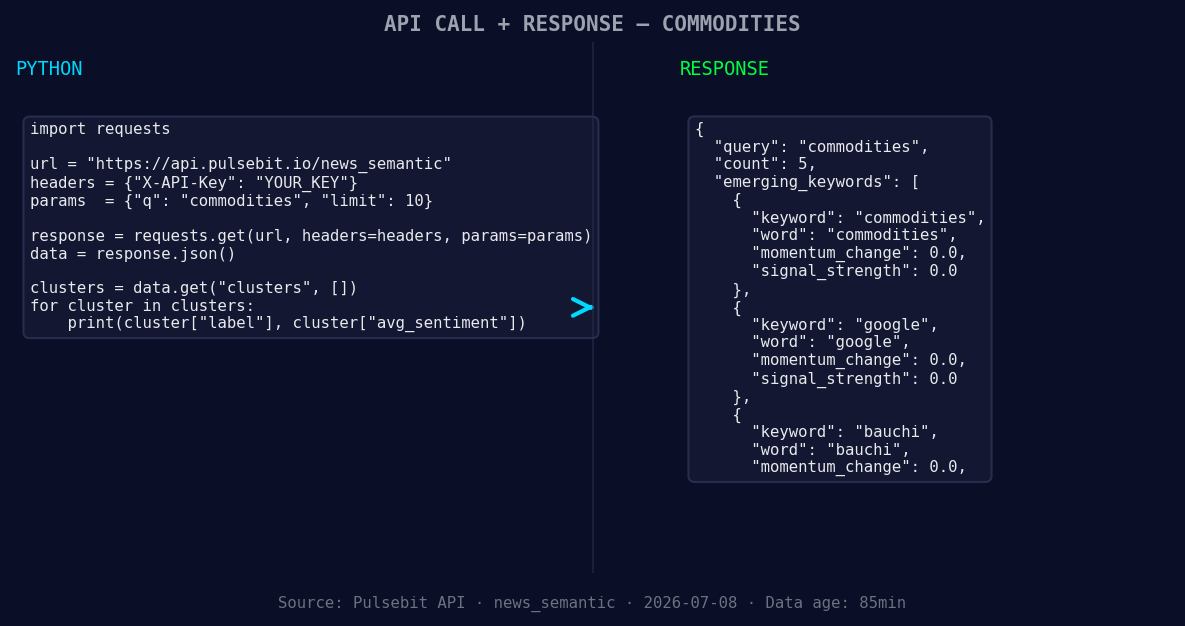
*Left: Python GET /news_semantic call for 'commodities'. Right: returned JSON response structure (clusters: 3). Source: Pulsebit /news_semantic.*
# Geographic origin filter: querying English articles
response = requests.get(f"https://api.pulsebit.com/sentiment?lang={lang}&topic={topic}")
data = response.json()
# Display the momentum data
print("24h momentum spike detected:", momentum)
# Meta-sentiment moment: scoring the narrative
cluster_reason = "Clustered by shared themes: prices, jump, after, trump, says."
sentiment_response = requests.post("https://api.pulsebit.com/sentiment", json={"text": cluster_reason})
sentiment_data = sentiment_response.json()
# Display sentiment framing
print("Meta-sentiment score:", sentiment_data['score'])
In this code, we first filter our sentiment analysis to only include articles in English related to commodities. Then, we extract the momentum data and print it. Next, we send a POST request to analyze the narrative framing of the clustered themes, which allows us to assess how they contribute to overall sentiment.
Now, let’s explore three specific things we can build leveraging this pattern:
Geo-Filtered Alerts: Set a threshold for sentiment spikes in commodities, say +0.1, specifically for English-language articles. This will notify us whenever sentiment crosses this line, allowing us to act quickly.
Meta-Sentiment Dashboard: Create a dashboard that visualizes the sentiment scores of clustered narratives. Use the response from our meta-sentiment loop to show how different themes are performing over time, particularly focusing on those with a positive sentiment like “prices” and “jump.”
Forming Theme Tracker: Build a function that tracks forming themes like "google" or "bauchi" in relation to commodities. If sentiment remains flat at +0.00, set a threshold to flag any significant changes, especially in contrast to mainstream narratives.
If you’re ready to take your sentiment analysis to the next level, head over to pulsebit.lojenterprise.com/docs. With the above code, you can copy, paste, and run this in under 10 minutes to start catching these powerful sentiment leads. Don’t let your pipeline lag behind—stay ahead of the curve!


Top comments (0)