

Your Pipeline Is 29.4h Behind: Catching Agriculture Sentiment Leads with Pulsebit
We've just uncovered a significant anomaly: sentiment for "agriculture" is clocking in at -0.75, while momentum remains steady at +0.00. It’s interesting to note that the leading language driving this sentiment is Spanish, showing a 29.4-hour lead with no lag compared to the dominant data source. This spike is not just a number; it’s a signal that something is brewing in the agricultural narrative that your pipeline might be missing.
The Problem
If your pipeline doesn't account for multilingual origins or entity dominance, it's likely that it missed this negative sentiment by a staggering 29.4 hours. The Spanish press is leading the conversation, and if your model is only tuned to English or overlooks this linguistic nuance, it leaves a significant gap in your understanding. This oversight means you're operating with outdated information that could affect your decision-making and strategy.

Spanish coverage led by 29.4 hours. Da at T+29.4h. Confidence scores: Spanish 0.85, English 0.85, Nl 0.85 Source: Pulsebit /sentiment_by_lang.
The Code
Let’s dive into the code to catch this sentiment anomaly. We’ll use our API to filter by language and assess the sentiment of the underlying narrative.
First, we’ll set up a geographic filter to collect data in Spanish:

Geographic detection output for agriculture. India leads with 7 articles and sentiment +0.11. Source: Pulsebit /news_recent geographic fields.
import requests
# Define the parameters for the API call
topic = 'agriculture'
lang = 'sp'
url = 'https://api.pulsebit.com/sentiment'
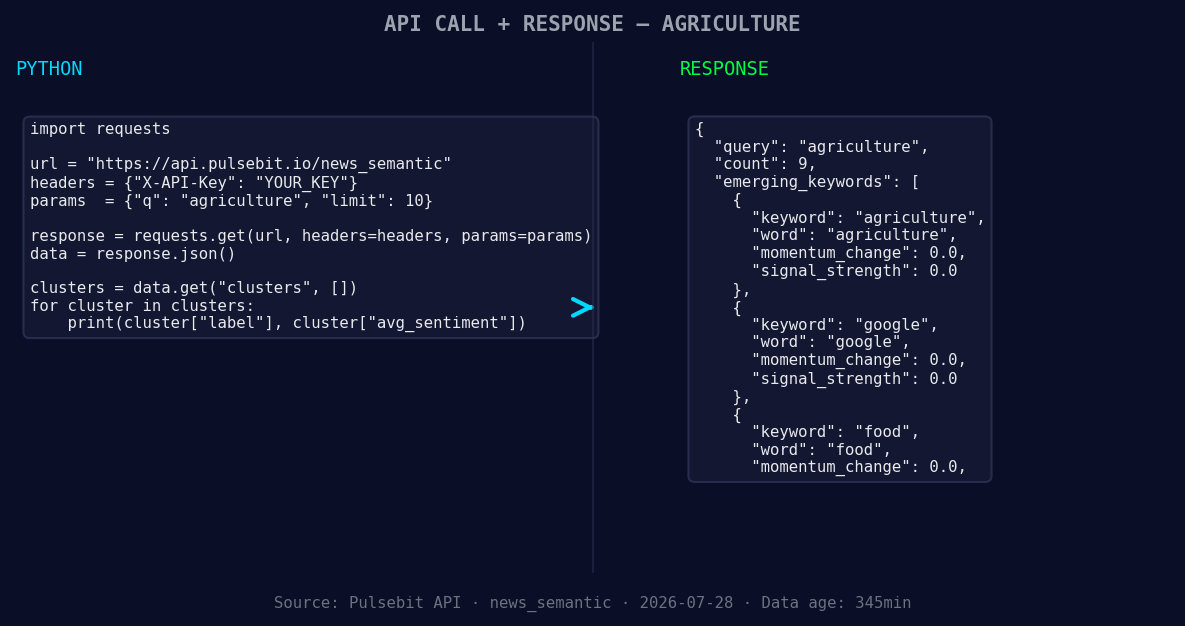
*Left: Python GET /news_semantic call for 'agriculture'. Right: returned JSON response structure (clusters: 3). Source: Pulsebit /news_semantic.*
# Make the API call
response = requests.get(url, params={'topic': topic, 'lang': lang})
data = response.json()
# Print the results
print(data)
Next, we’ll run the cluster reason string back through our sentiment endpoint to score the narrative itself. Here’s how you can do that:
# Cluster reason string
reason_string = "Clustered by shared themes: mediterranean, climate, drought, societal, around."

# Score the narrative framing
meta_sentiment_response = requests.post(url, json={'text': reason_string})
meta_sentiment_data = meta_sentiment_response.json()

# Print the results
print(meta_sentiment_data)
This code not only helps you capture the latest sentiment but also allows you to evaluate the framing of narratives that cause sentiment shifts.
Three Builds Tonight
Now that we've caught this significant insight, here are three specific things you can build using this pattern:
- Geo-Filtered Alerts: Set up an alert system that triggers when sentiment for "agriculture" in Spanish drops below -0.50. Use the geo filter to ensure you only get relevant results:
   if data['sentiment_score'] < -0.50:
       # Trigger alert
       send_alert('Negative sentiment detected in Spanish press regarding agriculture.')
Meta-Sentiment Analysis on Forming Themes: Build a dashboard to visualize sentiment trends for narratives around "agriculture", "food", and "google" against mainstream themes like "mediterranean", "climate", and "drought". Use the meta-sentiment loop to enrich your insights.
Dynamic Sentiment Tracking: Implement a feature that dynamically tracks sentiment changes in real-time, specifically for topics that show zero momentum (like "agriculture" at +0.00). Regularly query the sentiment score and adjust your strategies accordingly.
Get Started
This is just the beginning. Dive deeper into our documentation at pulsebit.lojenterprise.com/docs and get started. You can copy-paste and run this in under 10 minutes. Don't let your pipeline fall behind; stay ahead with timely insights!


Top comments (0)