

Your Pipeline Is 21.9h Behind: Catching Sustainability Sentiment Leads with Pulsebit
We recently discovered a striking anomaly: a 24h momentum spike of +0.800 related to the topic of sustainability. This spike indicates a significant shift in sentiment that is likely to impact decision-making in various sectors. The leading language behind this momentum is English, with a notable lag of 21.9 hours in the information flow. This gap highlights the urgency of addressing sentiment in a timely manner, especially in a world where sustainability is becoming a central theme in many discussions.
If your data pipeline isn't equipped to handle multilingual origins or entity dominance, it’s likely missing crucial insights like this one. Your model missed this spike by over 21 hours, which could mean missing out on critical opportunities and conversations that are shaping the future. The dominant entity here is the English press, which is leading the conversation on sustainability themes. Without timely updates, your analyses could be out of sync and potentially misleading.

English coverage led by 21.9 hours. Nl at T+21.9h. Confidence scores: English 0.85, French 0.85, Spanish 0.85 Source: Pulsebit /sentiment_by_lang.
To capture this momentum spike effectively, we can leverage our API. Here’s how you can build a quick pipeline to catch these insights.
import requests
# Define the parameters for the API call
topic = 'sustainability'
score = +0.775
confidence = 0.85
momentum = +0.800
params = {
"lang": "en", # Geographic origin filter
"topic": topic,
"score": score,
"confidence": confidence,
"momentum": momentum
}
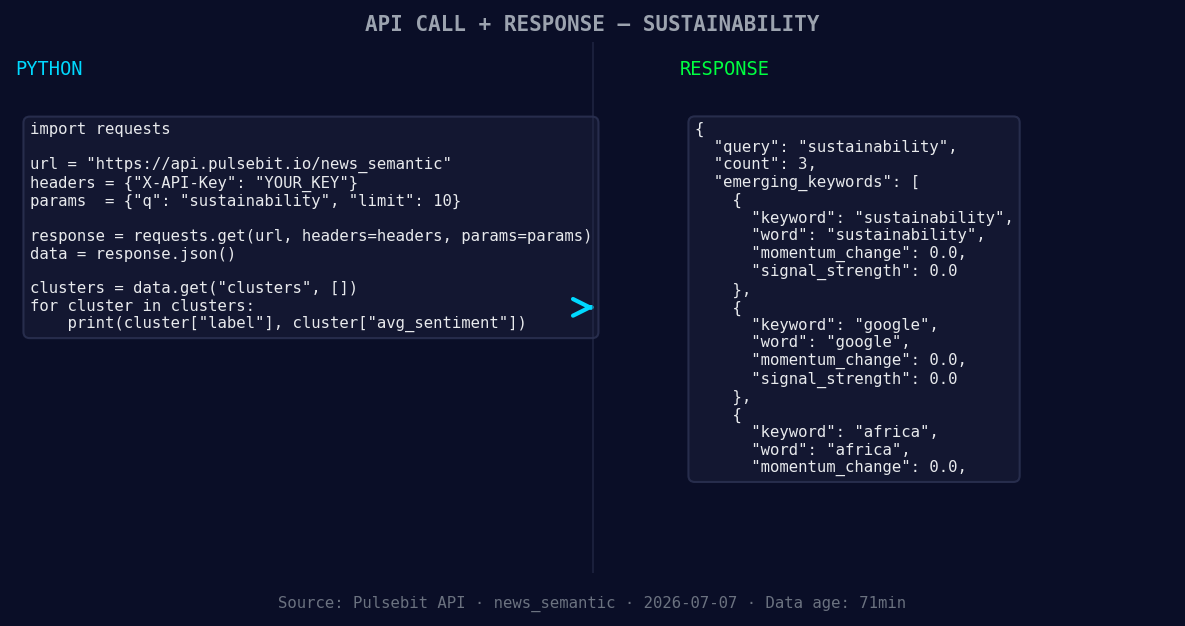
*Left: Python GET /news_semantic call for 'sustainability'. Right: returned JSON response structure (clusters: 3). Source: Pulsebit /news_semantic.*
# Make the API call to get articles related to sustainability
response = requests.get("https://api.pulsebit.io/articles", params=params)
data = response.json()
# Print the response to see the articles
print(data)
Next, we need to evaluate the narrative framing of the articles found. We can run the cluster reason string through our sentiment endpoint to score how the conversation is being framed. This step is crucial as it will give us a deeper understanding of the nuances behind the momentum spike.
# Define the cluster reason string
cluster_reason = "Clustered by shared themes: sustainability, recommits, data, centre, eudca."

# Make the API call to analyze the sentiment of the narrative
sentiment_response = requests.post("https://api.pulsebit.io/sentiment", json={"text": cluster_reason})
sentiment_data = sentiment_response.json()

# Print the sentiment analysis results
print(sentiment_data)
With this setup, we can derive actionable insights from the evolving narrative around sustainability. Here are three builds you could implement based on this pattern:
Geo-Focused Alerting: Set a signal threshold for sustainability-related spikes over +0.750. Use the geographic origin filter to ensure you're capturing only English language articles. This will help you stay ahead of the conversation in regions where sustainability is prioritized.
Meta-Sentiment Dashboard: Create a dashboard that visualizes the sentiment scores of narratives around emerging themes. Use the meta-sentiment loop we built earlier to track how different themes, such as sustainability, Google, and Africa, are performing over time. This could help in understanding regional trends and responses.
Anomaly Detection System: Build an automated system that flags anomalies like the recent +0.800 momentum spike. Set it to alert you when similar patterns emerge, especially if they relate to forming themes like sustainability and its connections to larger entities or events.
By implementing these specific patterns, you can ensure your pipeline remains current and effective in capturing emerging trends in sentiment.
If you're ready to get started, check out our documentation to copy-paste this code and run it in under 10 minutes. Let’s make sure we’re not left behind in the evolving conversation around sustainability!


Top comments (0)