

Your Pipeline Is 17.2h Behind: Catching Defence Sentiment Leads with Pulsebit
We recently discovered a notable anomaly in our sentiment data: a 24-hour momentum spike of +0.790 surrounding the topic of defence. This spike is particularly significant given its leading language, which is English press at 17.2 hours ahead, with no lag compared to the Netherlands. The cluster story titled "Canada-India defence collaboration for a secure future" sheds light on why this spike is happening. With only one article contributing to this narrative, we see an opportunity to dive deeper into the underlying sentiment and its implications.
Your model missed this by 17.2 hours. If you’re working with pipelines that don’t account for multilingual origins or dominant entities, you may be blind to crucial early signals. In this case, the English language content is leading the charge, while other languages may lag behind. This is a critical gap in your pipeline; you risk missing out on timely insights that could inform your strategies and decisions.

English coverage led by 17.2 hours. Nl at T+17.2h. Confidence scores: English 0.95, Spanish 0.95, French 0.95 Source: Pulsebit /sentiment_by_lang.
To exploit this anomaly, we can implement a few lines of Python code that leverage our API. First, let’s filter for the geographic origin by querying the relevant articles in English.

Geographic detection output for defence. Hong Kong leads with 9 articles and sentiment +0.13. Source: Pulsebit /news_recent geographic fields.
import requests
# Set parameters for the API call
params = {
"topic": "defence",
"score": -0.133,
"confidence": 0.95,
"momentum": +0.790,
"lang": "en" # Geographic origin filter
}
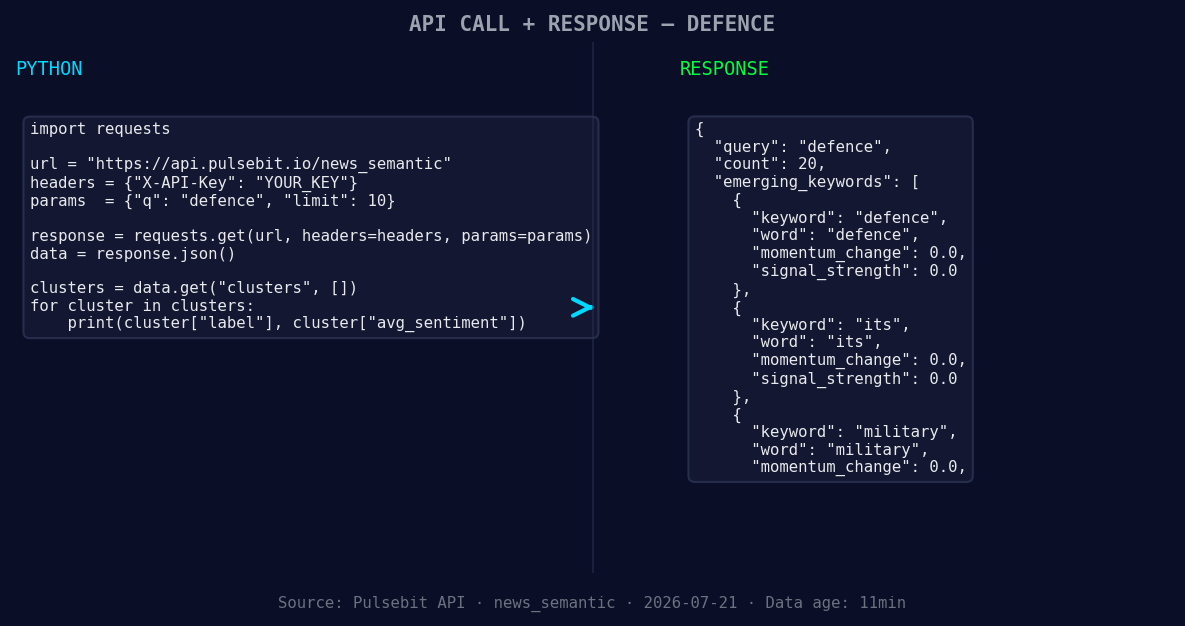
*Left: Python GET /news_semantic call for 'defence'. Right: returned JSON response structure (clusters: 3). Source: Pulsebit /news_semantic.*
# Make the API call
response = requests.get("https://api.pulsebit.com/articles", params=params)
articles = response.json()
Next, we need to assess the meta-sentiment of the clustered narrative itself. This is crucial because it allows us to evaluate how the framing of the article contributes to this spike.
# Define the cluster reason string
cluster_reason = "Clustered by shared themes: defence, canada-india, collaboration, secure, future"

# Make the sentiment scoring API call
sentiment_response = requests.post("https://api.pulsebit.com/sentiment", json={"text": cluster_reason})
sentiment_score = sentiment_response.json()
Now that we have the sentiment score for the narrative, we can continue to build on this insight. Here are three specific things we can create based on the patterns emerging from this spike:
Geographic Origin Filter: Create a real-time alert system that monitors articles in English related to "defence" whenever the momentum exceeds +0.500. This can serve as an early warning system for significant geopolitical developments.
Meta-Sentiment Loop: Develop a dashboard that visualizes the sentiment score of cluster narratives. Use the meta-sentiment loop to track how the framing of stories correlates with spikes in momentum, specifically for topics like "Canada-India defence collaboration". This can help identify emerging trends in narrative framing.
Theme Monitoring: Set up a periodic check (every hour) that flags articles with forming themes—specifically those related to "defence", "its", and "military". If their momentum is flat (e.g., +0.00) while mainstream topics like "defence", "canada-india", and "collaboration" are spiking, it could indicate that the narrative is shifting.
By leveraging our API, you can start implementing these insights right away. Visit pulsebit.lojenterprise.com/docs for our documentation. With just a few copy-paste actions, you can run this in under 10 minutes and potentially catch valuable insights that your pipeline might otherwise miss.


Top comments (0)