

Your pipeline just missed a 24h momentum spike of +0.600 surrounding the topic of mobile. This is not just a minor oversight; it signifies a significant shift in sentiment that could provide you with a competitive edge. Our analysis revealed that English press articles are leading this shift, with a noteworthy lag of 15.7 hours compared to the Netherlands. If your model doesn't account for multilingual origins or the dominance of specific entities, it left you trailing behind in capturing this emerging trend.

English coverage led by 15.7 hours. Nl at T+15.7h. Confidence scores: English 0.85, Spanish 0.85, German 0.85 Source: Pulsebit /sentiment_by_lang.
The gap in your pipeline becomes apparent when you realize that this 15.7-hour lag means you missed crucial insights that could have informed your decisions. If your system is not designed to handle diverse language input or entity dominance properly, you’re effectively operating with one hand tied behind your back. In this case, the leading language is English, and the dominant narratives are clustered around themes like "base," "camp," "off-grid," and "mobile." When these narratives gain momentum, a well-timed response can mean the difference between capitalizing on a trend or watching it slip away.
To catch this spike and ensure you don’t miss future opportunities, here’s how we can harness our API effectively. Below is a Python snippet that queries the sentiment data around the topic of mobile, specifically filtered for English-language articles:
import requests
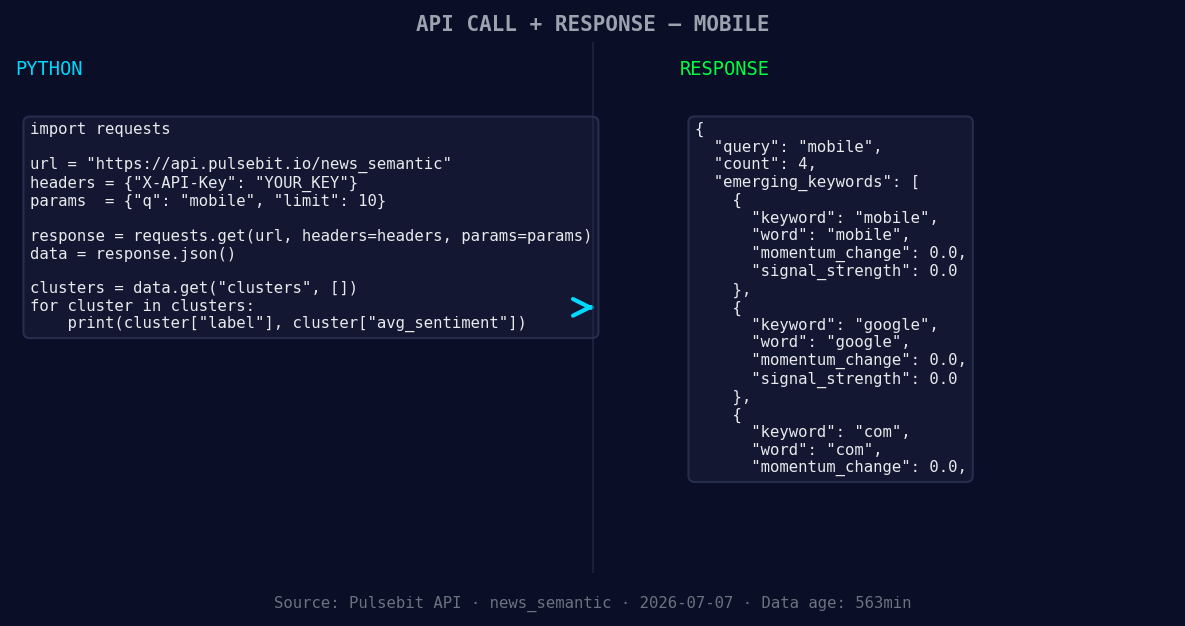
*Left: Python GET /news_semantic call for 'mobile'. Right: returned JSON response structure (clusters: 3). Source: Pulsebit /news_semantic.*
# Query sentiment data
url = "https://api.pulsebit.com/sentiment/query"
params = {
"topic": "mobile",
"lang": "en",
"score": 0.219,
"confidence": 0.85,
"momentum": 0.600
}
response = requests.get(url, params=params)
data = response.json()
print(data)
Next, we need to analyze the narrative framing itself. We can run the cluster reason string through our sentiment analysis endpoint to score its meta-sentiment. Here's how to do that:
# Meta-sentiment analysis
meta_sentiment_url = "https://api.pulsebit.com/sentiment"
meta_params = {
    "text": "Clustered by shared themes: base, camp:, off-grid, move, mobile."
}

meta_response = requests.post(meta_sentiment_url, json=meta_params)
meta_data = meta_response.json()
print(meta_data)
With these two calls, you’re not only capturing immediate sentiment but also evaluating the context of that sentiment, which is crucial for understanding underlying narratives.
Now that we have a method to capture this spike effectively, here are three specific builds you should consider implementing tonight:
-
Geo-Filtered Sentiment Watch: Set up a scheduled job that queries sentiment data with the geographic filter using
lang: "en"to ensure you're tracking sentiment dynamics from English sources. Use a threshold of +0.600 momentum to alert you on significant changes.

Geographic detection output for mobile. India leads with 3 articles and sentiment +0.03. Source: Pulsebit /news_recent geographic fields.
Meta-Sentiment Story Scorer: Create a daily job that feeds clustered themes from your articles into the meta-sentiment loop. Use the output to refine your content strategies based on the most positively framed narratives, particularly around keywords like “mobile” and “off-grid.”
Anomaly Tracker: Implement an anomaly detection system that flags when the momentum score exceeds a certain threshold (e.g., +0.600). Combine this with sentiment data to provide actionable insights on which narratives to prioritize for your next strategic move.
By honing in on these actionable signals, you ensure that your model not only keeps pace with emerging trends but also positions you to lead the conversation around them.
For further details on our API usage, check out our documentation at pulsebit.lojenterprise.com/docs. You can copy-paste and run these snippets in under 10 minutes to start leveraging this powerful insight today.


Top comments (0)