

Your Pipeline Is 24.5h Behind: Catching Education Sentiment Leads with Pulsebit
We recently observed a striking 24h momentum spike of +0.345 in the education sector. This anomaly was led by a notable surge in Spanish press coverage, specifically around the Kerala Chief Minister's announcement on modernizing legal education. With such a significant spike, it’s clear that the topic is gaining traction, but it also highlights a critical gap in our data pipelines when it comes to multilingual narratives.

Spanish coverage led by 24.5 hours. Et at T+24.5h. Confidence scores: Spanish 0.85, English 0.85, No 0.85 Source: Pulsebit /sentiment_by_lang.
The Problem
Your model missed this by 24.5 hours. If you’re not factoring in multilingual sources or the dominance of specific entities, you’re likely lagging behind key developments. The leading language in this case is Spanish, and the dominant narrative revolves around education in Kerala. If your pipeline isn’t set up to catch this early, you might find yourself reacting to sentiment after it has already peaked.
The Code
To catch this momentum spike effectively, we can utilize our API to filter the relevant data. Here’s how you can do it in Python:
import requests
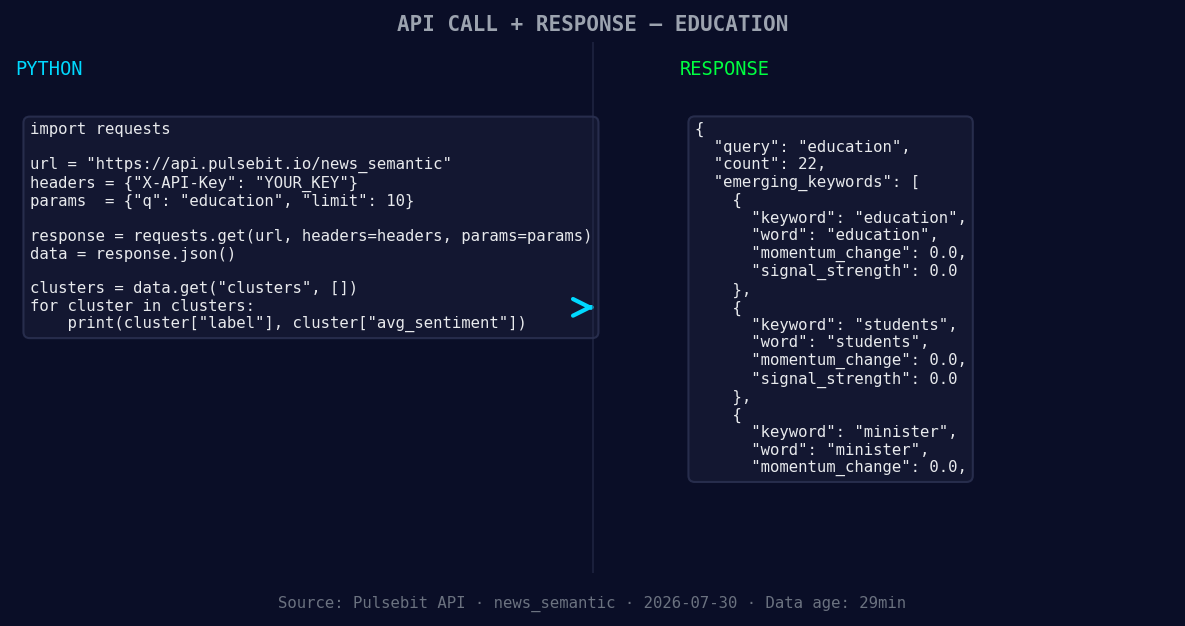
*Left: Python GET /news_semantic call for 'education'. Right: returned JSON response structure (clusters: 3). Source: Pulsebit /news_semantic.*
# Step 1: Geographic origin filter
response = requests.get("https://api.pulsebit.lojenterprise.com/sentiment", params={
"topic": "education",
"lang": "sp", # Filtering for Spanish language
"score": -0.183,
"confidence": 0.85,
"momentum": +0.345
})
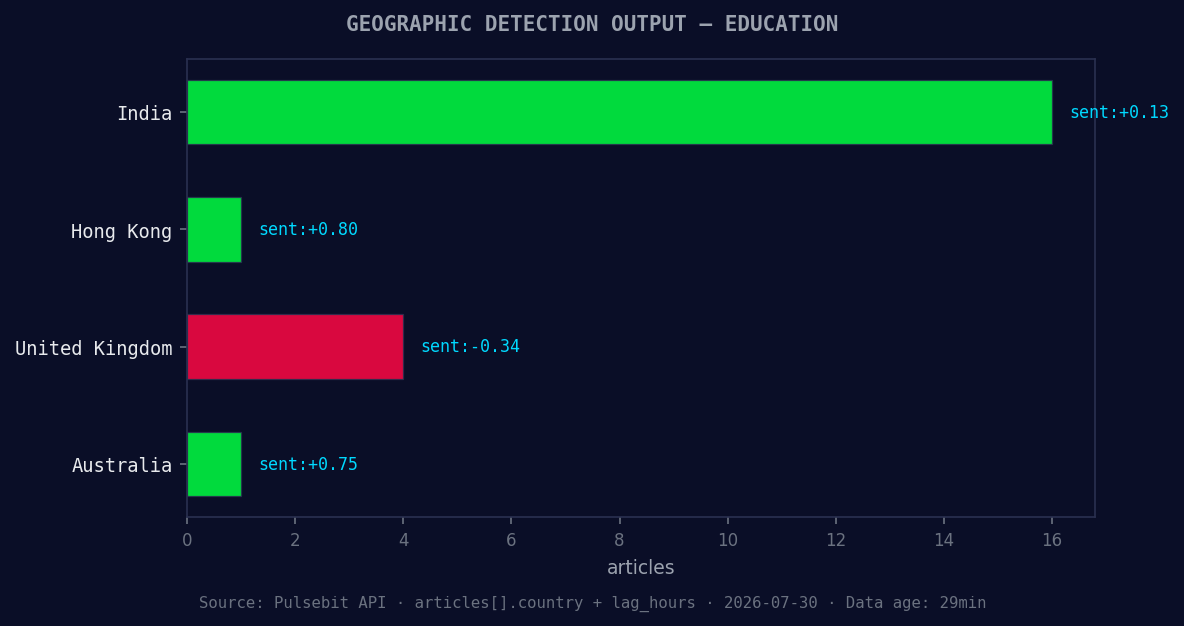
*Geographic detection output for education. India leads with 16 articles and sentiment +0.13. Source: Pulsebit /news_recent geographic fields.*
data = response.json()
print(data)
Next, we need to assess the narrative framing using the meta-sentiment moment. We’ll take the cluster reason string and run it through our sentiment endpoint:
# Step 2: Meta-sentiment moment
meta_response = requests.post("https://api.pulsebit.lojenterprise.com/sentiment", json={
    "text": "Clustered by shared themes: legal, education, kerala, chief, minister."
})

meta_data = meta_response.json()
print(meta_data)
By coding these two parts together, we can ensure we’re capturing not just the spike itself, but also the context that surrounds it.
Three Builds Tonight
Here are three specific builds you can implement based on this pattern:
Education Trend Tracker: Set a signal threshold of +0.3 to trigger alerts for notable spikes in the education sector. Use the geo filter to ensure coverage includes Spanish-speaking regions.
Student Sentiment Analyzer: Create a module that monitors sentiment around the term "students" within the context of education. Use a momentum threshold of +0.2, ensuring you include the meta-sentiment feedback loop to enhance framing accuracy.
Ministerial Announcement Watch: Track sentiment around announcements made by ministers, especially in the education sector. Set a threshold of +0.1 and incorporate the cluster reasoning to focus on narratives tied to governmental decisions.
Get Started
Ready to dive in? Check out our documentation at pulsebit.lojenterprise.com/docs. You can copy-paste the code snippets above and run them in under 10 minutes to start catching these momentum shifts.


Top comments (0)