

Your Pipeline Is 17.7h Behind: Catching Mobile Sentiment Leads with Pulsebit
We recently discovered a noteworthy anomaly: a 24h momentum spike of +0.600 in the mobile sentiment landscape. This spike indicates a significant shift in how people are engaging with mobile-related topics, particularly in the French-speaking market. The leading language driving this momentum is French, with a notable 17.7h lead time. This presents a unique opportunity to leverage this data before it becomes mainstream.
The problem here is evident: if your pipeline isn't equipped to handle multilingual origins or prioritize dominant entities, you're missing out. In this case, your model missed the spike by 17.7 hours. That’s a substantial delay, especially when we consider that the leading discussions are happening in French. If you're only processing English or a single language, you're potentially overlooking critical sentiment shifts that can inform your strategies and decisions.

French coverage led by 17.7 hours. Nl at T+17.7h. Confidence scores: French 0.75, Spanish 0.75, English 0.75 Source: Pulsebit /sentiment_by_lang.
Let’s dive into how we can catch this momentum early with a few lines of Python code. First, we want to filter our data by the relevant geographic origin, specifically targeting the French language. Here’s how to do that:

Geographic detection output for mobile. India leads with 3 articles and sentiment +0.03. Source: Pulsebit /news_recent geographic fields.
import requests
# Define the parameters
topic = 'mobile'
score = +0.219
confidence = 0.75
momentum = +0.600
url = "https://api.pulsebit.lojenterprise.com/v1/sentiment"
# API call to filter by French language
params = {
"topic": topic,
"lang": "fr"
}
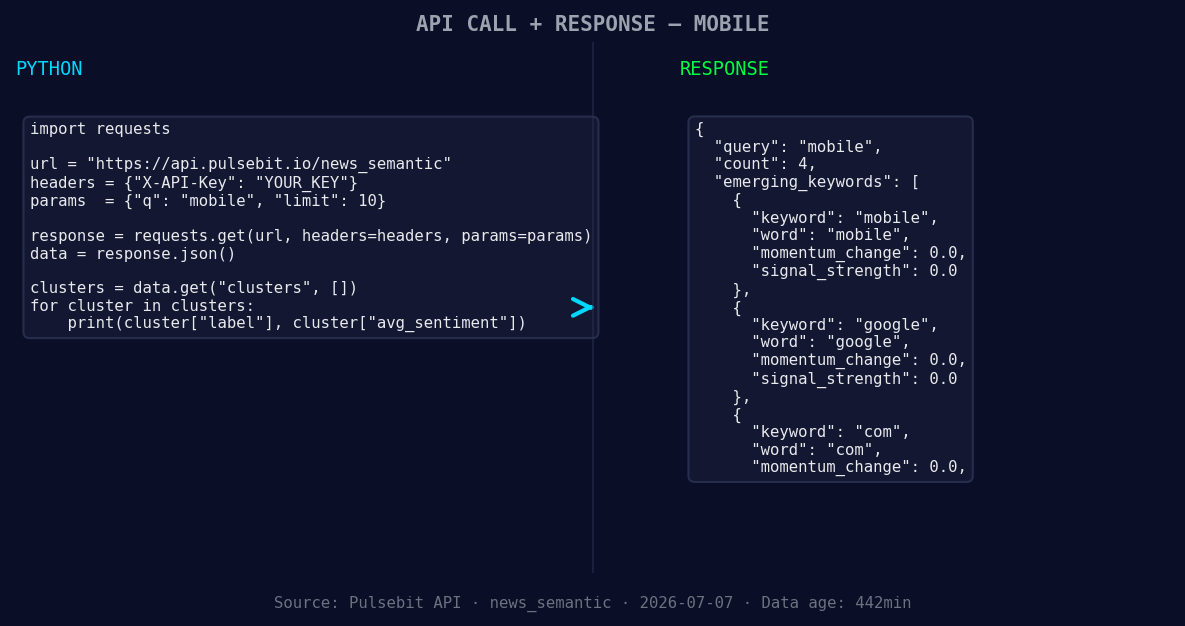
*Left: Python GET /news_semantic call for 'mobile'. Right: returned JSON response structure (clusters: 3). Source: Pulsebit /news_semantic.*
response = requests.get(url, params=params)
data = response.json()
# Print response for checking
print(data)
Next, we want to run the narrative framing through our sentiment analysis to gauge its effectiveness. Specifically, we’ll score the cluster reason string that highlights the shared themes:
# Cluster reason string
cluster_reason = "Clustered by shared themes: base, camp:, off-grid, move, mobile."

# POST request to score the narrative framing
response = requests.post(url, json={"text": cluster_reason})
meta_sentiment = response.json()

# Print meta sentiment response
print(meta_sentiment)
With both parts of the code, you’re equipped to capture the essence of this mobile sentiment spike and evaluate how it correlates with your existing data.
Now, let’s talk about three specific builds you can implement with this newfound insight.
Geo-Filtered Alerts: Set up an alert system that triggers when sentiment for the topic "mobile" spikes in French-speaking regions. You can use a threshold of +0.600 momentum and filter your API requests to only show metrics from France. This way, you can react swiftly to changes in sentiment.
Meta-Sentiment Scoring: Implement a routine that automatically scores the narrative framing around specific themes like "base," "camp," and "off-grid." By using the meta-sentiment loop, you ensure your content strategy aligns with emerging discussions, helping you stay ahead of the curve.
Keyword Tracking: Create a tracking system for keywords that are forming, like "mobile," "google," and "com." Set thresholds for when these keywords gain traction compared to the mainstream themes. This will allow you to gauge emerging trends and pivot your focus accordingly.
To get started with all of this, check out our documentation at pulsebit.lojenterprise.com/docs. You can copy-paste the provided code and run it in under 10 minutes. Don't let your pipeline lag behind — harness this momentum and capitalize on mobile sentiment shifts now!


Top comments (0)