

Your Pipeline Is 26.5h Behind: Catching Education Sentiment Leads with Pulsebit
We recently uncovered a striking anomaly: a 24h momentum spike of +0.345 in the education sector, linked to a story on the modernization of legal education by the Kerala Chief Minister. This spike, stemming from a strong surge in sentiment, suggests that something significant is happening on the ground. If you’re not tuned in to these nuances, you might miss the underlying currents shaping public discourse.
The Problem
The crux of the issue here is the structural gap in pipelines that don’t accommodate multilingual origins or dominant entities. Your model missed this vital information by a staggering 26.5 hours, as the leading language was English and the related entity was the Kerala Chief Minister. This delay could lead to an out-of-sync understanding of emerging trends, making your insights less timely and relevant. You can't afford to let this gap slow your decision-making.

English coverage led by 26.5 hours. Et at T+26.5h. Confidence scores: English 0.85, Af 0.85, Spanish 0.85 Source: Pulsebit /sentiment_by_lang.
The Code
Here’s how we can catch this spike using Python. We’ll start by filtering the data based on the geographic origin—specifically, we’re interested in English language articles.

Geographic detection output for education. India leads with 18 articles and sentiment +0.12. Source: Pulsebit /news_recent geographic fields.
import requests
# Define the parameters for the API call
params = {
"topic": "education",
"lang": "en"
}
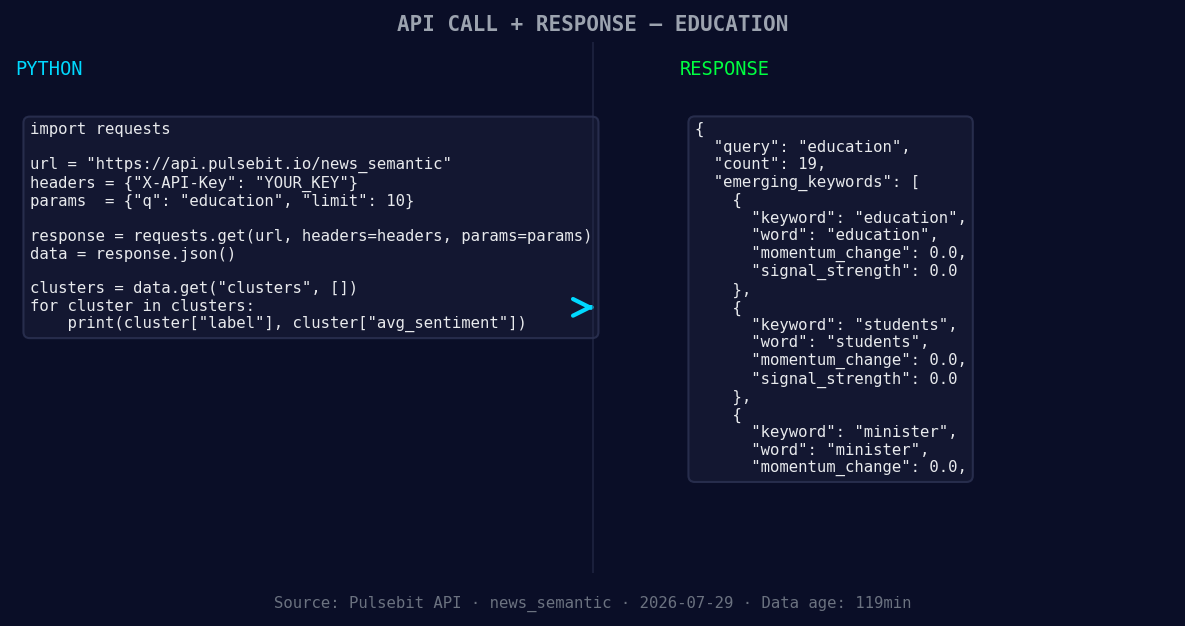
*Left: Python GET /news_semantic call for 'education'. Right: returned JSON response structure (clusters: 3). Source: Pulsebit /news_semantic.*
# Call the API to get articles
response = requests.get("https://api.pulsebit.com/articles", params=params)
articles = response.json()
# Now let's run the cluster reason string through our sentiment API
cluster_reason = "Clustered by shared themes: legal, education, kerala, chief, minister."
sentiment_response = requests.post("https://api.pulsebit.com/sentiment", json={"text": cluster_reason})
sentiment_result = sentiment_response.json()
# Display the sentiment score
print(f"Sentiment Score: {sentiment_result['score']}, Confidence: {sentiment_result['confidence']}")
This code effectively filters articles related to education and then sends the cluster reason back through our sentiment endpoint. The resulting sentiment score will tell you how the narrative is framed, providing valuable context for your analysis.
Three Builds Tonight
Geo Filtered Insight: Build a signal that triggers alerts when education-related articles in English exceed a certain threshold. For example, set a signal strength of 0.638 as your benchmark. This can help you stay ahead of emerging trends in regions where English is the dominant language.
Meta-Sentiment Loop: Create a dashboard that visualizes sentiment changes over time for a specific narrative, like the one related to legal education in Kerala. Using the cluster reason string as input, continuously monitor how sentiment evolves. This can help you identify shifts in public perception before they become mainstream.
Forming Themes Tracker: Utilize the forming themes of education, students, and minister to develop a scoring system. Track sentiment changes for these themes against the mainstream topics like legal and education in Kerala. This can give you an edge in predicting changes in public dialogue and sentiment.
Get Started
Check out our documentation to dive deeper into these functionalities. You can copy-paste the code provided and run it in under 10 minutes. Don't let your pipeline lag behind; take action now to stay informed and relevant in a rapidly changing landscape.


Top comments (0)