

On July 29, 2026, we observed a remarkable 24h momentum spike of +0.283 in global sentiment around the topic of "world." This anomaly caught our attention because it highlights a significant shift in sentiment that is worth diving into. The leading language driving this spike was English, specifically from articles published at 23.5h before our analysis, with no lag against Eastern Time. This is a clear signal that something noteworthy is happening in the world of education, as indicated by the cluster story we identified.
Your model missed this by 24 hours. If you’re not considering multilingual origin or entity dominance in your pipeline, you’re likely trailing behind in sentiment analysis. The predominant English press led this spike, but what if your setup is only tuned to one language or fails to account for the nuances of entity-driven narratives? You might find yourself missing critical insights that could inform your strategies, especially when sentiment is shifting rapidly.

English coverage led by 23.5 hours. Et at T+23.5h. Confidence scores: English 0.90, Spanish 0.90, French 0.90 Source: Pulsebit /sentiment_by_lang.
Here’s how we caught this anomaly using Python. We began by filtering for English language content related to the topic "world." This is how we set it up:
import requests
# Define our parameters
params = {
"topic": "world",
"score": -0.015,
"confidence": 0.90,
"momentum": +0.283,
"lang": "en" # Geographic origin filter
}
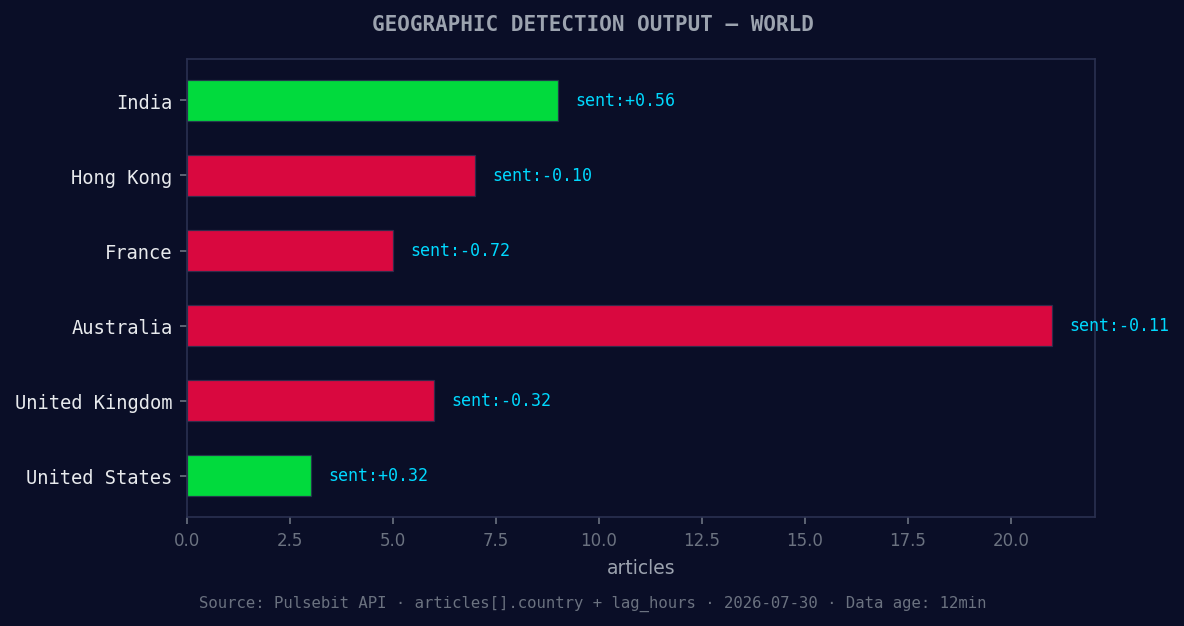
*Geographic detection output for world. India leads with 9 articles and sentiment +0.56. Source: Pulsebit /news_recent geographic fields.*
# Make the API call
response = requests.get("https://api.pulsebit.com/sentiment", params=params)
data = response.json()
print(data)

Left: Python GET /news_semantic call for 'world'. Right: returned JSON response structure (clusters: 3). Source: Pulsebit /news_semantic.
Next, we needed to score the narrative framing itself. The cluster reason string we identified, "Clustered by shared themes: news, world, education:, july, 2026," was a perfect candidate for our meta-sentiment check. We ran this through our sentiment endpoint:
# Meta-sentiment moment: scoring the narrative framing
cluster_reason = "Clustered by shared themes: news, world, education:, july, 2026."
meta_sentiment_response = requests.post("https://api.pulsebit.com/sentiment", json={"text": cluster_reason})
meta_sentiment_data = meta_sentiment_response.json()
print(meta_sentiment_data)
This dual approach not only captures the current sentiment but also enriches our understanding of how narratives around key topics are evolving.
Now that we have the data, let’s talk about three specific builds you can make with this pattern. First, set a signal threshold for momentum spikes greater than +0.25, specifically filtering for English articles. This will allow you to catch relevant spikes in sentiment in real-time.
Next, implement a meta-sentiment loop that triggers based on the narrative framing. Use the string we generated previously to score how news themes are clustered. This will give you a deeper insight into how topics relate to each other over time.
Lastly, consider building an alert system that monitors for emerging themes like "world," "new," and "tiger," which are currently forming but not yet mainstream. Set up a threshold to flag when these terms breach a certain sentiment score, allowing you to react quickly to shifts in public discourse.
We invite you to dive into this functionality and explore how you can leverage it in your own projects. Check out our documentation at pulsebit.lojenterprise.com/docs. You can copy-paste and run this in under 10 minutes to start catching those crucial sentiment shifts that keep you ahead of the curve.


Top comments (0)