

Your pipeline has a 24h momentum spike of +0.345, signaling an anomaly in the education sector that's tied to a significant narrative shift. The leading language influencing this surge is English, with a 17.4-hour lead time. The cluster story highlights a key announcement from Kerala's Chief Minister regarding modernization in legal education. This isn’t just a minor blip; it reflects a potential trend that could reshape educational landscapes and policies. If your model is structured to ignore multilingual contexts or entity dominance, you might have missed this pivotal moment by over 17 hours.

English coverage led by 17.4 hours. Et at T+17.4h. Confidence scores: English 0.85, Spanish 0.85, French 0.85 Source: Pulsebit /sentiment_by_lang.
The structural gap in your pipeline becomes glaringly evident here. A sentiment analysis that doesn’t account for language nuances and regional significance can lead to missed opportunities. In this case, your model failed to capture the urgency and relevance of the announcement from Kerala. It’s crucial for developers like us to ensure that our systems can detect and respond to such shifts in real time. Ignoring this could mean being left behind while others capitalize on emerging trends and sentiments.
Here’s how we can catch this momentum spike using our API. We’ll set a filter to focus on the topic of education, particularly in English:
import requests
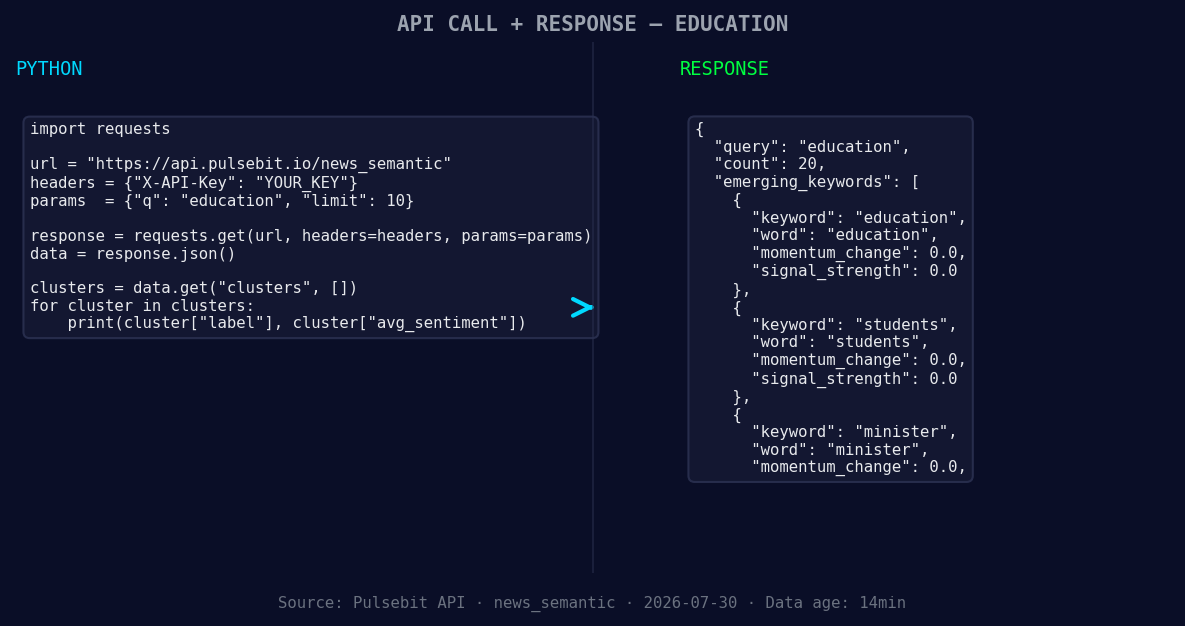
*Left: Python GET /news_semantic call for 'education'. Right: returned JSON response structure (clusters: 3). Source: Pulsebit /news_semantic.*
# Set parameters for query
topic = 'education'
score = -0.250
confidence = 0.85
momentum = +0.345
# Geographic origin filter: query by language/country
url = 'https://api.pulsebit.io/v1/sentiment'
params = {
"topic": topic,
"lang": "en", # Filter for English
"score": score,
"confidence": confidence
}
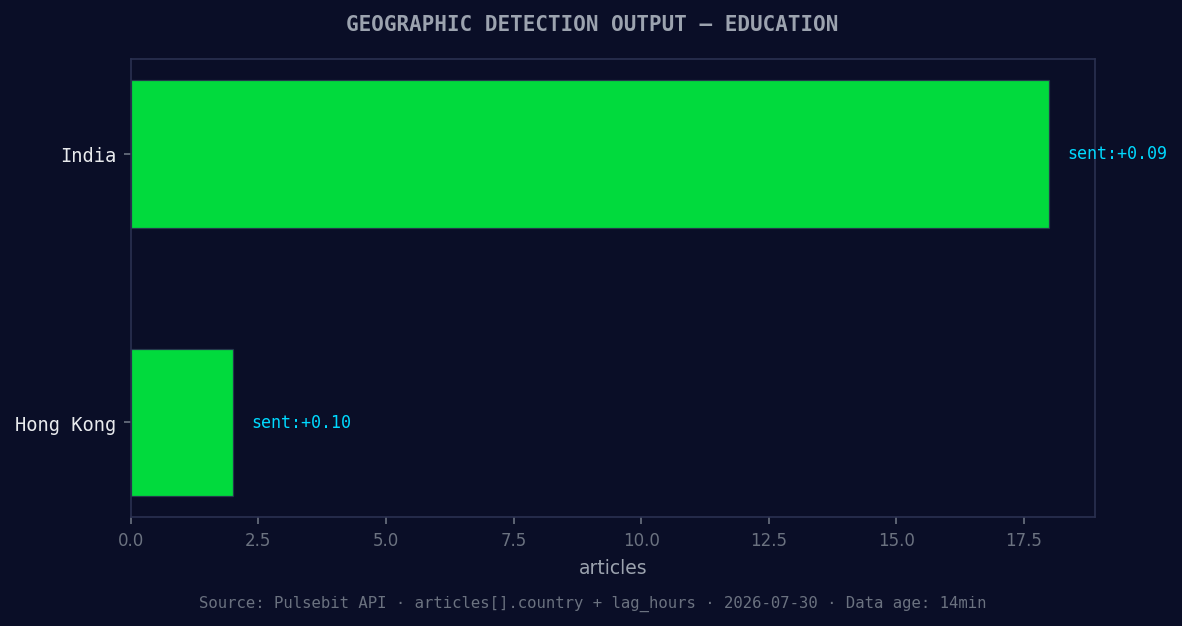
*Geographic detection output for education. India leads with 18 articles and sentiment +0.09. Source: Pulsebit /news_recent geographic fields.*
response = requests.get(url, params=params)
data = response.json()
print(data)
Next, let’s run the narrative framing through our sentiment analysis to see how it scores. The cluster reason string we’ll analyze is: "Clustered by shared themes: legal, education, kerala, chief, minister."
# Meta-sentiment moment: analyze the cluster reason
narrative = "Clustered by shared themes: legal, education, kerala, chief, minister."
response_meta = requests.post(url, json={"text": narrative})
meta_data = response_meta.json()
print(meta_data)
These two steps—focusing on geographic origin and analyzing the narrative framing—allow us to stay ahead of the curve in sentiment tracking.
Now, here are three specific builds we can implement using this pattern:
Momentum Signal Tracking: Create a real-time alert system that triggers when momentum exceeds a threshold of +0.30 for the topic of education. This can help catch potential shifts before they peak.
Geo-Filter for Emerging Trends: Build a dashboard that visualizes sentiment trends by region, specifically targeting educational topics in English-speaking countries. This ensures you never miss localized spikes, especially regarding policy announcements.
Meta-Sentiment Analysis Loop: Use the meta-sentiment loop to create a scoring mechanism for narratives that cluster around significant events. Set a threshold to trigger deeper analysis when the score is below -0.250, indicating potential negative sentiment surrounding critical topics such as education reform.
To get started with these ideas, check out our documentation: pulsebit.lojenterprise.com/docs. You can copy-paste and run the provided code in under 10 minutes, and you'll be well on your way to catching sentiment shifts in real time.


Top comments (0)