

Your Pipeline Is 13.2h Behind: Catching World Sentiment Leads with Pulsebit
We discovered a notable anomaly in sentiment analysis: a 24h momentum spike of -0.800. This signals a shift in how Americans perceive global leadership in AI, with the leading language being English, and the narrative dominated by thoughts around China. The cluster story, "More Americans think China is world leader in AI, new survey reveals," encapsulates a critical moment in our global sentiment pipeline.
When your pipeline doesn't account for multilingual origins or dominant entities like China, you risk falling behind. In this case, your model missed this by a staggering 13.2 hours. The leading language is English, but the sentiment is shaped by multiple influences. If you're not tracking these nuances, you may miss critical shifts in public perception that can affect your strategies and decisions.

English coverage led by 13.2 hours. Tl at T+13.2h. Confidence scores: English 0.90, Spanish 0.90, French 0.90 Source: Pulsebit /sentiment_by_lang.
To track this anomaly effectively, let's look at how we can leverage our API for a deep dive into the data. Here's how you can catch it with Python:
import requests
# Define parameters for the API call
topic = 'world'
score = -0.043
confidence = 0.90
momentum = -0.800
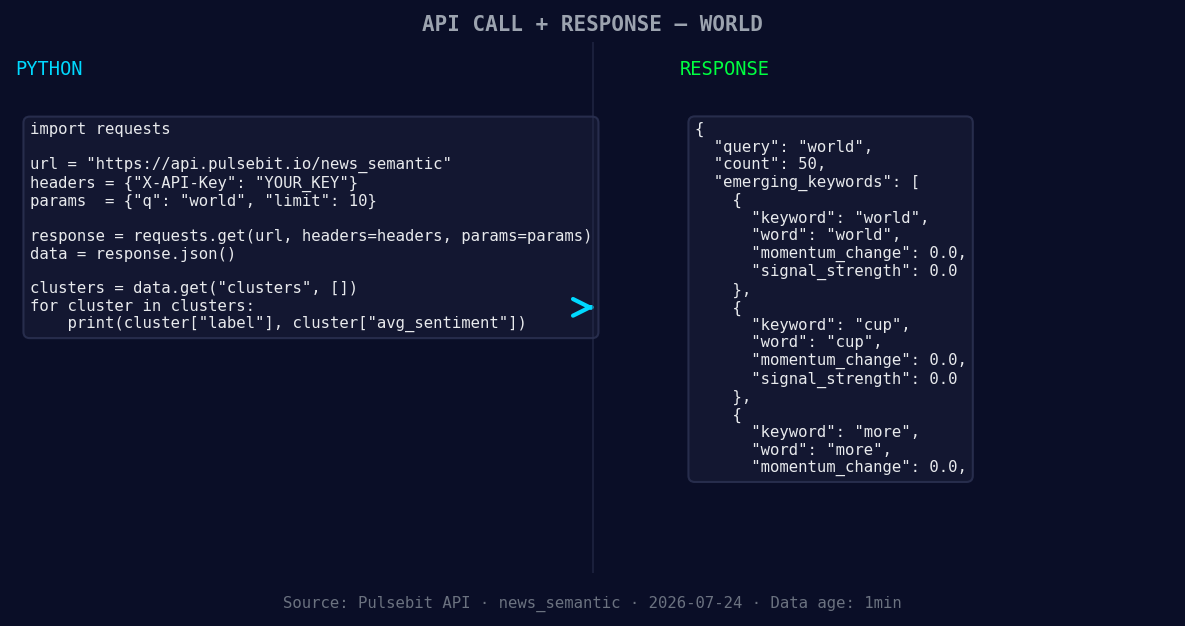
*Left: Python GET /news_semantic call for 'world'. Right: returned JSON response structure (clusters: 3). Source: Pulsebit /news_semantic.*
# Geographic origin filter: querying by language
response = requests.get("https://api.pulsebit.com/v1/sentiment", params={
"topic": topic,
"lang": "en"
})
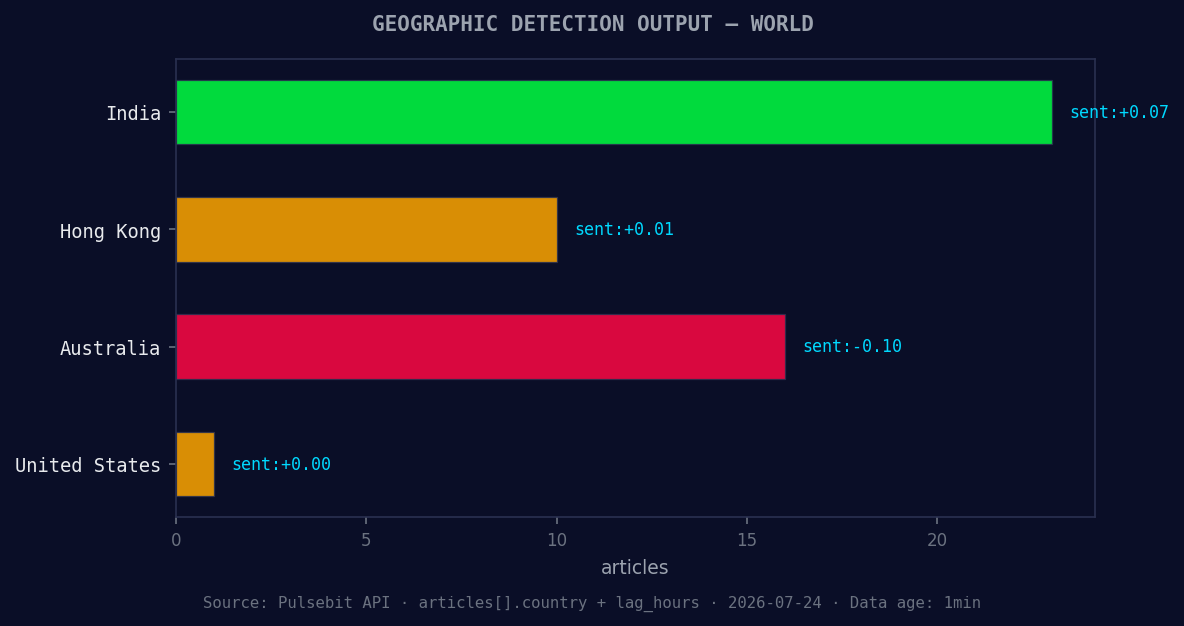
*Geographic detection output for world. India leads with 23 articles and sentiment +0.07. Source: Pulsebit /news_recent geographic fields.*
# Assuming we get JSON response
data = response.json()
print(data)
# Now, let's run the cluster reason through the sentiment score
cluster_reason = "Clustered by shared themes: more, americans, china, survey, leader."
meta_sentiment_response = requests.post("https://api.pulsebit.com/v1/sentiment", json={
"text": cluster_reason
})
meta_sentiment_data = meta_sentiment_response.json()
print(meta_sentiment_data)
This code snippet first queries our API for sentiment regarding the topic "world," specifically filtering for English-language sources. Next, it sends the clustered narrative back through the sentiment scoring endpoint to gauge how this framing influences the overall sentiment.
Now that we have the basics covered, let’s discuss three specific builds you can implement using this pattern:
Geographic Origin Filter: Build an alert system that triggers when sentiment on "world" in English dips below a certain threshold, e.g., score < -0.05. This will help you catch shifts in sentiment related to global leadership debates.
Meta-Sentiment Loop: Create a dashboard that visualizes the sentiment of clustered narratives. If the sentiment score for "Clustered by shared themes: more, americans, china, survey, leader." falls below a threshold (e.g., score < -0.03), flag this for further analysis to understand the implications on international relations.
Comparative Sentiment Analysis: Develop an endpoint that compares current sentiment trends with historical data, specifically focusing on the keywords "world" and "cup." This can help you gauge whether current sentiments are anomalies or part of a larger trend, especially when mainstream narratives are shaped by phrases like "more, americans, china."
With these builds, you can ensure that your data pipeline is not only catching current trends but also adapting to the dynamics of global sentiment.
To get started, check out our documentation at pulsebit.lojenterprise.com/docs. You can copy-paste and run this in under 10 minutes to start catching those sentiment leads!


Top comments (0)