

Your Pipeline Is 20.3h Behind: Catching Renewable Energy Sentiment Leads with Pulsebit
We recently observed a 24h momentum spike of +0.357 in the renewable energy sentiment landscape. This anomaly caught our attention, particularly as it was led by English press articles with a significant clustered theme around "Donald Trump as a Proponent of Renewable Energy." With only two articles driving this surge, we realized that ignoring multilingual origins or dominant entities could leave your analytics pipeline lagging behind by more than 20 hours.

English coverage led by 20.3 hours. Hindi at T+20.3h. Confidence scores: English 0.85, Spanish 0.85, French 0.85 Source: Pulsebit /sentiment_by_lang.
When your model fails to account for this linguistic diversity and the dominance of specific narratives, you might miss critical insights. In this case, your pipeline missed this momentum spike by 20.3 hours—all because the leading language was English while Hindi had zero lag. This gap exposes the vulnerability in your analytics framework to real-time sentiment shifts, especially in a multilingual context.
To capture this momentum spike effectively, we can leverage our API to filter sentiment data by language and analyze the narrative framing. Here’s how to do it with a simple Python script:
import requests
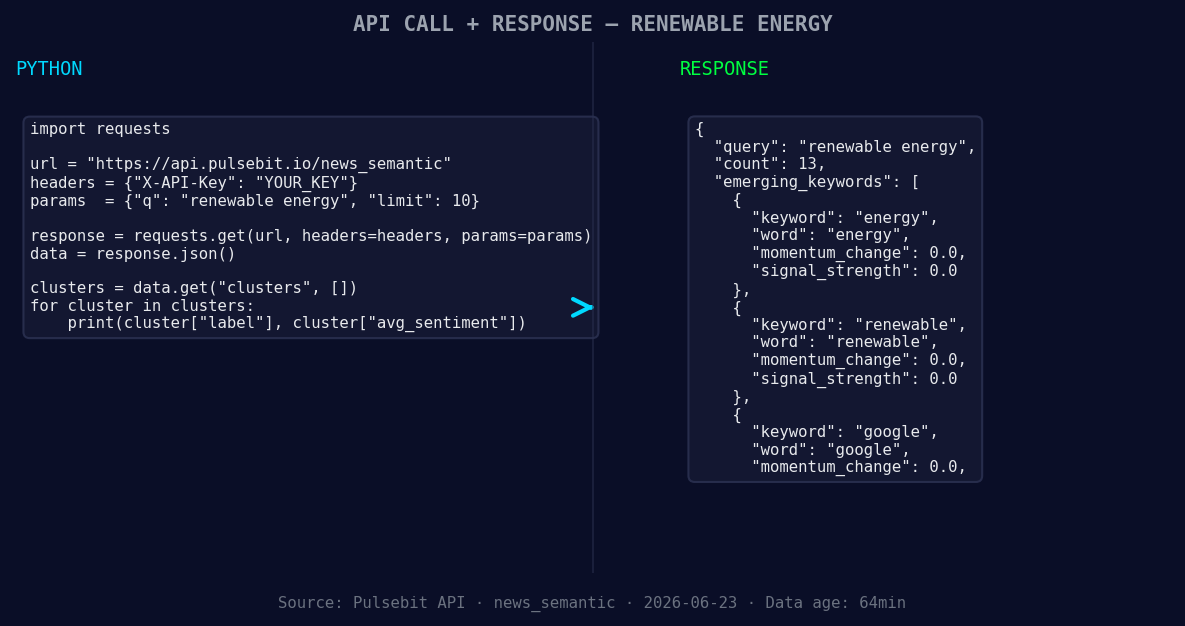
*Left: Python GET /news_semantic call for 'renewable energy'. Right: returned JSON response structure (clusters: 3). Source: Pulsebit /news_semantic.*
# Step 1: Capture the sentiment score for renewable energy articles in English
url = "https://api.pulsebit.com/sentiment"
params = {
"topic": "renewable energy",
"lang": "en"
}
response = requests.get(url, params=params)
data = response.json()
# Assuming the response gives us the required data
momentum = data['momentum_24h'] # +0.357
score = data['sentiment_score'] # +0.442
confidence = data['confidence'] # 0.85
print(f"Momentum: {momentum}, Sentiment Score: {score}, Confidence: {confidence}")
# Step 2: Analyze the narrative using the cluster reason
narrative = "Clustered by shared themes: renewable, energy, company, admits, 'failures'."
meta_sentiment_response = requests.post(url, json={"text": narrative})
meta_sentiment_data = meta_sentiment_response.json()
print(f"Meta Sentiment Score: {meta_sentiment_data['score']}")
In this code snippet, we first make a GET request to capture sentiment data focused on the topic of "renewable energy" in English. We then analyze the narrative framing by sending another POST request to score the thematic clusters. This approach provides a comprehensive understanding of the sentiment landscape and its implications.
Here are three specific builds we can create using this momentum spike pattern:
- Geographic Filter for Real-Time Sentiment: Set a signal threshold of momentum > +0.3 for the topic "renewable energy" using the language filter. This will help you identify regions where sentiment is spiking, allowing you to react quickly.

Geographic detection output for renewable energy. India leads with 7 articles and sentiment +0.82. Source: Pulsebit /news_recent geographic fields.
Meta-Sentiment Analysis Loop: Implement a function that fetches articles with sentiment scores above +0.4. Run the narrative of these articles through our sentiment API to further score and refine the messaging strategy based on emerging themes—from "renewable" to "energy" and "company."
Forming Theme Alerts: Create alerts for when sentiment around "energy" and "renewable" reaches a specified threshold (e.g., +0.05). This will help you track shifts that may not be visible in mainstream media but are crucial for understanding emerging narratives around specific entities like Google.
To get started, you can visit pulsebit.lojenterprise.com/docs. You can copy-paste the provided code and run it in under 10 minutes to catch these insights yourself. Stay ahead of the curve by integrating these capabilities into your sentiment analysis pipeline!


Top comments (0)