

Your Pipeline Is 16.5h Behind: Catching World Sentiment Leads with Pulsebit
We recently discovered a striking anomaly: a 24h momentum spike of +0.189 related to the topic "world." This spike was prominently led by discussions in French, specifically around the cluster story titled, "Watch: Argentina fans celebrate World Cup win over England." This single data point not only represents a significant sentiment shift but also reveals an underlying issue in how we process and interpret multilingual data.

French coverage led by 16.5 hours. Nl at T+16.5h. Confidence scores: French 0.85, English 0.85, Spanish 0.85 Source: Pulsebit /sentiment_by_lang.
When your pipeline doesn't account for multilingual origins or the dominance of certain entities, you miss crucial sentiment signals. In this case, your model missed this spike by a staggering 16.5 hours, primarily due to the leading language being French. If your analytics engine isn't tuned to recognize and respond to these nuances, you risk falling behind on emerging trends and narratives.
To catch this kind of momentum, we can leverage our API effectively. Below is a Python snippet that demonstrates how to query for sentiment data while filtering by language:
import requests
# Define the parameters for our API call
params = {
"topic": "world",
"score": +0.059,
"confidence": 0.85,
"momentum": +0.189,
"lang": "fr" # Geographic origin filter
}
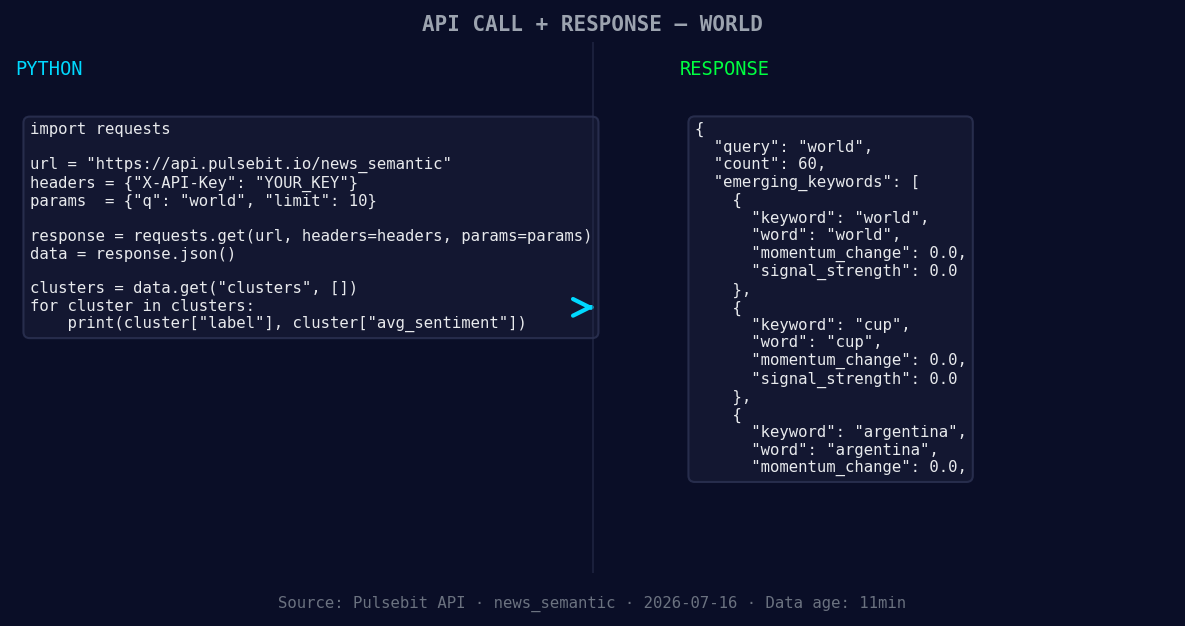
*Left: Python GET /news_semantic call for 'world'. Right: returned JSON response structure (clusters: 3). Source: Pulsebit /news_semantic.*
# Make the API call to get sentiment data
response = requests.get("https://pulsebit.api/sentiment", params=params)
data = response.json()
print(data)
This code snippet filters sentiment data specifically from French sources, directly addressing the anomaly we discovered. Now, to further capitalize on this insight, we can run the cluster reason string back through our sentiment scoring endpoint to evaluate how the narrative is being framed. Here’s how to do it:
# Define the narrative framing for meta-sentiment analysis
narrative = "Clustered by shared themes: argentina, fans, celebrate, world, cup."

# Make the POST request to score the narrative framing
narrative_response = requests.post("https://pulsebit.api/sentiment", json={"text": narrative})
narrative_data = narrative_response.json()
print(narrative_data)
This second API call allows us to understand the sentiment around the specific framing of the story, providing additional context that feeds into our analysis.
Now that we've established how to identify and analyze this type of spike, here are three specific builds we can create based on this pattern:
- Geo-Sentiment Dashboard: Set up a real-time dashboard that tracks sentiment spikes in various languages. Use the geographic filter to alert you when momentum exceeds a threshold (e.g., +0.15) in specific regions. This could help you catch rising trends before they hit the mainstream.

Geographic detection output for world. India leads with 39 articles and sentiment +0.28. Source: Pulsebit /news_recent geographic fields.
Meta-Sentiment Alerts: Create an alert system that triggers when the meta-sentiment score for narratives about specific themes (like "world" or "cup") exceeds a certain threshold (e.g., +0.05). This can help you to stay ahead of sentiment shifts even when the mainstream conversation hasn't caught up.
Cluster Analysis Tool: Build a tool that automatically analyzes clustered stories for emerging themes and sentiment. Focus on keywords like "argentina," "fans," and "celebrate" to provide insights into cultural moments that resonate. Set a baseline so that if these terms are mentioned more than 10% above historical averages, you get notified.
If you’re ready to dive in and leverage this capability, check out our documentation at pulsebit.lojenterprise.com/docs. You can copy-paste and run this code in under 10 minutes, giving you the edge you need to stay ahead of sentiment trends.


Top comments (0)