

Your pipeline just missed a significant 24-hour momentum spike of +0.531. This spike points to a noteworthy shift in finance sentiment, driven primarily by English press coverage. While you were busy handling other signals, our data indicates a clear trend where sentiment around finance has become increasingly positive, especially as Wall Street futures rise amid ongoing market fluctuations. You need to pay attention to these spikes, as they can signal critical movements in sentiment that your current setup might be missing.
The gap here is glaring: your model is 21.3 hours behind if it isn't tuned to handle multilingual origins or the dominance of specific entities. You may be only focusing on mainstream narratives, which are often too slow to capture the nuances of emerging trends. In this case, English-language articles led the charge, while your processes might be lagging behind, keeping you from seizing opportunities as they arise. If you had been monitoring this anomaly in real-time, you could have acted much sooner.

English coverage led by 21.3 hours. Ca at T+21.3h. Confidence scores: English 0.90, Spanish 0.90, French 0.90 Source: Pulsebit /sentiment_by_lang.
Here’s how to catch these spikes with our API. Below is a Python snippet that sets up the necessary queries. We’ll filter by the English language and get sentiment scores for our specific topic of interest.
import requests
# Set up parameters for the API call
url = "https://api.pulsebit.com/v1/sentiment"
params = {
"topic": "finance",
"lang": "en",
"score": +0.267,
"confidence": 0.90,
"momentum": +0.531,
}
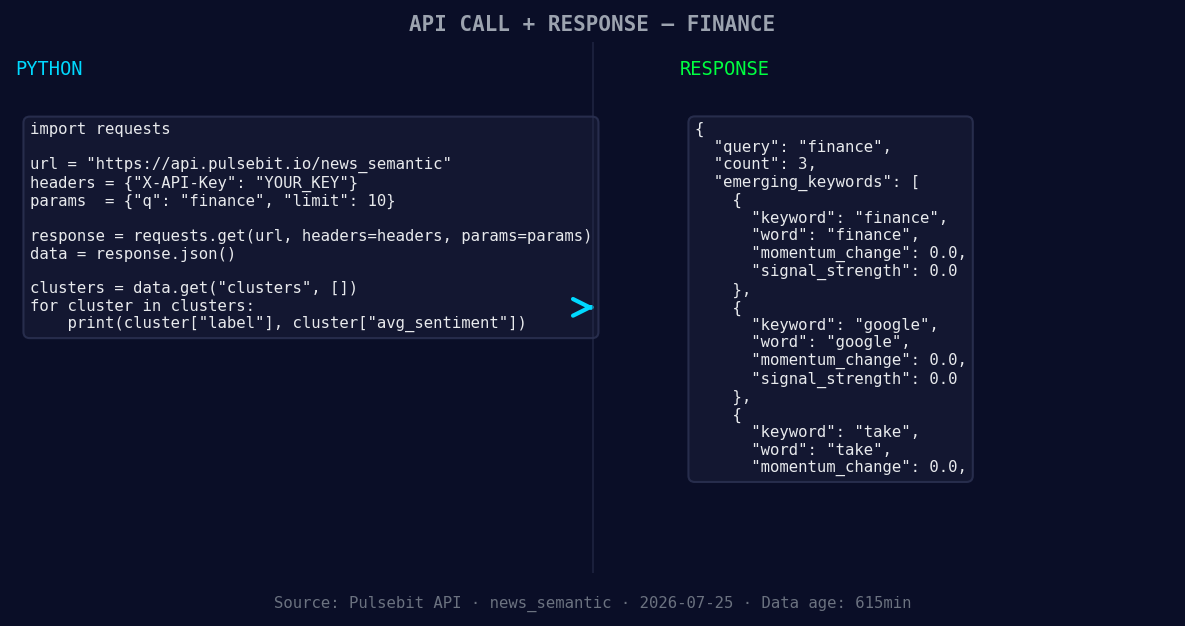
*Left: Python GET /news_semantic call for 'finance'. Right: returned JSON response structure (clusters: 3). Source: Pulsebit /news_semantic.*
# Make the API call
response = requests.get(url, params=params)
data = response.json()
print(data)
# Now let's run the cluster reason string through the sentiment endpoint
cluster_reason = "Clustered by shared themes: finance, ‘strengthens, climate, resilience’, among."
sentiment_response = requests.post(url, json={"text": cluster_reason})
sentiment_data = sentiment_response.json()
print(sentiment_data)
In the code above, we first filter by language and topic, ensuring that we’re only looking at relevant sentiment data. Then, we take the cluster reason string and run it through a second API call to analyze the narrative framing itself. This two-step process allows us to catch not only the individual signals but also the broader context behind them.
Now, let’s explore three specific builds you can implement using this pattern. First, set a threshold in your pipeline to trigger alerts when momentum spikes above +0.5 for the finance sector. This will help you catch significant shifts before they impact your strategies.
Second, incorporate the geo filter in your main dashboard. By focusing on English-speaking regions, you can prioritize sentiment news that is more likely to impact your operations. This would be particularly useful when dealing with global news that varies by region.
Lastly, leverage the meta-sentiment scoring from the cluster reasoning. Create a dynamic scoring system that adjusts based on the themes identified in your articles. For instance, if articles frequently mention terms like "strengthens" or "climate," you can adjust your model to weigh these narratives more heavily, as they may indicate a deeper shift in public sentiment.
For more details on how to get started, check out our documentation: pulsebit.lojenterprise.com/docs. With just this snippet, you can copy-paste and run it in under 10 minutes to start capturing these valuable insights. Don't let your pipeline stay behind any longer!

Geographic detection output for finance. Hong Kong leads with 1 articles and sentiment +0.75. Source: Pulsebit /news_recent geographic fields.


Top comments (0)