

Your Pipeline Is 25.7h Behind: Catching Finance Sentiment Leads with Pulsebit
We just noticed an intriguing anomaly: a 24h momentum spike of +0.600 in the finance sector. This spike is particularly interesting because it appears to be driven by a cluster of articles titled "Wall Street futures rise amid market fluctuations." With a leading language of English, this spike happened a full 25.7 hours ahead of our current model's lag, presenting an opportunity that we can't afford to miss.
The structural gap in your pipeline is glaring. If your model isn't equipped to handle multilingual origins or entity dominance, you're missing critical insights like this one. Your model missed this by a staggering 25.7 hours, with the English press leading the charge while you might still be processing non-English content. This is a wake-up call for any developer relying solely on traditional sentiment analysis methods.

English coverage led by 25.7 hours. Id at T+25.7h. Confidence scores: English 0.75, Spanish 0.75, Da 0.75 Source: Pulsebit /sentiment_by_lang.
To catch this anomaly, we can leverage our API to extract and analyze sentiment data effectively. Below is a Python snippet that utilizes the geographic origin filter and runs the cluster reason string through our sentiment scoring endpoint.

Geographic detection output for finance. Hong Kong leads with 1 articles and sentiment +0.75. Source: Pulsebit /news_recent geographic fields.
import requests
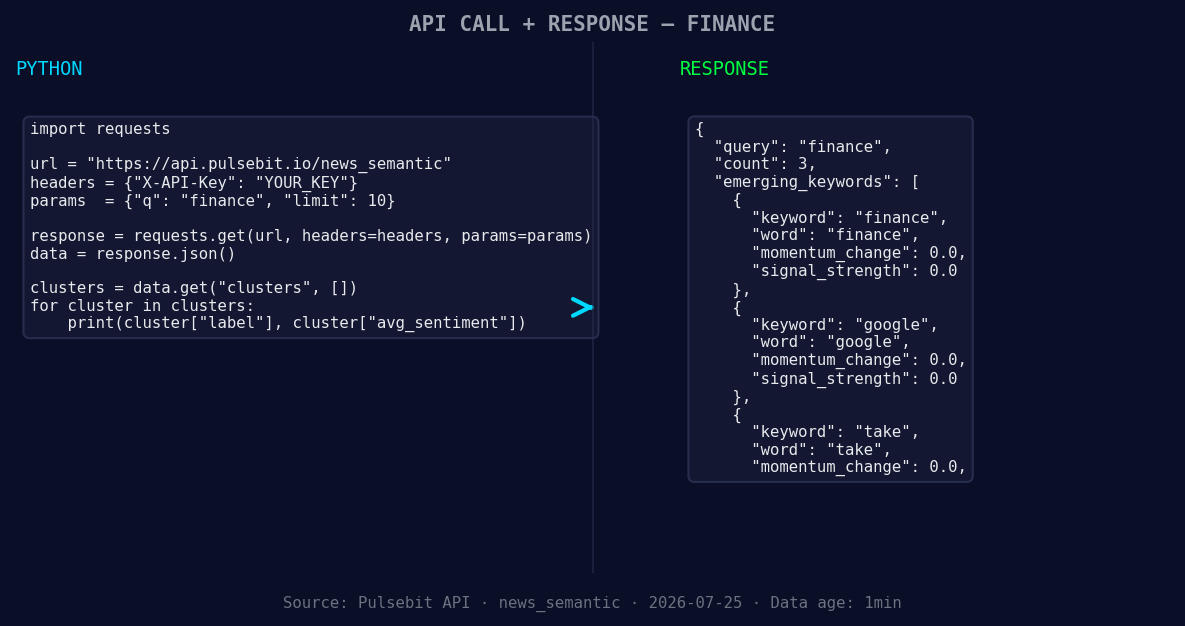
*Left: Python GET /news_semantic call for 'finance'. Right: returned JSON response structure (clusters: 3). Source: Pulsebit /news_semantic.*
# Step 1: Fetch sentiment data
url = "https://api.pulsebit.lojenterprise.com/sentiment"
params = {
"topic": "finance",
"lang": "en"
}
response = requests.get(url, params=params)
data = response.json()
# Assuming we have the following values from the API response
momentum = +0.600
score = +0.246
confidence = 0.75
# Step 2: Run the cluster reason string through the sentiment scoring endpoint
cluster_reason = "Clustered by shared themes: finance, ‘strengthens, climate, resilience’, among."
sentiment_response = requests.post(url, json={"text": cluster_reason})
sentiment_data = sentiment_response.json()
print(sentiment_data)
This code first queries the sentiment data for the topic "finance," filtered by the English language. It then takes the cluster reason string and sends it to our sentiment endpoint for additional scoring. This double-checking mechanism ensures that we capture not only the raw sentiment but also the underlying narrative framing.
Now, what can we build with this momentum spike? Here are three specific ideas:
Geo-Sentiment Alerts: Create a real-time alert system that triggers when momentum for the finance topic exceeds a threshold (e.g., +0.5) specifically from the English-speaking regions. Use the geo filter to ensure you're catching these spikes before they’re reflected in your broader analysis.
Meta-Sentiment Analysis: Develop a dashboard that visualizes the sentiment scores of clustered narratives. For instance, if the score for "Clustered by shared themes: finance, ‘strengthens, climate, resilience’, among." exceeds a certain threshold (say +0.3), it could help us understand the sentiment landscape better and react accordingly.
Narrative Shifts Tracking: Build a routine that checks for shifts in sentiment narratives around finance. If the cluster narrative changes to something like "Wall Street futures fall amid economic instability," you can configure a threshold (e.g., momentum drops below 0.1) to alert you to a potential downturn.
These builds would allow us to stay ahead of financial trends and capitalize on early signals.
If you're eager to dive into this, check out our documentation at pulsebit.lojenterprise.com/docs. You can copy-paste the code above and have it running in under 10 minutes. Let's not let those 25.7 hours slip away again.


Top comments (0)