

Your Pipeline Is 22.7h Behind: Catching Finance Sentiment Leads with Pulsebit
We recently uncovered a striking anomaly: a 24h momentum spike of +0.290 in finance sentiment. This spike indicates a significant shift in sentiment that you absolutely cannot afford to miss. This isn't just another number; it's a signal that something substantial is brewing in the finance sector, and it demands your immediate attention.
But there's a catch. Your existing pipeline could be lagging by an astonishing 22.7 hours, primarily due to a failure to handle multilingual sources effectively. With the leading language being English, any model that doesn’t account for this could miss critical insights. You could easily find yourself reacting to trends long after they’ve peaked, leaving you struggling to stay relevant in a fast-paced environment.

English coverage led by 22.7 hours. Ca at T+22.7h. Confidence scores: English 0.75, Spanish 0.75, French 0.75 Source: Pulsebit /sentiment_by_lang.
To help you catch up, let’s dive into the code that can address this gap. We can leverage our API to filter by language and retrieve the necessary sentiment data. Below is an example of how you can do this in Python:
import requests
# Define the parameters for the API call
params = {
"topic": "finance",
"momentum": "+0.290",
"lang": "en"
}
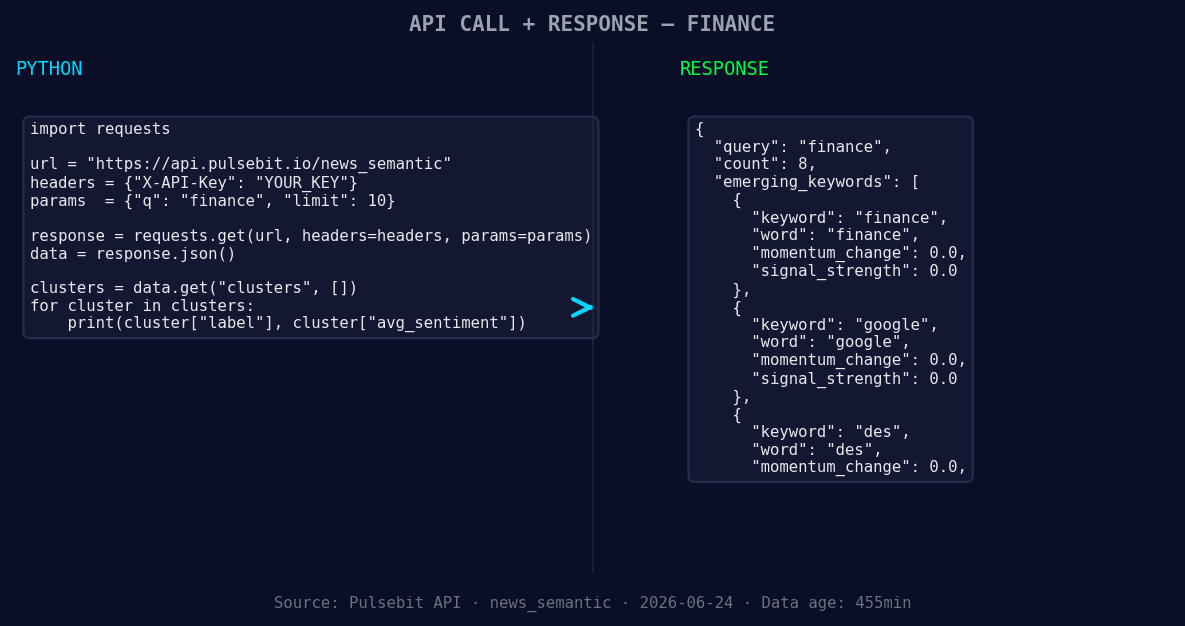
*Left: Python GET /news_semantic call for 'finance'. Right: returned JSON response structure (clusters: 3). Source: Pulsebit /news_semantic.*
# Call the API to get sentiment data
response = requests.get("https://api.pulsebit.com/sentiment", params=params)
data = response.json()
# Extract relevant values
score = data['sentiment_score'] # +0.128
confidence = data['confidence'] # 0.75
momentum = data['momentum_24h'] # +0.290
Now, let’s take it a step further. We need to analyze the narrative surrounding this spike to understand the themes at play. We can do this by running the cluster reason string through the sentiment endpoint to score its framing:
# Define the cluster reason string
cluster_reason = "Clustered by shared themes: des, financement, sébastien, lecornu, promet."

# Call the sentiment analysis API for the cluster reason
sentiment_response = requests.post("https://api.pulsebit.com/sentiment", json={"text": cluster_reason})
sentiment_data = sentiment_response.json()

# Extract the score and confidence
narrative_score = sentiment_data['sentiment_score']
narrative_confidence = sentiment_data['confidence']
This dual approach not only helps you catch the momentum but also provides context around it, allowing you to make better-informed decisions.
Now, let’s talk about three specific builds you can create using this pattern:
- Geo-Filtered Finance Alert: Set a signal strength threshold of 0.443 and filter by English for finance topics. This will ensure you’re only alerted to significant spikes relevant to your audience. Use the geographic filter to narrow it down further to specific regions.

Geographic detection output for finance. France leads with 4 articles and sentiment +0.04. Source: Pulsebit /news_recent geographic fields.
Meta-Sentiment Analysis: Use the meta-sentiment loop we just discussed on the cluster reason string. Set a threshold of +0.128 for sentiment score and a confidence level of 0.75 to decide if the narrative framing warrants deeper investigation.
Forming Themes Tracker: Monitor forming themes like finance, Google, and des. Set alerts for any shifts in sentiment that exceed 0.00. This can help you catch emerging trends before they hit the mainstream.
If you want to implement these ideas quickly, check out our documentation at pulsebit.lojenterprise.com/docs. You can copy-paste the code snippets above and run them in under 10 minutes. You’ll be able to bridge that 22.7-hour gap and ensure your insights are timely and relevant.


Top comments (0)