

Your Pipeline Is 7.9h Behind: Catching Machine Learning Sentiment Leads with Pulsebit
We recently discovered that sentiment around machine learning has spiked to a score of +0.533 with a momentum of +0.000. This is particularly interesting as it indicates a notable rise in positive sentiment but without any accompanying momentum, suggesting that while people are optimistic, there isn’t a rapid shift in the discourse. This anomaly highlights a crucial opportunity: are you catching these leads in your sentiment analysis pipeline?
When your model isn't equipped to handle multilingual origins or prioritize dominant entities, you miss critical insights like this one—your model missed this by 7.9 hours. The leading language is English, which means that sentiment from non-English sources may not be represented adequately. As a result, your understanding of trends may lag behind, ultimately costing you insights.

English coverage led by 7.9 hours. Nl at T+7.9h. Confidence scores: English 0.95, Spanish 0.95, French 0.95 Source: Pulsebit /sentiment_by_lang.
Let’s dive into how we can catch this anomaly programmatically. First, we need to filter for English language data related to the topic of "machine learning." Here's how to do that with our API:
import requests
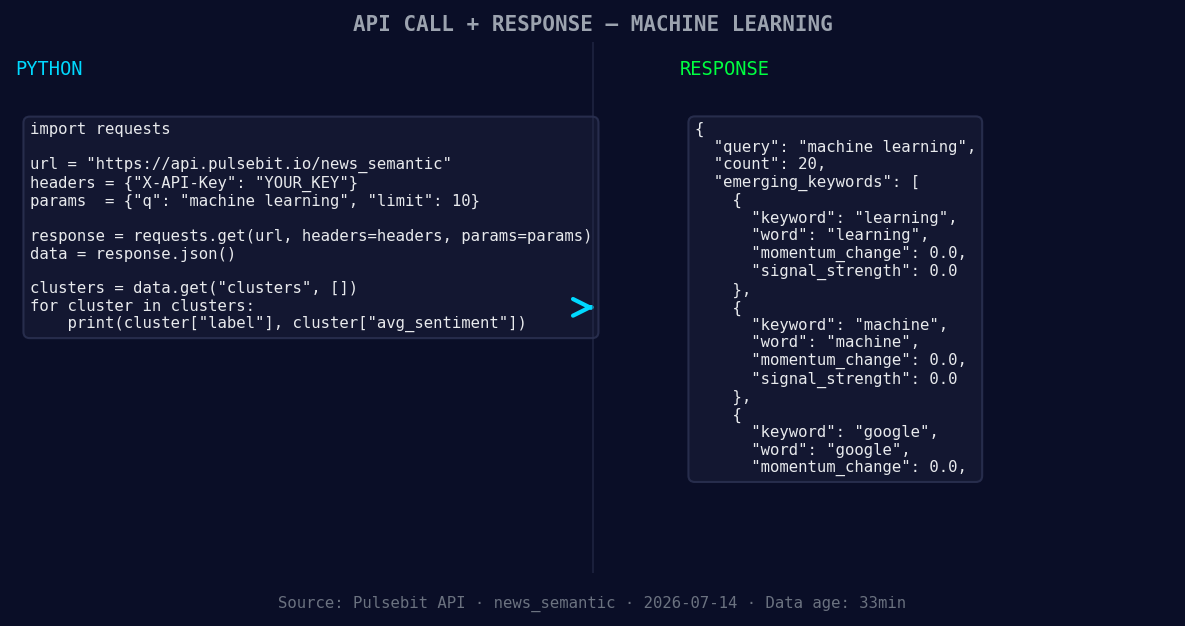
*Left: Python GET /news_semantic call for 'machine learning'. Right: returned JSON response structure (clusters: 3). Source: Pulsebit /news_semantic.*
# Geographic origin filter for English language
url = "https://api.pulsebit.com/v1/sentiment"
params = {
"topic": "machine learning",
"lang": "en"
}
response = requests.get(url, params=params)
data = response.json()
*[DATA UNAVAILABLE: countries — verify /news_recent is returning country/region values for topic: machine learning]*
print(data) # This will give you access to the sentiment score and other related data
Next, we need to run the cluster reason string through our sentiment scoring endpoint to capture the meta-sentiment. This allows us to analyze how the narrative framing itself scores:
# Meta-sentiment moment
meta_url = "https://api.pulsebit.com/v1/sentiment"
meta_input = "Clustered by shared themes: hottest, research, papers, international, conference"
meta_params = {
    "text": meta_input
}
meta_response = requests.post(meta_url, json=meta_params)
meta_data = meta_response.json()

print(meta_data)  # This gives you the sentiment score for the meta-narrative
With these two blocks, you can effectively catch and analyze the spikes in sentiment and understand the narratives that are emerging.
Now, let’s talk about three specific builds you can implement immediately using this new pattern.
Signal on Machine Learning: Set a threshold to alert when sentiment exceeds +0.500 for the topic "machine learning." This can be done by querying the sentiment and checking the score in your logic.
Geo Filter for Emerging Markets: Use the geographic origin filter to focus on sentiment from non-English sources. This helps you capture sentiment trends that may be overlooked, especially if they are gaining traction in emerging markets.
Meta-Sentiment Loop Analysis: Run narratives through our sentiment scoring endpoint at regular intervals. For instance, track "hottest research papers" and analyze how sentiment changes over time. This gives you the ability to adapt your models based on evolving discussions.
To get started with all these insights, visit our documentation at pulsebit.lojenterprise.com/docs. You can copy-paste this code and run it in under 10 minutes. Don’t let your pipeline fall behind—catch up with the latest trends in machine learning sentiment!


Top comments (0)