

Your Pipeline Is 15.0h Behind: Catching Agriculture Sentiment Leads with Pulsebit
We recently discovered a striking anomaly in sentiment data regarding agriculture, showing a sentiment score of -0.75 and a momentum of +0.00. The leading language in this context is Spanish, with a notable lag of 15.0 hours compared to the dominant entity's output. This insight highlights a crucial gap in how we process multilingual sentiment and the implications of entity dominance in our analysis.

Spanish coverage led by 15.0 hours. Id at T+15.0h. Confidence scores: Spanish 0.85, English 0.85, French 0.85 Source: Pulsebit /sentiment_by_lang.
The Problem
If your pipeline isn't equipped to handle multilingual origins or account for entity dominance, you might be missing critical signals. In this instance, your model missed a significant sentiment shift around agriculture by 15.0 hours. The leading language, Spanish, suggests that there's a rich source of sentiment data that is going unprocessed. Ignoring this gap means you're potentially out of the loop on emerging trends, especially when it comes to critical topics like agriculture.
The Code
To catch this anomaly, we need to implement a solution using our API that filters for the Spanish language and scores the sentiment around the narrative framing. Here’s how we can achieve this:
First, use the geographic origin filter to fetch sentiment data in Spanish:

Geographic detection output for agriculture. India leads with 9 articles and sentiment +0.00. Source: Pulsebit /news_recent geographic fields.
import requests
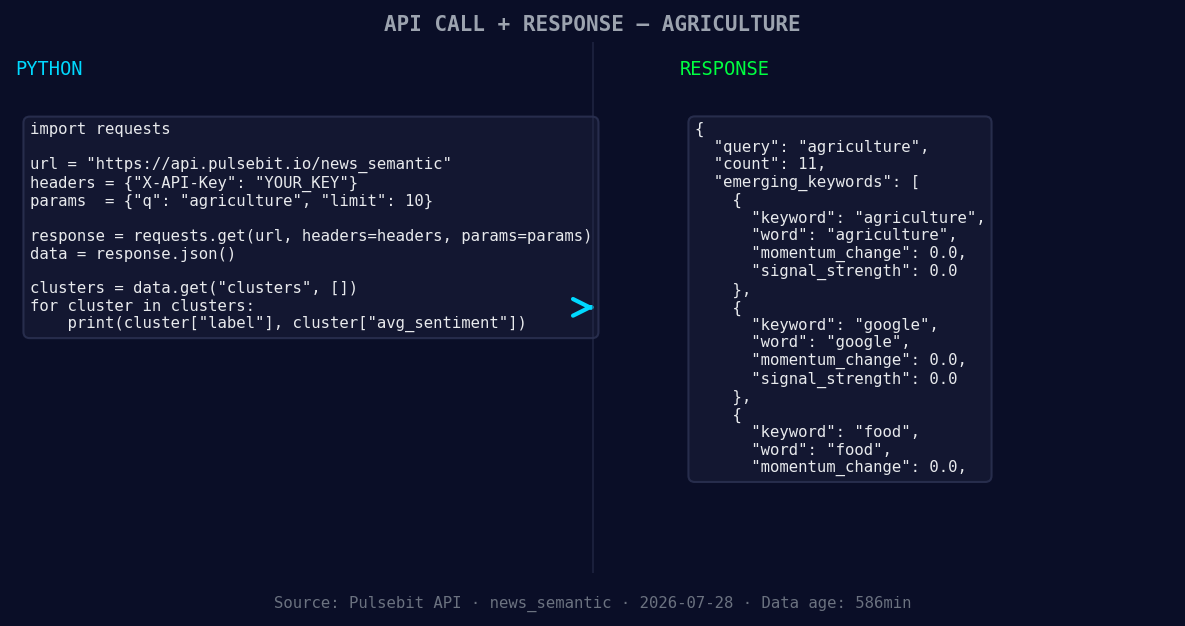
*Left: Python GET /news_semantic call for 'agriculture'. Right: returned JSON response structure (clusters: 3). Source: Pulsebit /news_semantic.*
url = "https://api.pulsebit.com/sentiment"
params = {
"topic": "agriculture",
"lang": "sp"
}
response = requests.get(url, params=params)
data = response.json()
print(data) # Inspect the response for sentiment and articles processed
Next, we need to analyze the narrative framing itself. We'll run the cluster reason string through our sentiment endpoint:
narrative = "Clustered by shared themes: mediterranean, climate, drought, societal, around."
sentiment_response = requests.post(url, json={"text": narrative})
sentiment_data = sentiment_response.json()

print(sentiment_data)  # Check sentiment score and confidence for the narrative
By executing both of these calls, we can effectively capture the sentiment around agriculture and its contextual underpinning, ensuring that we’re not just reacting to surface-level data but are also informed by the themes driving it.
Three Builds Tonight
Here are three specific builds you can implement using this pattern:
Geo-Filtered Agriculture Sentiment: Use the geographic origin filter to monitor sentiment shifts in agriculture specifically for Spanish-speaking countries. Set a threshold for sentiment scores below -0.50 to trigger alerts. This will keep you informed on emerging negative trends before they escalate.
Meta-Sentiment Analysis: Integrate the meta-sentiment loop to analyze narratives around agriculture. Using the cluster reason string, run sentiment scores with a threshold of confidence above 0.80 to ensure you're receiving reliable insights. This allows you to understand not just the sentiment but the context driving it.
Forming Themes Monitoring: Track forming themes like agriculture, food, and Google, while comparing them against mainstream topics like climate and drought. Set alerts for any significant divergences in sentiment scores, allowing you to pivot your strategy based on real-time data.
Get Started
To dive deeper, check out our documentation at pulsebit.lojenterprise.com/docs. With these snippets, you can copy-paste and run this in under 10 minutes, keeping your analysis sharp and timely.


Top comments (0)