

Your model just missed a significant anomaly: a 24-hour momentum spike of +0.272 in the entertainment sector. This spike indicates a rising sentiment that demands our immediate attention. With the leading language being English, and the dominant entity related to an article from news8000.com, we can see that there is a clear opportunity to capture emerging trends in entertainment before they become mainstream.
But here’s the kicker: your pipeline is trailing by 29.2 hours. If you’re not equipped to handle multilingual sources or account for entity dominance, you’re missing out on timely insights that could enhance your decision-making. The focus on English content, led by that singular article, may have left you blind to the broader sentiment shifts occurring across different platforms and languages. You need to bridge that gap to stay relevant.

English coverage led by 29.2 hours. Af at T+29.2h. Confidence scores: English 0.85, French 0.85, Spanish 0.85 Source: Pulsebit /sentiment_by_lang.
Let’s dive into the code that can help you catch these anomalies in real-time. We’ll start by querying our API for the entertainment topic, filtering for English content:
import requests
# Define parameters
topic = 'entertainment'
lang = 'en'
# API call to fetch sentiment data
response = requests.get(f"https://api.pulsebit.io/sentiment?topic={topic}&lang={lang}")
data = response.json()
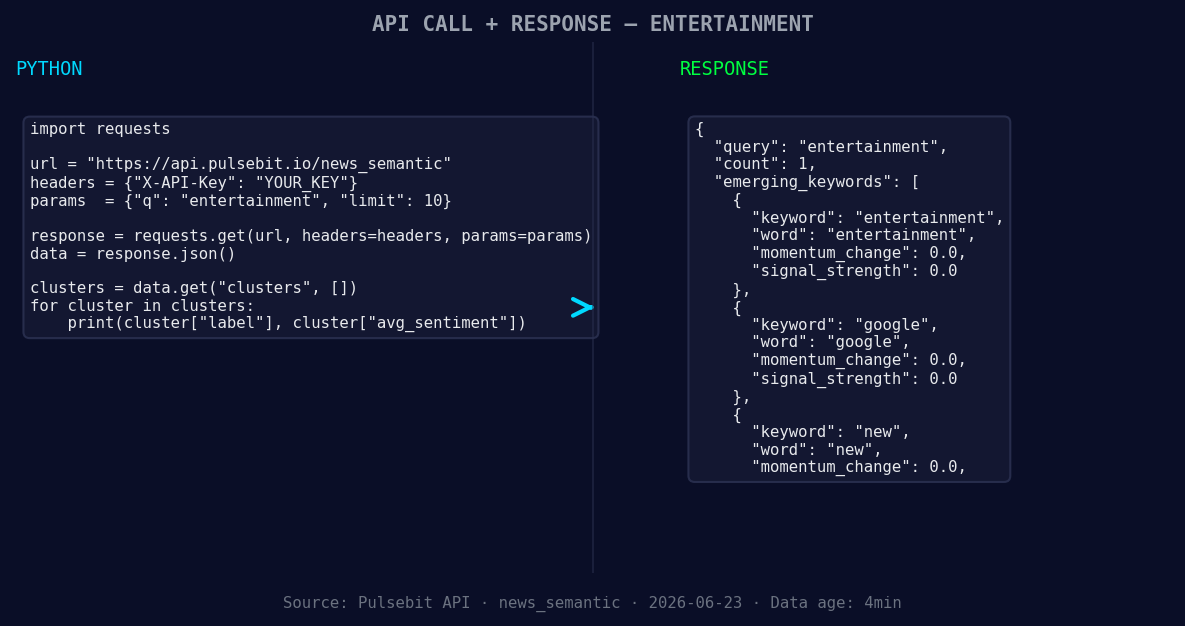
*Left: Python GET /news_semantic call for 'entertainment'. Right: returned JSON response structure (clusters: 3). Source: Pulsebit /news_semantic.*
# Check for momentum spike
momentum = data['momentum_24h']
if momentum > 0.25:
print(f"Momentum Spike Detected: {momentum}")
Now that we have the data, we need to analyze the narrative framing of the sentiment cluster. This step involves sending the cluster reason string back through our sentiment endpoint to score it:
# Meta-sentiment moment
cluster_reason = "Clustered by shared themes: eye, entertainment, news8000, com,"
meta_sentiment_response = requests.post("https://api.pulsebit.io/sentiment", json={"text": cluster_reason})
meta_sentiment_data = meta_sentiment_response.json()

# Output the meta sentiment score
print(f"Meta Sentiment Score: {meta_sentiment_data['sentiment_score']}")
In the above snippets, we not only capture the momentum but also gauge the sentiment of the narrative surrounding it, providing a more nuanced understanding of the entertainment landscape.
Now, here are three specific builds you can implement based on this pattern:
- Geographic Origin Filter: Create a pipeline that triggers alerts for any momentum spikes exceeding +0.25 in the entertainment sector, specifically filtering for English articles originating from the U.S. This will ensure you capture localized trends before they spread globally.
![DATA UNAVAILABLE: countries — verify /news_recent is return
[DATA UNAVAILABLE: countries — verify /news_recent is returning country/region values for topic: entertainment]
Meta-Sentiment Loop: Implement a routine that scores any cluster reason text exceeding a certain confidence threshold (like 0.85). Create dashboards that visualize the shifting sentiment for articles clustered by themes like "new," "entertainment," and "google," allowing you to spot emerging narratives in real-time.
Threshold Alert System: Build a notification system that alerts you when the score for themes like "entertainment" and "news8000" rise above a threshold of +0.00. This could help in identifying new content opportunities for your editorial team as mainstream narratives shift.
If you want to get started with our API, check out the documentation at pulsebit.lojenterprise.com/docs. You can copy, paste, and run these snippets in under 10 minutes. Don't let your pipeline lag behind; catch those insights before they become yesterday's news.


Top comments (0)