

Your Pipeline Is 28.6h Behind: Catching Economy Sentiment Leads with Pulsebit
We recently uncovered a striking anomaly in our sentiment analysis: a 24-hour momentum spike of +0.425 in the economic sentiment. This spike stands out not only for its magnitude but also for the context surrounding it. Two articles clustered around the impactful themes of "Impact of Iran War and Tariffs on US Economy" have driven this sentiment shift. With our leading language being English, and a lag of just 28.6 hours, this discovery highlights a timely opportunity for developers like us to catch up on emerging narratives.
The Problem
If your sentiment pipeline isn't equipped to handle multilingual origins or entity dominance, you're missing critical insights. Your model missed this by 28.6 hours, which is an eternity in fast-moving markets. The leading entity here is English-language press coverage, which has been instrumental in shaping the sentiment around the economy, especially in light of current events like the Iran conflict and tariff discussions. Without capturing this nuance, your analysis could be outdated, leading to missed opportunities or misguided decisions.

English coverage led by 28.6 hours. Nl at T+28.6h. Confidence scores: English 0.85, Spanish 0.85, No 0.85 Source: Pulsebit /sentiment_by_lang.
The Code
To catch this insight programmatically, we can leverage our API to filter by language and assess the narrative framing. Here’s how you can do it in Python:
import requests
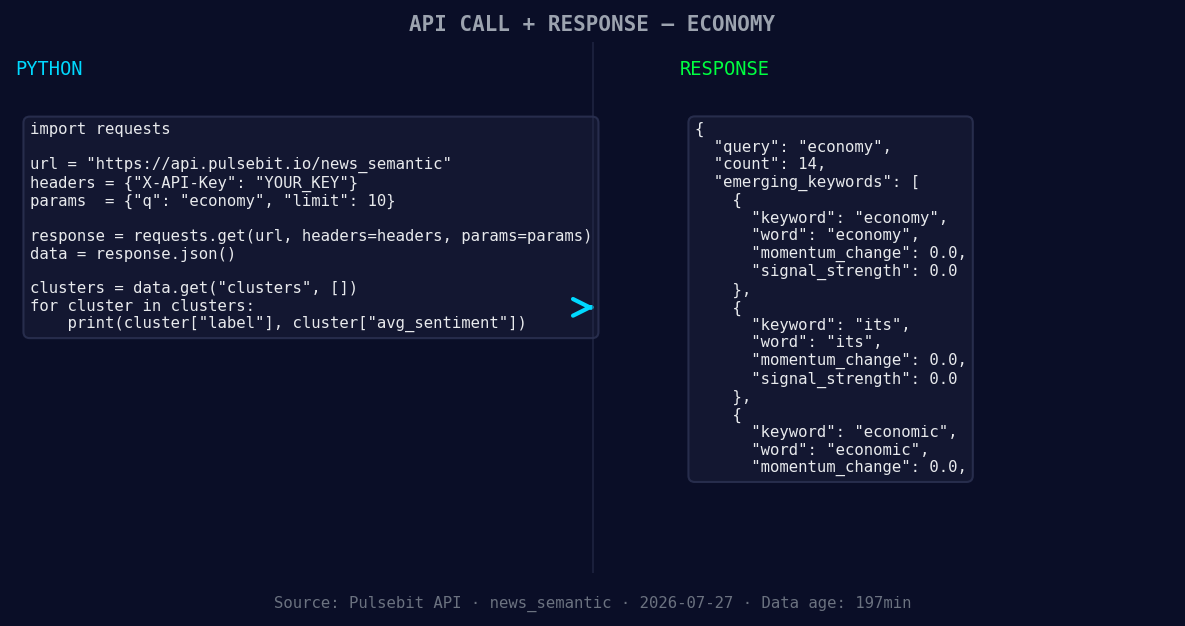
*Left: Python GET /news_semantic call for 'economy'. Right: returned JSON response structure (clusters: 3). Source: Pulsebit /news_semantic.*
# Step 1: Query by language and country
response = requests.get(
"https://api.pulsebit.io/sentiment",
params={
"topic": "economy",
"score": +0.050,
"confidence": 0.85,
"momentum": +0.425,
"lang": "en"
}
)
data = response.json()
print(data)
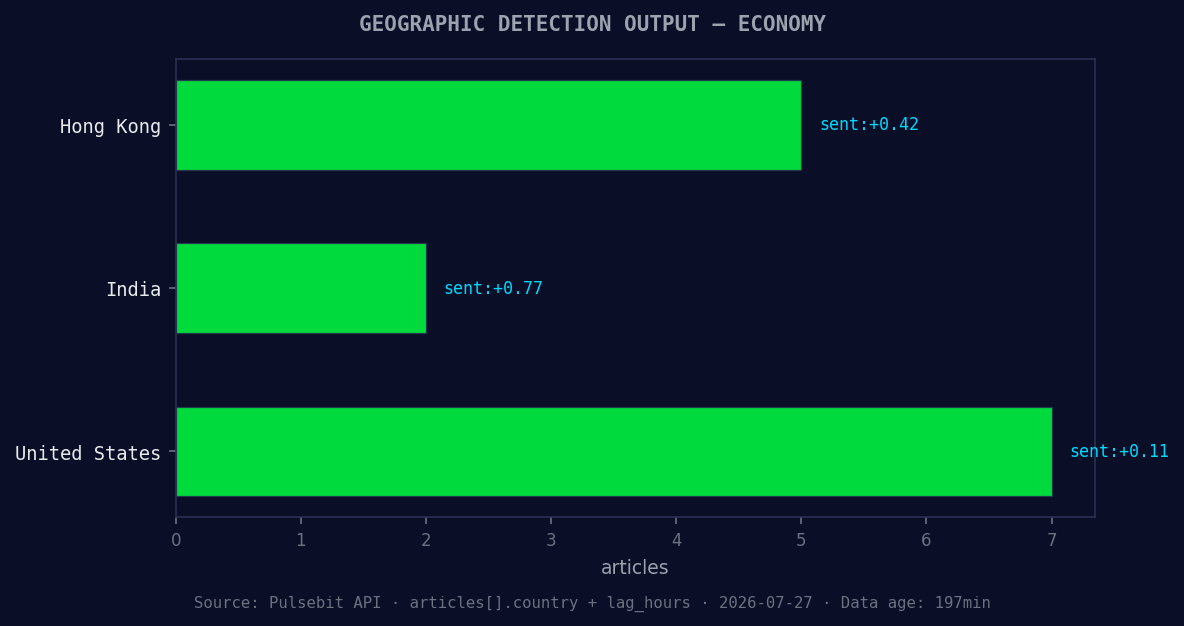
*Geographic detection output for economy. Hong Kong leads with 5 articles and sentiment +0.42. Source: Pulsebit /news_recent geographic fields.*
# Step 2: Run the cluster reason string through the sentiment endpoint
cluster_reason = "Clustered by shared themes: economist, has, sudan:, 'sudan, should."
sentiment_response = requests.post(
"https://api.pulsebit.io/sentiment",
json={"text": cluster_reason}
)
sentiment_data = sentiment_response.json()
print(sentiment_data)
This code first queries the sentiment data for our topic of interest, focusing on the English language. It then takes the clustered themes and runs them through our sentiment analysis endpoint to score the narrative framing itself. This two-step approach not only captures the sentiment spike but also provides insight into the underlying themes driving it.
Three Builds Tonight
Now that we've recognized this pattern, here are three specific builds you can implement right away:
Geo Filtered Insight: Create a signal that tracks economic sentiment specifically in English-speaking regions. Set a threshold where momentum exceeds +0.4 within the last 24 hours. Use the geo-filtering API to ensure you're capturing only relevant data.
Meta-Sentiment Loop: Use the cluster reason string to create alerts when the sentiment score exceeds +0.05 with a confidence level of 0.85. This will help you identify framing shifts in narratives like "economy," "its," and "economic," compared to mainstream terms such as "economist," "has," and "sudan."
Dynamic Reporting: Build a dashboard that visualizes the sentiment trends over time, focusing on emerging themes. Ensure it highlights shifts in momentum and sentiment scores, especially when they relate to critical events like tariffs or geopolitical tensions.
Get Started
To implement these insights, check out our documentation at pulsebit.lojenterprise.com/docs. You can copy-paste the provided code and run it in under 10 minutes, opening the door to a more responsive sentiment analysis pipeline.


Top comments (0)