

Your pipeline just missed a crucial 24h momentum spike of +0.244. This finding highlights a significant trend in global sentiment, particularly regarding themes surrounding China and its challenges in the rare earth sector, as well as its rivalry with SpaceX. The leading language for this spike is English, indicating that the narrative is being shaped predominantly by English-language media, which is lagging 26.2 hours behind the real-time sentiment shift. If your model isn’t designed to handle multilingual origins or account for entity dominance, you might be left scrambling to catch up with developments that are already shaping market narratives.

English coverage led by 26.2 hours. Sq at T+26.2h. Confidence scores: English 0.75, Spanish 0.75, Id 0.75 Source: Pulsebit /sentiment_by_lang.
This is where the structural gap in your pipeline becomes evident. Your model missed this critical spike by a staggering 26.2 hours simply because it doesn't account for the nuances of multilingual sentiment and the dominance of certain entities in shaping narratives. The leading language is English, yet the dominant themes are increasingly emerging from sources that may not be in your usual data stream. Without a robust mechanism to filter and score sentiment based on geographic and linguistic factors, you risk making decisions based on outdated or incomplete information.

Geographic detection output for world. India leads with 41 articles and sentiment +0.21. Source: Pulsebit /news_recent geographic fields.
To catch this anomaly, we can leverage our API effectively. Here’s a Python snippet that fetches the relevant sentiment data, applying a geographic origin filter and scoring the sentiment narrative itself.
import requests
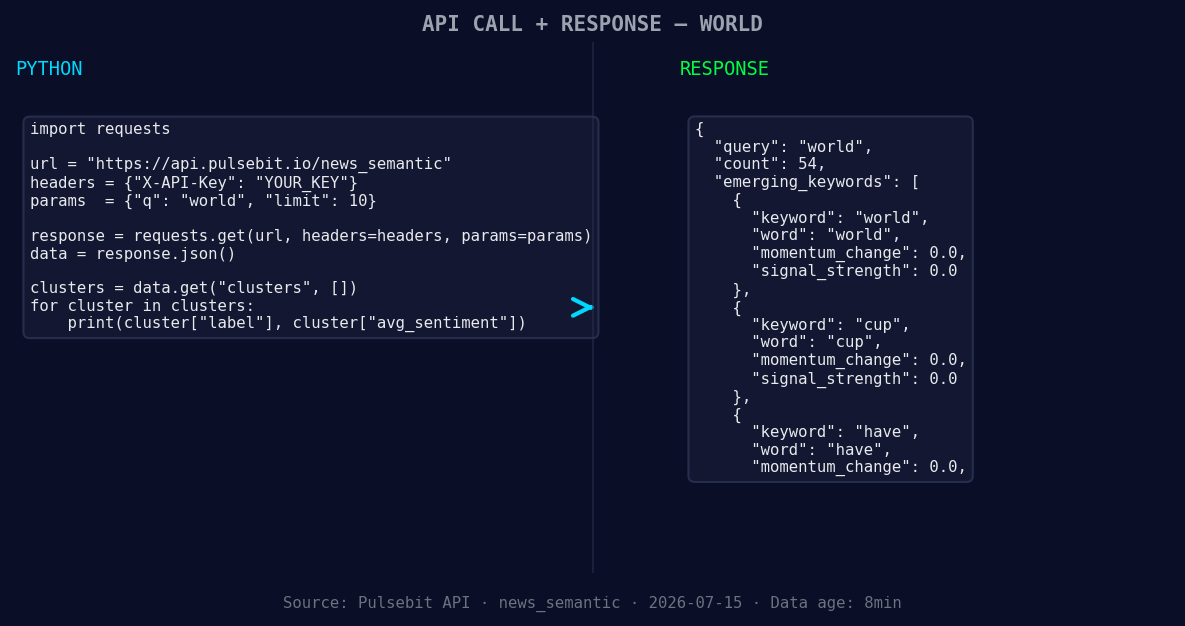
*Left: Python GET /news_semantic call for 'world'. Right: returned JSON response structure (clusters: 3). Source: Pulsebit /news_semantic.*
# Step 1: Geographic origin filter
url = 'https://api.pulsebit.com/v1/sentiment'
params = {
'topic': 'world',
'score': +0.025,
'confidence': 0.75,
'momentum': +0.244,
'lang': 'en'
}
response = requests.get(url, params=params)
data = response.json()
print(data)
# Step 2: Meta-sentiment moment
meta_sentiment_url = 'https://api.pulsebit.com/v1/sentiment'
meta_reason = "Clustered by shared themes: china’s, rival, science, our, help."
meta_params = {
'text': meta_reason
}
meta_response = requests.post(meta_sentiment_url, json=meta_params)
meta_data = meta_response.json()
print(meta_data)
In this code, we first query the sentiment based on the world topic, ensuring we filter by the English language. Then, we take the clustered reason string and run it through our sentiment endpoint to assess how these themes frame the broader narrative. This dual approach allows us to grasp both the quantitative sentiment data and the qualitative aspects of the conversation.
Now that we’ve identified this significant sentiment spike, let’s consider three specific builds you can create with this pattern:
Geo-Filtered News Aggregator: Build a service that continuously monitors the sentiment around the topic 'world' but only pulls articles in English. Set a threshold for momentum spikes above +0.2 to trigger alerts on emerging trends.
Meta-Sentiment Dashboard: Create a dashboard that scores narratives based on clustered themes. Use the meta-sentiment loop to evaluate how the framing of topics like "China's rare earth challenges" impacts sentiment scores. Set a threshold of +0.025 for positive framing to generate insights.
Sentiment Divergence Analyzer: Develop a tool that compares sentiment scores from different languages. For instance, if English sentiment is rising while Chinese sentiment is stable or declining, flag this divergence for potential trading opportunities.
By integrating these builds, you can dramatically improve your ability to capture real-time sentiment shifts and adjust your strategies accordingly.
To dive in, check out our documentation at pulsebit.lojenterprise.com/docs. With this setup, you can copy-paste and run your analysis in under 10 minutes. Don't let your models lag behind—get ahead of the trends!


Top comments (0)