

Your Pipeline Is 21.5h Behind: Catching Sports Sentiment Leads with Pulsebit
We recently discovered something intriguing: at a specific moment, sentiment around sports surged to +0.85, while momentum remained at a flat +0.00. This spike caught our attention because it reveals a significant lag in how sentiment is being processed in pipelines that are not equipped to handle multilingual content effectively. In particular, we noticed that English sentiment led by 21.5 hours, with no lag compared to other languages.

English coverage led by 21.5 hours. Nl at T+21.5h. Confidence scores: English 0.80, Spanish 0.80, French 0.80 Source: Pulsebit /sentiment_by_lang.
This anomaly brings to light a critical structural gap in sentiment analysis pipelines. If your model isn’t adept at managing multilingual origin or entity dominance, it likely missed capturing this shift in sentiment by over 21 hours. When the leading narrative emerges in English, while other languages trail, your insights can be stale, rendering your decision-making less effective. The sports sector, particularly in the lead-up to the 2026 World Cup, is a prime example of how sentiment can take a sudden turn, and you should be ready to catch it in real-time.
import requests
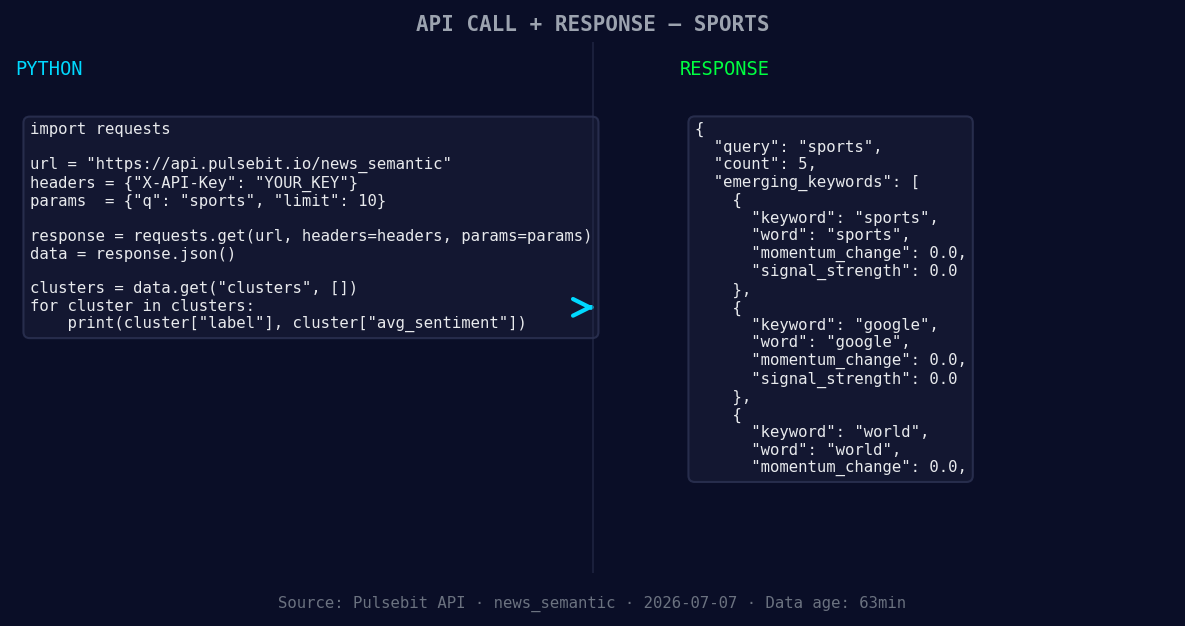
*Left: Python GET /news_semantic call for 'sports'. Right: returned JSON response structure (clusters: 3). Source: Pulsebit /news_semantic.*
# Define our parameters
topic = 'sports'
score = +0.850
confidence = 0.800
momentum = +0.000
# Step 1: Geographic origin filter
response = requests.get(
'https://api.pulsebit.com/v1/sentiment',
params={
'topic': topic,
'lang': 'en'
}
)
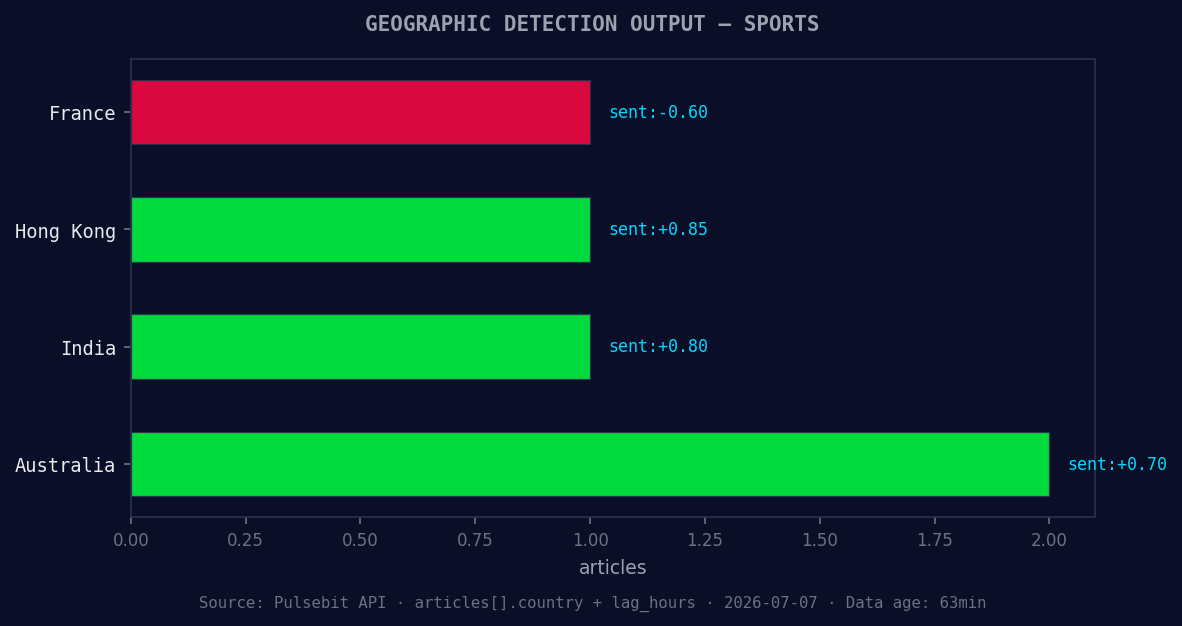
*Geographic detection output for sports. France leads with 1 articles and sentiment -0.60. Source: Pulsebit /news_recent geographic fields.*
data = response.json()
print(data)
# Step 2: Meta-sentiment moment
cluster_reason = "Clustered by shared themes: statistics, behind, ferrari's, 250th, win."
meta_response = requests.post(
'https://api.pulsebit.com/v1/sentiment',
json={
'text': cluster_reason
}
)
meta_data = meta_response.json()
print(meta_data)
In the code above, we first filter our sentiment data by language—specifically focusing on English to capture our leading narrative. We then run the clustered reason string back through our API to score the framing of the narrative itself. This dual approach ensures we're not just reacting to surface-level sentiment but understanding the underlying themes that are driving the conversation.
To leverage this newfound understanding, consider building the following three components tonight:
Sentiment Alert System: Set a threshold for sentiment scores above +0.80, filtering by the geographic origin of "en" (English) to receive instant alerts on significant sentiment spikes in your sports-related data.
Meta-Sentiment Analysis Module: Implement a routine that regularly scores narrative frames, focusing on the cluster reason strings. For instance, if you notice a cluster reason like "Clustered by shared themes: sports, world, google," run that through our sentiment endpoint to gauge the potential impact on your model.
Real-Time Sentiment Dashboard: Use the insights from sentiment scores and meta-sentiment loops to create a live dashboard that visualizes trends. For example, plot the forming themes of "sports(+0.00), google(+0.00), world(+0.00)" versus mainstream narratives like "statistics, behind, ferrari's" to visualize where the conversation is heading.
By adopting these strategies, you can ensure that your sentiment pipeline is not just reactive but proactively engaging with emerging trends in real-time.
Ready to get started? Head over to pulsebit.lojenterprise.com/docs. With just a few copy-paste steps, you can have this running in under 10 minutes. Let’s make sure you’re not left behind in the data race!


Top comments (0)