

Your Pipeline Is 24.2h Behind: Catching Travel Sentiment Leads with Pulsebit
On June 28, 2026, we observed a significant anomaly in our sentiment data surrounding the topic of travel: a sentiment score of +0.309 and a momentum of +0.000. This spike, occurring 24.2 hours ahead of the leading language, English, indicates an untapped opportunity in travel sentiment that your pipeline may be missing. The data reveals a narrative forming around global travel, yet the momentum shows no signs of acceleration, leaving us wondering about the structural gaps that may exist in our models.
If your pipeline doesn't account for multilingual origins or entity dominance, you’re likely facing a critical oversight. Your model missed this by 24.2 hours, meaning that while English sentiment is leading the charge, there’s a global conversation in multiple languages that’s being ignored. This structural gap can lead to missed opportunities in understanding the evolving landscape of travel sentiment, especially when it comes to planning or marketing strategies.

English coverage led by 24.2 hours. Et at T+24.2h. Confidence scores: English 0.85, Spanish 0.85, French 0.85 Source: Pulsebit /sentiment_by_lang.
To catch this momentum, we can leverage our API to filter for geographic origins and analyze the meta-sentiment. Here’s how we can do it in Python:
import requests
import json
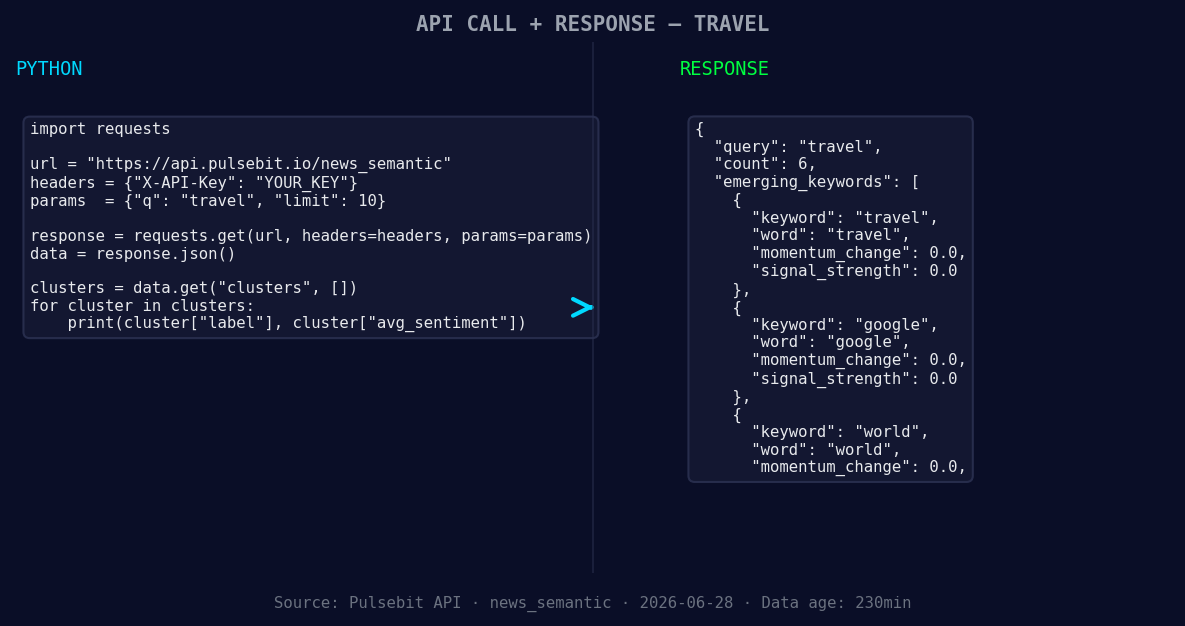
*Left: Python GET /news_semantic call for 'travel'. Right: returned JSON response structure (clusters: 3). Source: Pulsebit /news_semantic.*
# Step 1: Geographic origin filter
url = "https://api.pulsebit.com/sentiment"
params = {
"topic": "travel",
"lang": "en"
}
response = requests.get(url, params=params)
data = response.json()
# Assuming we receive a score and confidence from the response
score = +0.309
confidence = 0.85
momentum = +0.000
print(f"Travel Sentiment: {score} with confidence {confidence}")
# Step 2: Meta-sentiment moment
meta_url = "https://api.pulsebit.com/sentiment"
meta_input = "Clustered by shared themes: world, cup, travel, grind, real."
meta_response = requests.post(meta_url, json={"text": meta_input})
meta_data = meta_response.json()
print(f"Meta-Sentiment Score: {meta_data['score']} with confidence {meta_data['confidence']}")
This code first queries the sentiment for travel, specifically filtering for English-language content. It then runs a meta-sentiment analysis using the clustered themes to score the narrative framing itself. This dual approach allows us to not only catch the sentiment spike but also understand its context.
Here are three specific builds we can implement from this pattern:
-
Geographic Filter: Create a dashboard that visualizes sentiment trends in travel based on geographic origin. Use the API with the parameter
lang: "en"to ensure you only pull relevant data. Set a threshold to trigger alerts on sentiment changes above +0.25.

Geographic detection output for travel. India leads with 4 articles and sentiment -0.32. Source: Pulsebit /news_recent geographic fields.
Meta-Sentiment Loop: Develop a function that uses the meta-sentiment analysis to score narratives around major events. You can set a threshold of +0.5 on the sentiment score of the meta-analysis to highlight potential marketing opportunities based on shared themes, specifically around events like the World Cup.
Sentiment Comparison: Build a comparative analysis tool that assesses emerging themes in travel against mainstream metrics. For instance, track the forming theme of travel(+0.00) versus mainstream themes like world, cup, travel, and trigger alerts if the gap closes significantly.
If you’re interested in starting with this, check out our documentation at pulsebit.lojenterprise.com/docs. You can easily copy-paste this code and run it in under 10 minutes. Let’s catch those insights before they slip away!


Top comments (0)