

Your Pipeline Is 8.4h Behind: Catching Economy Sentiment Leads with Pulsebit
We recently uncovered a fascinating anomaly: a 24-hour momentum spike in sentiment around the economy, hitting +0.385. This spike suggests that something significant is happening, and it’s happening fast. The leading language for this sentiment is English, with an 8.4-hour lead time. If you’re not capturing these shifts in real time, you might be missing critical insights.
When your pipeline doesn’t account for multilingual origins or the dominance of certain entities, you could be caught off guard. In this case, you missed this critical momentum spike by 8.4 hours, and it came from English articles discussing how Africa’s borderless economy is outgrowing its financial infrastructure. That’s a serious lag when the sentiment is shifting and the conversation is evolving rapidly.

English coverage led by 8.4 hours. Id at T+8.4h. Confidence scores: English 0.85, Spanish 0.85, No 0.85 Source: Pulsebit /sentiment_by_lang.
To catch these signals, we can leverage our API to build a small script in Python that highlights this momentum spike effectively. Here’s how to get started.
import requests
# Set up parameters for the API call
topic = 'economy'
momentum = +0.385
score = +0.279
confidence = 0.85
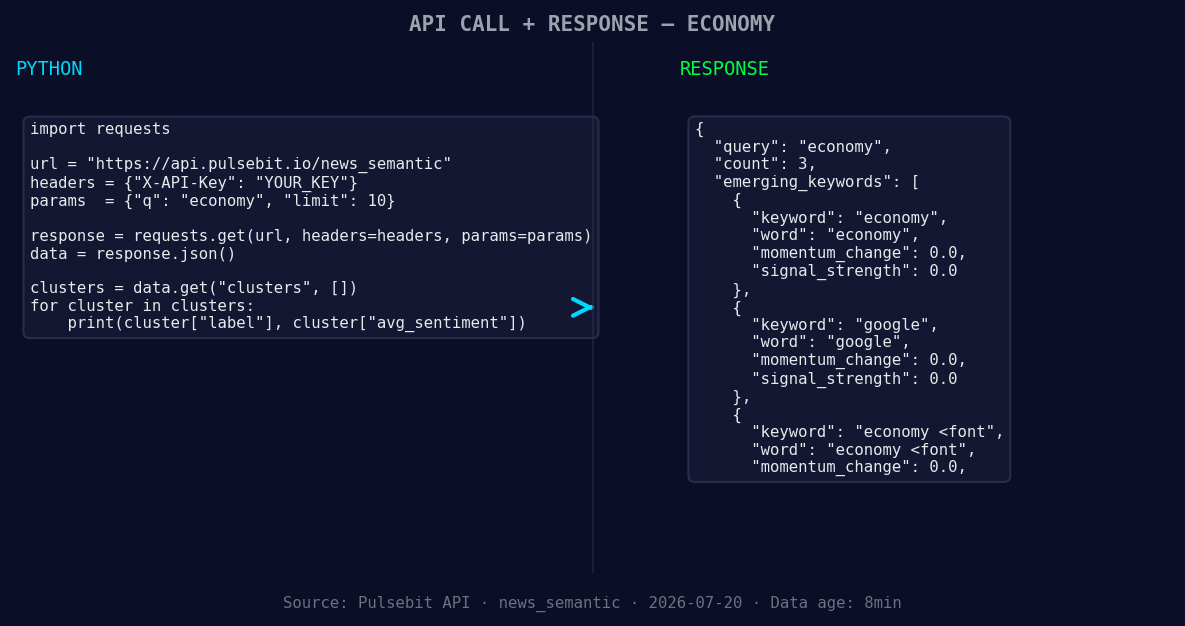
*Left: Python GET /news_semantic call for 'economy'. Right: returned JSON response structure (clusters: 3). Source: Pulsebit /news_semantic.*
# Geographic origin filter: Query by language
response = requests.get(
'https://api.pulsebit.com/sentiment',
params={
'topic': topic,
'lang': 'en', # Filter for English articles
'momentum_24h': momentum,
'score': score,
'confidence': confidence
}
)
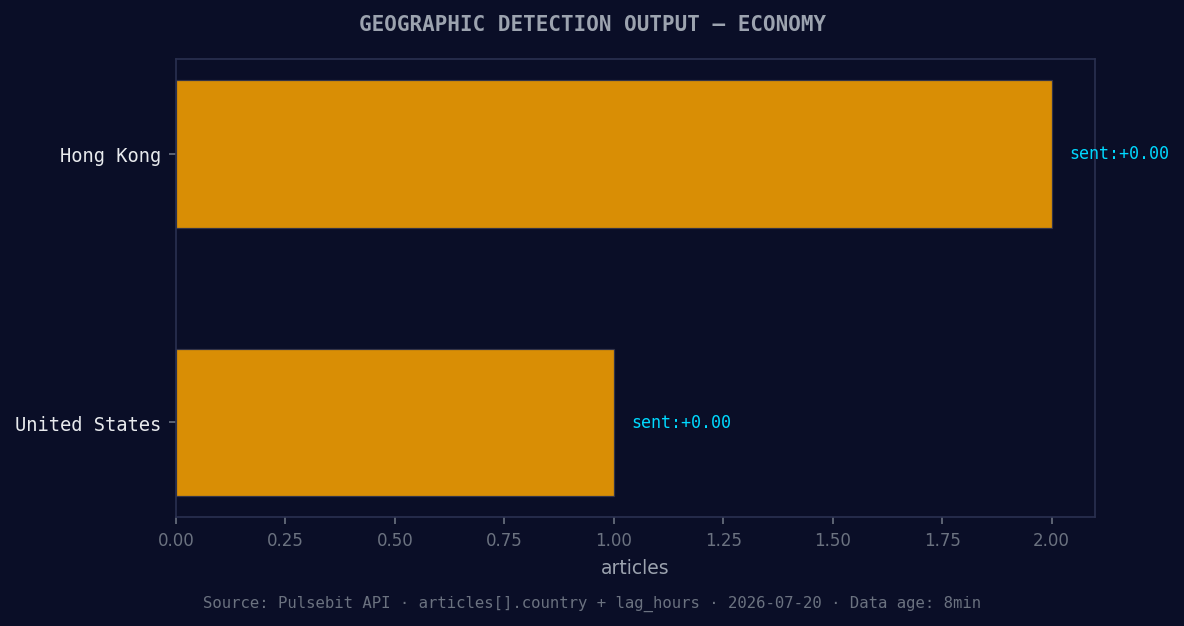
*Geographic detection output for economy. Hong Kong leads with 2 articles and sentiment +0.00. Source: Pulsebit /news_recent geographic fields.*
# Process the response
data = response.json()
print(data)
Next, we need to evaluate the narrative framing surrounding this momentum spike. We'll run the cluster reason string through our sentiment endpoint to score the narrative itself:
# Define the cluster reason
cluster_reason = "Clustered by shared themes: borderless, economy, outgrowing, its, financial."

# Run the meta-sentiment moment
meta_sentiment_response = requests.post(
    'https://api.pulsebit.com/sentiment',
    json={'text': cluster_reason}
)

# Process the response
meta_sentiment_data = meta_sentiment_response.json()
print(meta_sentiment_data)
This two-step approach not only captures the current sentiment but also provides insight into the narrative framework that drives the conversation.
Now, let's consider three specific builds we can create with this data:
Sentiment Alert System: Set up a webhook that triggers alerts when the momentum exceeds a threshold, say +0.300. Use the geo filter to ensure you’re only alerted for English-language articles, which could indicate crucial shifts in sentiment around the economy.
Narrative Analysis Dashboard: Create a dashboard that displays real-time sentiment scores using the meta-sentiment loop. This will help you visualize how the narrative around the economy is evolving and how it connects to broader themes like "borderless" and "outgrowing."
Comparative Analysis Tool: Build a comparative tool that analyzes sentiment spikes across different topics. You could set up a threshold of +0.250 and compare sentiment shifts across themes like "google" and "economy" against mainstream narratives to identify emerging trends and potential market shifts.
Each of these builds leverages the insights from the current anomaly while ensuring that your system is adaptive and responsive to real-time shifts in sentiment.
If you want to replicate this in your own projects, check out our documentation at pulsebit.lojenterprise.com/docs. You can copy-paste this code and be operational in under 10 minutes.


Top comments (0)