

Your Pipeline Is 21.3h Behind: Catching Inflation Sentiment Leads with Pulsebit
We recently uncovered a fascinating anomaly: a 24h momentum spike of +0.100 in inflation sentiment. This spike hints at a significant shift in sentiment, particularly as we see a leading narrative emerging in the press about inflation's impact on the ASX. The specific cluster story reads, "Live: ASX tipped to rise ahead of key inflation numbers." It's crucial to pay attention to these subtleties, as they can significantly alter your trading strategies or sentiment analysis.
If your pipeline isn't designed to handle multilingual origin or entity dominance, you're missing crucial insights like this by roughly 21.3 hours. This lag means that while you're still processing older data, the market is already reacting to new information. The leading language in this instance is English, and if your model isn't optimized for multilingual sentiment, you're effectively running with a handicap. You might be stuck with outdated narratives while the rest of the industry adapts and evolves.

English coverage led by 21.3 hours. No at T+21.3h. Confidence scores: English 0.85, Spanish 0.85, French 0.85 Source: Pulsebit /sentiment_by_lang.
Let’s dive into how we can catch this sentiment spike using our API. We’ll write a Python snippet to query sentiment data about inflation, filtering for English-language articles and assessing the narrative’s framing.
import requests
# Define parameters for fetching sentiment data
params = {
"topic": "inflation",
"score": 0.025,
"confidence": 0.85,
"momentum": 0.100,
"lang": "en" # Geographic origin filter for English
}
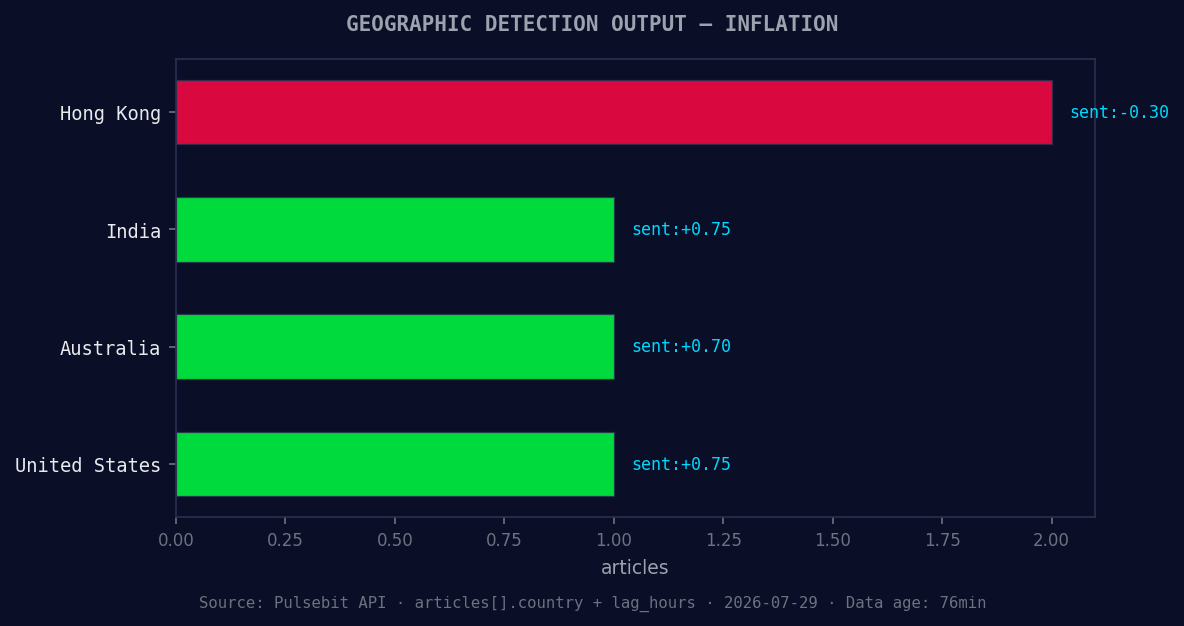
*Geographic detection output for inflation. Hong Kong leads with 2 articles and sentiment -0.30. Source: Pulsebit /news_recent geographic fields.*
# API call to fetch sentiment data
response = requests.get("https://api.pulsebit.com/sentiment", params=params)
inflation_sentiment = response.json()
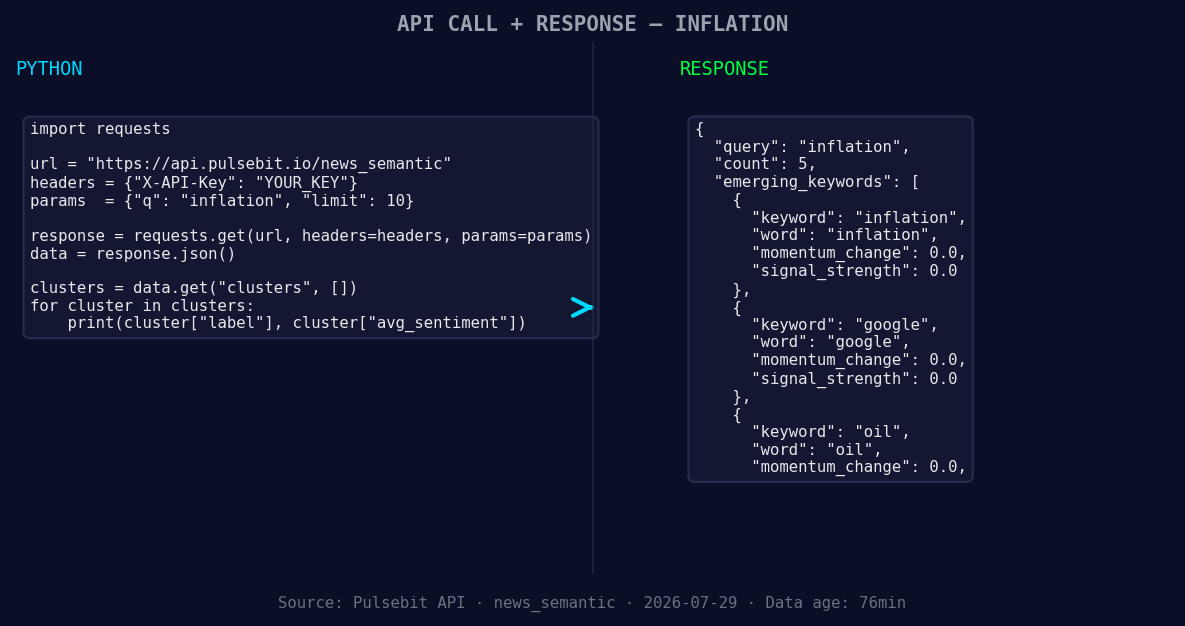
*Left: Python GET /news_semantic call for 'inflation'. Right: returned JSON response structure (clusters: 3). Source: Pulsebit /news_semantic.*
# Cluster reason string to evaluate meta-sentiment
cluster_reason = "Clustered by shared themes: live:, asx, tipped, rise, ahead."
# Checking the sentiment of the cluster narrative
meta_sentiment_response = requests.post("https://api.pulsebit.com/sentiment", json={"text": cluster_reason})
meta_sentiment = meta_sentiment_response.json()
print(inflation_sentiment)
print(meta_sentiment)
This code snippet first queries sentiment data on inflation, filtered specifically for English-language sources. We then run a second call to analyze the sentiment of the narrative that clustered around this spike. This dual-layer approach allows us to not only pinpoint the sentiment spike but also understand how the narrative itself is framing the conversation around inflation.
Here are three specific builds we can create with this pattern.
Geo-Filtered Spike Alerts: Set up a real-time alerting system that triggers when the momentum for inflation crosses a threshold, say +0.050. Use the geo filter to only alert for English-language sources, ensuring you're catching relevant sentiment shifts as they happen.
Meta-Sentiment Analysis Dashboard: Develop a dashboard that continuously evaluates the narrative framing of clustered stories about inflation. For example, you can use the text from "Clustered by shared themes: live:, asx, tipped, rise, ahead." to assess how public sentiment is evolving in relation to specific events.
Forming Theme Tracker: Build an endpoint that tracks forming themes around inflation, oil, and Google. Whenever you detect a new spike in sentiment for any of these topics, log it against the mainstream narratives like "live:, asx, tipped" to see how they interrelate and drive market movements.
Getting started with these capabilities is straightforward. You can find all the necessary endpoints and examples at pulsebit.lojenterprise.com/docs. With our API, you should be able to copy-paste this code and run it in under 10 minutes. Let’s make sure we’re not left behind as the momentum shifts!


Top comments (0)