

Your 24h momentum spike of -0.331 in renewable energy sentiment is a clear signal that we need to talk about. This is not just a number; it reflects a significant shift in how this topic is being discussed across different languages and regions, particularly in English press. With the leading language being English at 23.3 hours ahead of German, it becomes crucial to recognize how these disparities can affect your pipeline's ability to capture sentiment accurately.
If your model does not account for multilingual sources or the dominance of certain entities, it’s missing out big time. You’ve got a 23.3-hour lag in capturing this critical sentiment shift. This delay means you’re potentially missing out on insights that could inform your strategy, especially when the current conversations around renewable energy are being led by English-language articles. If you’re not adapting, you’re falling behind.

English coverage led by 23.3 hours. German at T+23.3h. Confidence scores: English 0.95, Spanish 0.95, French 0.95 Source: Pulsebit /sentiment_by_lang.
Let’s dive into the code to catch this momentum spike using our API. First, we need to filter our query by the English language to focus on those leading narratives in renewable energy.
import requests
# Define the API endpoint and parameters
url = "https://api.pulsebit.com/sentiment"
params = {
"topic": "renewable energy",
"lang": "en", # Geographic origin filter
"score": 0.517,
"confidence": 0.95,
"momentum": -0.331
}
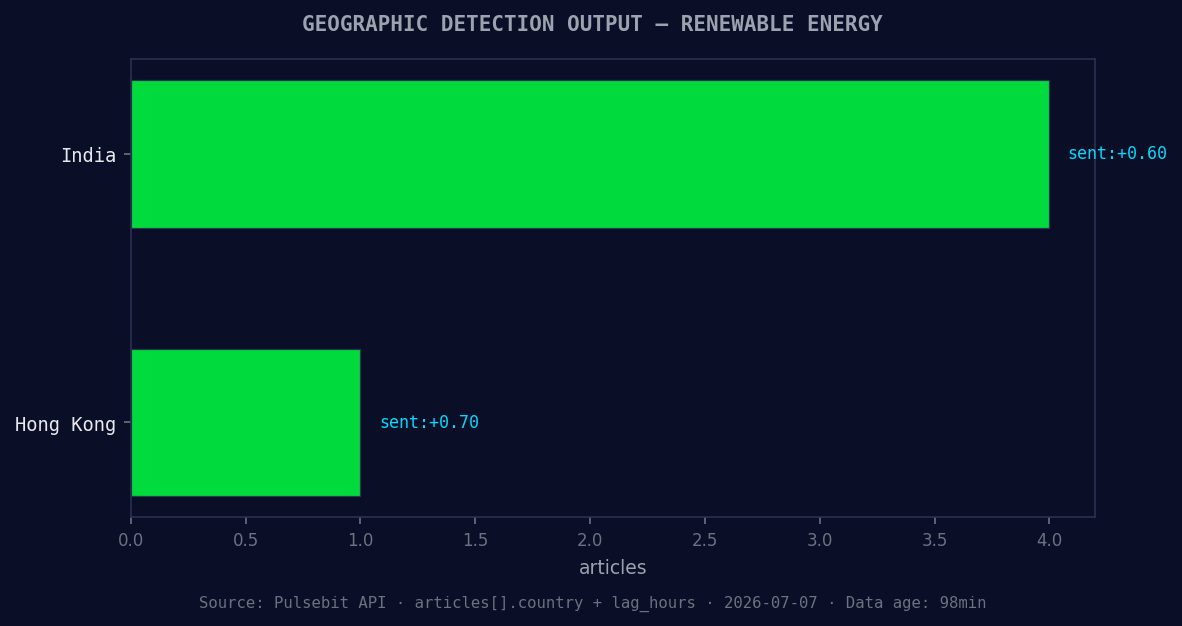
*Geographic detection output for renewable energy. India leads with 4 articles and sentiment +0.60. Source: Pulsebit /news_recent geographic fields.*
# Make the API call
response = requests.get(url, params=params)
data = response.json()
print(data)

Left: Python GET /news_semantic call for 'renewable energy'. Right: returned JSON response structure (clusters: 3). Source: Pulsebit /news_semantic.
Next, we’ll run a meta-sentiment analysis on the cluster reason string to understand how the narrative surrounding this momentum spike is framed. This step is essential for gauging the cluster's thematic sentiment.
# Meta-sentiment moment: scoring the cluster reason string
cluster_reason = "Clustered by shared themes: targets, renewables, expanded, renewable, energy."
meta_sentiment_url = "https://api.pulsebit.com/sentiment"
meta_sentiment_response = requests.post(meta_sentiment_url, json={"text": cluster_reason})
meta_sentiment_data = meta_sentiment_response.json()
print(meta_sentiment_data)
Now that we have the data and insights, here are three specific things you can build based on this momentum spike:
Geo-Based Alerts: Set up an alert that triggers when the sentiment for "renewable energy" in English drops below a score of 0.5. This will ensure you're always aware of potential negative shifts early. Use the geo filter to focus on this English sentiment.
Meta-Sentiment Dashboard: Build a dashboard that visualizes the meta-sentiment of clustered narratives. Pull in data like "targets, renewables, expanded" and track how the sentiment fluctuates over time against mainstream narratives.
Anomaly Detection Pipeline: Create a pipeline that flags any significant discrepancies in sentiment between English and German sources. If the English sentiment spikes while German sentiment remains stagnant, it could indicate an emerging trend that warrants deeper investigation.
If you want to start implementing these features, head over to pulsebit.lojenterprise.com/docs. You can copy-paste the above code snippets and run them in under 10 minutes to start catching those crucial sentiment signals.


Top comments (0)