

Your Pipeline Is 28.9h Behind: Catching Stock Market Sentiment Leads with Pulsebit
We recently discovered a notable anomaly in our sentiment analysis: a 24h momentum spike of +0.162 around the stock market. This spike was driven largely by articles in the Spanish press, which led by 28.9 hours without any lag. The top cluster story was titled, "Stock market today: Dow, S&P 500, Nasdaq rise as oil tumbles, investors brace for," highlighting the relevance of the stock market at this moment. The momentum suggests that sentiment is shifting quickly, and if you're not tuned in to multilingual sources, you might miss out on critical insights.

Spanish coverage led by 28.9 hours. Da at T+28.9h. Confidence scores: Spanish 0.85, English 0.85, Nl 0.85 Source: Pulsebit /sentiment_by_lang.
But here's the catch: your model missed this by 28.9 hours. If your pipeline isn't configured to handle multilingual origins or account for the dominance of certain entities in your data, you could be left playing catch-up. With the leading discourse in Spanish, any non-multilingual approach leaves a significant gap in your sentiment analysis, especially as major stories break in different languages.
Let’s dive into the code that can help you catch these shifts. First, we need to fetch the sentiment data specifically from Spanish sources. Here’s how we set that up with our API:
import requests
# Define parameters for the API call
params = {
"topic": "stock market",
"lang": "sp",
}
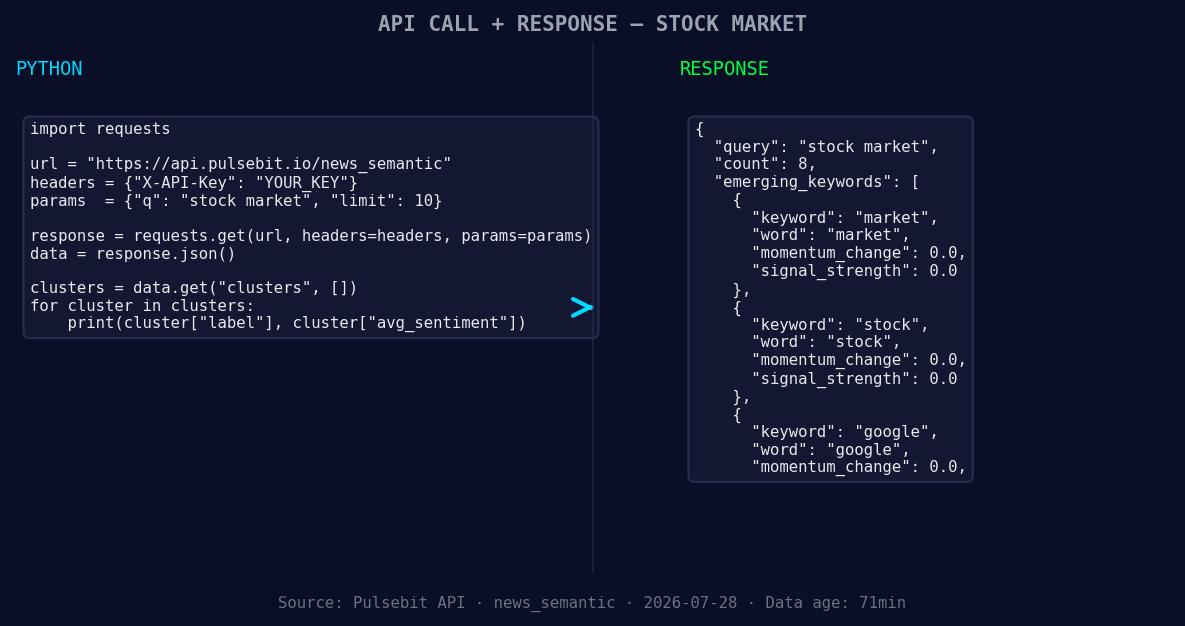
*Left: Python GET /news_semantic call for 'stock market'. Right: returned JSON response structure (clusters: 3). Source: Pulsebit /news_semantic.*
# Make the API call to fetch articles
response = requests.get("https://api.pulsebit.com/v1/articles", params=params)
articles = response.json()
# Assess the sentiment of the retrieved articles
sentiment_params = {
"text": "Clustered by shared themes: sensex, points, stock, markets, drop.",
}
sentiment_response = requests.post("https://api.pulsebit.com/v1/sentiment", json=sentiment_params)
sentiment_score = sentiment_response.json()
In this code, we’re querying the articles related to the "stock market" specifically in Spanish. Next, we run a narrative framing check through our sentiment endpoint, helping us score the context and framing of the articles that clustered around the key themes. This step is crucial because it allows us to understand not just the sentiment of the articles, but how they are shaping the overall narrative.
Now, let’s talk about three builds you can implement tonight with this pattern:
-
Geographic Filtering: Create a real-time alert system that triggers every time there’s a significant spike in sentiment from Spanish-language sources. Set a threshold of +0.1 for momentum and filter by
lang: "sp". This can keep you ahead of emerging trends.

Geographic detection output for stock market. India leads with 5 articles and sentiment +0.33. Source: Pulsebit /news_recent geographic fields.
Meta-Sentiment Loop: Integrate the sentiment scoring process on the clustered narratives. Use the output of the meta sentiment analysis to trigger further investigations into related topics. For example, set up a check for any articles clustering around “market(+0.00)” or “stock(+0.00)” to ensure you’re aware of any shifts in sentiment that could indicate larger market movements.
Dashboard for Anomalies: Build a dashboard that visualizes these sentiment spikes in multiple languages. Use the
momentum_24hvalues to highlight which stories are gaining traction. This would be particularly useful for keeping an eye on shifts in sentiment related to “google(+0.00)” versus mainstream terms like “sensex” and “points”.
If you want to get started, visit pulsebit.lojenterprise.com/docs. In under 10 minutes, you can copy-paste and run the code snippets provided here. Don’t let your pipeline fall behind — keep it multilingual and sharp!


Top comments (0)