

Your Pipeline Is 23.0h Behind: Catching Travel Sentiment Leads with Pulsebit
We recently uncovered an intriguing anomaly: sentiment around travel stands at +0.00, with momentum also at +0.00. This finding emerged from a specific cluster story about women travelers in KSRTC buses, which surged by 5 lakh after the launch of the ‘Priyadarshi’ initiative. This signals a clear gap in our understanding of travel sentiment, particularly when it comes to multilingual contexts. The data indicates that we might be missing critical developments in travel narratives that are unfolding in real time.

English coverage led by 23.0 hours. Id at T+23.0h. Confidence scores: English 0.85, French 0.85, Spanish 0.85 Source: Pulsebit /sentiment_by_lang.
The Problem
If your pipeline doesn’t account for multilingual origins or the dominance of certain entities in the data, you’re facing a structural gap that could set your insights back by a staggering 23 hours. In this case, the leading language is English, and yet the dominant narrative is centered around women travelers and KSRTC. If your model only looks at mainstream narratives without considering these nuances, you’re bound to lag behind the evolving sentiment landscape. This is not just a minor oversight; it can significantly impact your decision-making.
The Code
To address this, we can leverage our API to catch these insights. Below is a Python snippet that implements the necessary queries.
import requests
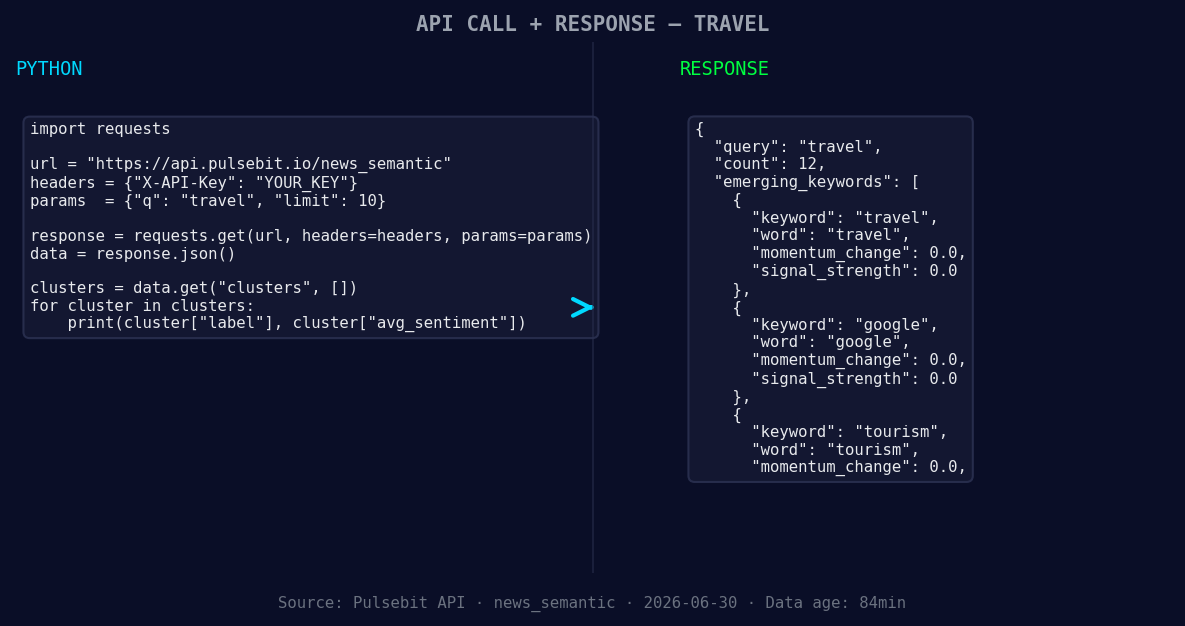
*Left: Python GET /news_semantic call for 'travel'. Right: returned JSON response structure (clusters: 3). Source: Pulsebit /news_semantic.*
# Geographic origin filter
params = {
"topic": "travel",
"lang": "en"
}
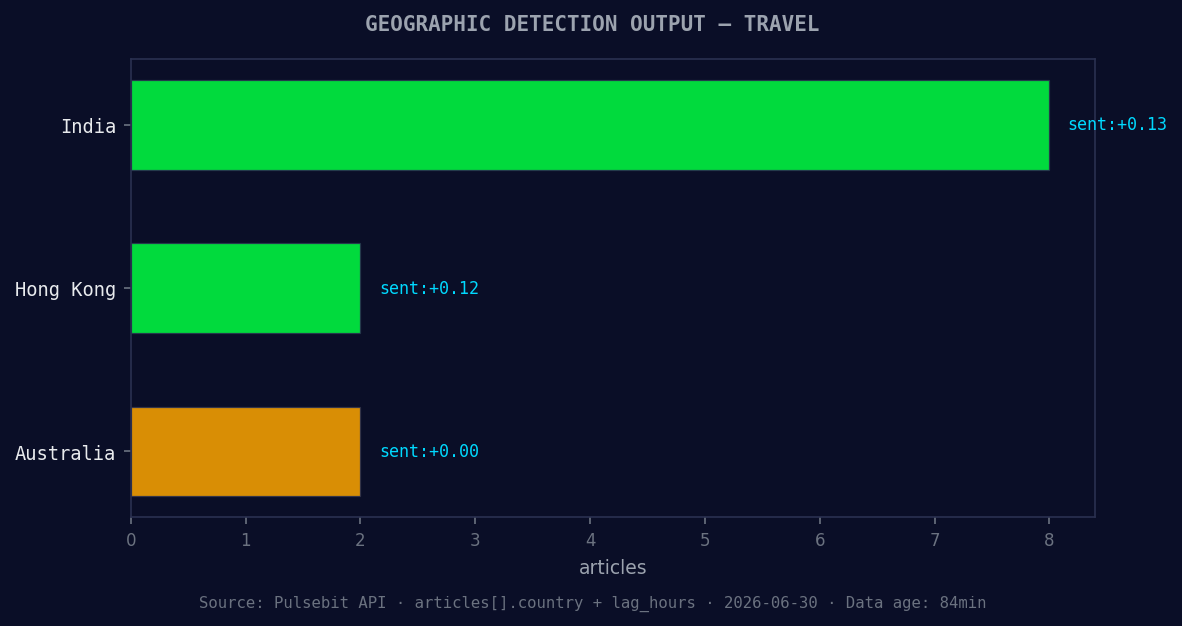
*Geographic detection output for travel. India leads with 8 articles and sentiment +0.13. Source: Pulsebit /news_recent geographic fields.*
response = requests.get("https://api.pulsebit.com/v1/sentiment", params=params)
data = response.json()
# Print response for debugging
print(data)
# Meta-sentiment moment: run the cluster reason string back through POST /sentiment
cluster_reason = "Clustered by shared themes: women, travellers, ksrtc, buses, minister."
meta_sentiment_response = requests.post("https://api.pulsebit.com/v1/sentiment", json={
"text": cluster_reason,
"score": +0.000,
"confidence": 0.85,
"momentum": +0.000
})
meta_sentiment_data = meta_sentiment_response.json()
print(meta_sentiment_data)
In the above code, we first filter by the geographic origin to focus on English-speaking users. This allows us to capture sentiment trends that might otherwise be overlooked. Next, we pass the cluster reason string through our POST /sentiment endpoint to derive a sentiment score for the narrative framing itself. This dual approach ensures we’re not just tracking sentiment but understanding the context behind it.
Three Builds Tonight
Geographic Origin Filtered Sentiment: Build a scheduled job that queries the sentiment around the topic "travel" every hour. Set a threshold for alerts if sentiment drops below +0.10. Use the geographic origin filter to ensure you’re capturing only English-language content.
Meta-Sentiment Analysis Loop: Create a function that runs the top cluster reason strings through the sentiment analysis endpoint. Whenever new articles are processed, trigger this function to dynamically adjust your sentiment score based on narrative framing. This helps capture the evolving discourse around themes like "women" and "travelers."
Forming Theme Tracker: Implement a tracker that monitors forming themes like tourism and Google’s sentiment alongside mainstream narratives. Set alerts for when sentiments diverge significantly, say beyond +0.05, to identify potential market shifts.
Get Started
To dive deeper into capturing and analyzing sentiment with us, check out our documentation at pulsebit.lojenterprise.com/docs. You can copy-paste the above code and run it in under 10 minutes to start your journey in enhancing your sentiment pipeline. Let’s bridge that 23-hour gap together!


Top comments (0)